Categories
Digital Marketing

How to Improve Organic Clickthrough for Your Content

Google search result pages are becoming more diverse and even interactive, which makes any clickthrough study out there much less reliable, because no two sets of search results are the same.

But how much control do writers and content creators have over how their content is represented in search? As it turns out, they do have quite a few options when it comes to optimizing their search snippets!

The anatomy of a standard search snippet

The standard Google search snippet has changed over the years, but in essence all the key elements are still there:

  • The clickable title or headline of the snippet (in blue)

  • The description of that page (about two lines long — it was lengthened for no particular reason a few years ago, but now seems to be back to two lines)

  • The URL path (used to be in green, now it is black)

On a mobile device, there’s also a tiny logo next to the URL:

Here’s how much control you have over these standard elements of your search snippet (in the order they currently appear):

Logo

Google will use your site favicon when deciding which image to show next to your URL. This means that you have full control over this part of the search snippet.

URL path

These days, Google will do its best to show the meaningful URL path (almost like a breadcrumb) instead of simply the URL of the page. This consists of:

  • The domain: I don’t have any research to support this, but I personally always scan domain names when choosing what to click. That being said, your choice of a domain name may somewhat impact your clickthrough (if you do a particularly good job picking a snappy domain name that intrigues) and you do have full control over this part of the snippet. Tools like Namify specialize in finding exactly that type of domains that are short, memorable, and witty.

  • The breadcrumb or the truncated URL: You can use breadcrumb schema to force Google to use breadcrumb instead of the URL, and watch your Search Console to see if that helped clickthrough:

Title

Google used to rely on the page title to generate the title of the search snippet, but it has been rewriting that part more and more often recently.

That being said, it is still recommended to optimize your title to include keywords and entice more clicks — and hope Google will keep it intact.

Description

Google has been generating the search snippet description for years without using the associated meta description: recent studies show that Google ignores meta descriptions in about 70% of cases.

You may still want to create meta descriptions in case Google needs some clues, but expect them to figure this part out on their own.

Another way to try and trick Google into using your chosen snippet description is to create concise summaries of the content and add it at the beginning of the article. Using semantic analysis tools like Text Optimizer, you can also ensure these summaries are semantically relevant to the topic:

Now, let’s see how we can enhance that standard search snippet to let it stand out and attract more clicks.

Rich snippets for content-based pages

Rich snippets are search snippets enhanced with some additional details. Web publishers can control rich snippets by adding schema markup, so they are thus under website owners’ control.

Here are the types of rich snippets that will work for content-based pages:

FAQ page

Your page doesn’t have to be FAQ to qualify for this rich snippet. All you need to do is answer two or more subsequent questions somewhere on that page to use the code. There are several WordPress plugins — including this one — that help you code that section.

HowTo schema

The HowTo schema was introduced for the DIY niche as a way to feature snippets that include step-by-step instructions.

These days, I see HowTo rich snippets implemented for just about any tutorial:

Video schema

More often than not, these rich snippets show up only on mobile devices, but they seem to be very common. A video rich snippet includes a video thumbnail:

Video schema will help you ensure the rich snippet is indeed generated, although I’ve seen dozens of cases when Google creates a rich snippet once you simply embed a video on the page, no schema required.

That being said, using the rich code won’t hurt, especially given there’s an easy video schema generator for you to create a code easily.

Structured snippets

Structured snippets are less popular than rich snippets, even though they are very common on search.

Structured snippets import tabular data to formulate a more informative search snippet:

All it takes to qualify for this type of a snippet is to create an HTML table. It is a good idea to use tables for summaries, feature comparisons, lists, etc.

Image thumbnails

Image thumbnails are very rare on desktop. Yet on mobile devices, images show up inside most search snippets:

There’s no particular optimization tactic here, but there are best practices that may or may not help:

Dates

Google shows dates within a search snippet when they think this may be useful to a searcher. Obviously, dates may have a big impact on clicking patterns: Based on the research by Ignite Visibility, about half of searchers claim that dates in search snippets are either “important” or “very important” clickthrough factors.

  • People may feel willing to click on a search snippet with a more recent date.

  • They can scroll past an older date even when the page ranks on top.

Google has clear guidelines as to how web publishers can keep those dates fresh:

  • Don’t try to hide dates, because they are useful.

  • When updating a piece, re-publish it on a new date only when you’ve basically rewritten it.(I.e., don’t redirect, better to update the old piece and change the publish date).

  • Include an “Updated on” note on top of the article if you updated it (Google will pick up on that date).

  • Using schema “datePublished” and “dateModified” is not required but will be helpful.

Google will understand all of the following date formats:

  • Published December 4, 2019

  • Posted Dec 4, 2020

  • Last updated: Dec 14, 2018

  • Updated Dec 14, 2021 8pm ET

Mini sitelinks

Mini sitelinks are probably the most unpredictable element of a search snippet. Google may randomly pick links from navigation, tag, or category links, etc. There’s also no way to tell Google they made a poor choice.

Unlike sitelinks, which usually show up for the top-ranking result and mostly for branded searches, mini sitelinks can be generated for just about any result out there.

Mini sitelinks represent a very useful feature, though, because they increase your odds that your search snippet will get a click (by adding more clickable links to your snippet).

One way to increase your chances that Google will show mini sitelinks within your search snippet is to use an on-page table of contents (which is powered by HTML anchor links).

Here’s an example of the table of contents:

And here are the mini sitelinks they generate:

Featured snippets

As of January 2020, featured snippets were officially considered the #1 organic result (previously they were “position zero” — appearing before the top organic result).

It still remains a big question whether they get clicked more than “normal looking” search results, or whether they are comprehensive enough to get fewer clicks. However, recent research suggests they’re still important for SEO.

With that being said, featured snippets are not easy to predict, but if you choose to optimize for them, be sure to check my older Moz column that is still very valid: How to Optimize for Featured Snippets. Just don’t forget to monitor your clickthrough to ensure getting featured didn’t hurt.

Indented results

Showing intended results is a relatively new trend. So far it is not clear how exactly to get that type of search snippet, but you can track them in tools like STAT.

Complementing your product page with how-to content on the same topic may be a good idea (Google may decide to rank both as indented results). At least this is something to experiment with.

Monitoring and measuring

While rank monitoring is pretty straightforward, this kind of optimization is harder to monitor because your rankings remain the same. Here are two tools you can use:

1. Google Search Console

Google Search Console provides clear clickthrough data that can help you signal of positive or negative impact of your optimization efforts:

In the Performance tab, click in the date range filter (it usually defaults to three months), go to “Compare” tab and select “Compare last 3 months year over year”:

From there, you can click to “Pages” or “Queries” tab to identify pages or search queries that have lost organic traffic from the past year (especially if there was no substantial position change):

2. WebCEO

WebCEO provides a more convenient way to keep an eye on your keywords that are losing clicks. The tool has a separate tag and a notification system alerting you of any queries that see a decline in clicks:

3. Visualping

Another useful tool here is Visualping that you can set to monitor your exact search snippet to be alerted when it changes:

This is a great way to correlate your optimization with the actual change that happened (and then clickthrough change).

Using SiteChecker’s website monitoring tool you can also monitor your competitors’ pages and correlate their edits to an improved search snippet:

Conclusion

Whether it is good or bad news, organic traffic is no longer about rankings. In fact, you may well be ranking #1 (i.e. get featured) and notice a decrease in clickthrough once your page is promoted. But, you can experiment with all kinds of ways to improve your organic clickthrough without investing more into your rankings, even though organic CTR is much harder to predict these days.

source https://moz.com/blog/improve-content-organic-clickthrough

Categories
Digital Marketing

Adding STAT Reports to Google Sheets Using App Scripts

The team at MacMillan Search has generated a lot of value by combining automated STAT reports with Google Sheets. From adding ranking details to other tool’s outputs, to giving the content teams up-to-date “People Also Ask” reports, the end result has proven to be a great time-saver in our week-to-week SEO workflows by reducing manual work and providing standard outputs that easily integrate with any spreadsheet.

Why did we create this script?

STAT’s wealth of keyword rankings details is very useful for enterprise SEOs to understand both the macro and micro details of their rankings. Google Sheets is one of the most common cloud-based spreadsheets platforms, and is easy to share between teams and organizations. That’s why SEOs use both of these tools regularly when analyzing keyword data.

Despite this, documentation on how to integrate STAT into Google Sheets is limited. To address this gap, we created our own script!

It’s proven useful for several reasons:

  1. Not everyone likes CSVs: We leverage the STAT reports to provide clients with direction. Having to download a CSV and open it every week isn’t for everyone. With this script, you can set a weekly ticket with a link to the spreadsheet, and review the output regularly.

  2. It saved us time: SEO is a marathon, not a sprint. When we identify an opportunity, there is ongoing work that will have us reviewing reports regularly. The weekly ticket approach to review a spreadsheet shaves some time off of each task, and over the course of the engagement, this saved time adds up.

  3. Cleaner output: Using Vlookups, Uniques, etc., you can create a summary page of this information, highlighting what clients and/or readers care about. You can also integrate this information with other data sources.

  4. Create automation without using an API: Automation, when done correctly, saves time. Using this script with triggers opens the door to automation.

How to implement this script

1) Create a report in STAT

The STAT knowledge base has a great resource on reports. The only thing we would get specific on is the naming of the report and the recipient email.

Naming

What you name your report is not as important as keeping it clear and concise. This makes scaling to other projects with similar reports cleaner and easier. You will also use this report name as one of the variables in the scripts.

We also suggest placing the company or project name at the end of the report name in parentheses (e.g. “(MacMillan Search)”). This makes it easier to find the report in your email.

Recipient email

It’s important to use a Gmail-enabled email for the account where you’ll be building the sheet. This way, Google has an easier time getting the app script to extract the CSV from the email.

Scheduling

For our clients, weekly data is the most useful — enough detail to spot trends, but not so much that it becomes just noise to be ignored. For reports with limited fluctuations (e.g. People Also Ask), monthly might be satisfactory.

Timing

Select “Run this report immediately” to confirm that your report works, right after creating the script. This way, you’re ready to set your triggers and let the data flow.

The rest of the settings are specific to what details you want from your report.

2) Create a Google Sheet and add the script

Create a new sheet in Google Drive under the account associated with your report’s recipient email. Then you’re ready to add the script:

1. Under the menu “Tools”, select “<> Script editor”

2. Paste the script below into the “Script editor”.

3. A few things will need to be edited to work with your data:

  • var COMPANY_NAME updated to the company or project name you used while creating the STAT Report

  • var REPORT_NAME updated to the name of your report minus the company name and parentheses

  • var SHEET_NAME updated to the name of the sheet in the spreadsheet

4. Confirm the Script works by saving it, refreshing the sheet, and when the menu “Manual Update” loads, select “Import Keywords”.

5. The first time you run this you will get an “Authorization Required” pop-up:

Select “Continue”, follow the steps, and select “Import Keywords” under the menu again.

Your spreadsheet should now be populated with all of the details from your CSV.

3) Automate the population with triggers

Setting this sheet up to automatically update as the report comes out is very easy using Apps Script “Triggers”. To set up the triggers:

1. Go back into the “Script Editor”

2. Select the “alarm” icon “Triggers”

    3. Select “Add Trigger”

    4. Select the function “importKws”

    5. Select event source “Time-driven”

    6. Select type of time-based trigger “Week Timer” for weekly reports, “Month Timer” for monthly reports, etc.

    7. In our time zone, our reports usually come out late Sunday, so we pick early Monday morning:

    8. Click “Save”

      The result is a spreadsheet that regularly updates, populated by an emailed STAT report.

      We’ve found many uses for this script — anywhere we reference rank. And, since a project might take time to get implemented, we can provide current ranking information without leveraging the API.

      We’re curious to learn how you leverage it as well. If you find the script useful, reach out to us on LinkedIn and let us know what you’re using it for.

      Click here to copy the script! 

      source https://moz.com/blog/add-stat-reports-to-google-sheets

      Categories
      Digital Marketing

      22 Smart Google SEO Tips for 2022

      We’re back with a brand new season of Whiteboard Friday episodes for your viewing pleasure. First up: SEO expert Cyrus Shepard shares his top 22 tips for successful Google SEO in 2022. Watch to find out what to prioritize and what to look out for in the year ahead!

      22 Smart Google SEO Tips for 2022 Whiteboard

      Click on the whiteboard image above to open a high resolution version in a new tab!

      Video Transcription

      Howdy, Moz fans. Welcome to another edition of Whiteboard Friday, a very special edition, our annual SEO tips of the year edition. This year it is 22 smart SEO tips for 2022. I’m going to be talking about some of the most talked about things in the SEO industry over the past year plus a few tips from last year that we wanted to pull over because they were just that important.

      Because we’ve got 22 of them and we don’t want this video to take forever, we’re going to be going through these pretty quick, but for you we’ve linked to some resources in the transcript below so you can explore all of these topics further if you want. All right. Without further ado, let’s get started. 
      On-page SEO tips for 2022

      1. A/B testing

      I’m going to start with some on-page topics. Tip number one, A/B testing or simply testing.

      We’ve seen a lot more testing tools pop up in the last couple of years, which is awesome because SEO is not make a decision and implement it and you’re done. SEO is implement, evaluate, and then make decisions or sometimes course corrections.

      Is this something we need to pull back? Did C perform better than D? Which one would we choose? All the tips we’re talking about today can apply to this testing mentality. SEO is incredibly complex, and the old-school idea of best practices just doesn’t cut it anymore. So in ’22, develop a testing mentality with your SEO.

      2. Author pages

      Number two, author pages. I really love this because Google this year updated some of their advice around author pages and their schema markup. It’s an important part of my strategy and a lot of websites that I use. A good quality author page helps Google evaluate your authors, which can be used for E-A-T and other things, and helps link them with their expertise.

      So linking your articles to a good author page usually includes links to other websites, author profiles, links to the articles they wrote, some biographical information. It can help establish your authors as expertise in a certain space. So take a look at your author pages and try to improve them and make this a task. 

      3. Google title rewrites

      Google title rewrites, number three. I don’t think there is any topic more discussed in 2022 than Google rewriting titles. A lot of studies, including one I did, showing Google rewriting 60%, 70% or 80% of a site’s titles. It can be frustrating. But what we’re finding is a lot of people aren’t evaluating those Google title rewrites. When you do, you can learn a lot about your own titles.

      Why is Google rewriting it? Is my title too long? Am I missing important keywords? Do I have fluff in there that Google doesn’t like? Or in some cases you can go back and try to correct the title that Google rewrote if they’re doing just a terrible job. So Google title rewriting, do an audit of those Google titles and learn what you can do.

      5. Nuke the “fluff”

      Speaking of fluff, this may be the year that you want to nuke the SEO fluff. You know what I’m talking about with SEO fluff. It’s those flowery keywords. It’s those descriptions and it’s recipe pages. “Oh, I was walking along the Irish countryside thinking about my bread and biscuits.” That is your fluff. We’re finding that it may not be necessary, and it may even be detrimental to your SEO.

      Glenn Gabe wrote a great case study where they reduced a lot of their fluff on category descriptions and they actually saw an increase. Google is removing fluff from title tags. So this marketing, flowery, SEO writing stuff, it may not be helping you, and, in fact, it may be hurting you. Today Google is rewarding sites or seems to be rewarding sites that provide quick answers and more direct engagement.

      Better engagement, it’s usually better for your customers as well. So experiment with losing the fluff in 2022. 

      5. FAQ schema

      Number five, FAQ schema. So last year we talked a lot about different schema types, how-to schema, FAQ scheme, different things. If there was a clear winner in 2022, it was FAQ. The reason FAQ is the winner is because so many sites can qualify for it, it’s easy to implement, and if you win a FAQ schema in SERPs, you can gain a lot of Google real estate.

      So there are a lot of articles that talk about how to optimize for FAQs. You can get links, deep links in FAQs. There are a lot of things you can do. We’ll link to those in the transcript below. But take a look at your FAQ schema if you’re not currently using it: 

      6. Tabbed content

      Last year we talked about tabbed content, bringing your content that is in tabs, in navigation and bringing it out. This year, we’re getting a little more advanced.

      Our friends at Merj did a study about types of tabbed content and how easily Google can extract and render and index different tabbed content. So if you still have content in tabs, it doesn’t necessarily mean you have to take everything out, but you should research if Google is able to index and rank those appropriately. There are better resources this year to try to do that.

      So take a look at your tabbed content. 

      7. Faceted navigation

      Along the same lines, faceted navigation. We’ve been talking about faceted navigation for years, but this is the year to get a little more strategic with it. In certain ways, faceted navigation has always been like a set of rules, like if it has green dress, we are not going to index this or crawl it, but if it is size 12 or higher, we will index it.

      Today, smart SEOs are getting a lot more savvy about what they index, don’t index, and crawl with faceted navigation, and these tools are becoming increasingly available for sites like WordPress and things like that, where you can actually look at the traffic each page receives and index, crawl, faceted navigation on a page by page level, and these broad rules aren’t necessarily as necessary.

      You can get down to the nitty-gritty and increase your traffic that way, with fine-grained tools. So both tabbed content and faceted navigation, old-school concepts, but we’re getting much more sophisticated with them in 2022. 

      Link building tips for 2022

      All right, let’s talk about everybody’s favorite subject, links, because you need links to rank in SEO. But what a lot of smart SEOs know and talk about is you need links to rank in SEO, but you probably don’t need as many as you think.

      8. Internal link optimization

      If you only have a few good external links, one of the best ways to leverage that is optimize your internal link optimization. We’ve seen a number of new tools and processes talking about internal link optimization. We’re talking about pages that have too few links, under optimized anchor text, pages that have great opportunities that aren’t ranking that should.

      So if you haven’t done an internal link optimization audit in a while, this is the year to do it and this is the way to leverage those internal links that you’re getting. 

      9. Deep linking

      Speaking of which, deep linking. In the old days, if you linked to a page, you just linked to the URL. But we’re seeing an increase in deep linking, linking to specific passages, text fragments, things like that, navigation, jump links.

      This is increasingly becoming a popular strategy to get people deeper into the page and give Google and other search engines signals about very specific parts of pages. This seems relevant as Google has recently introduced passage ranking, where they’re not just evaluating the whole page. They can understand individual passages as well.

      So making deep linking part of your strategy, as opposed to just linking to the URL, seems to be a great way of moving forward. 

      10. High ROI link building

      High ROI link building. I watched a great presentation from Ross Simmonds this year, the Coolest Cool, on link building with assets and determining the ROI of each of them, because everything you build links with, whether it be a tool, a blog post, a free PDF, it has a cost and that cost has an ROI.

      Ross found that certain things have higher ROIs than others. Tools have an incredibly high ROI, but they’re also expensive to create. Pages with stats on them, not that expensive to create, but also a really high ROI. 

      I’m going to link to that video. It might be a paid subscription. I apologize about that. But it’s awesome. It was voted number one at MozCon. If you do link building, it’s definitely worth watching and definitely worth the cost. High ROI link building, know the cost of everything you’re producing and how much value you’re getting out of it.

      11. Reduce redirects

      Let’s go old school again. Our friend Nick LeRoy tweeted not too long ago about reducing redirects. This is really old school, but a lot of people are forgetting it these days. If you have a large site and you have thousands or millions of redirects all sending confusing signals, 301 jumps to a 302 jumps to a 404, what is that? 

      Looking at your redirect chains and reducing them to a single redirect with a clear directive can help reduce canonicalization errors. It can improve crawling efficiency, and at scale it can influence your rankings. So if you have a large site or even a small site with a lot of redirects, this is the year you want to do a redirect audit. Get on it. Audit, on it.

      12. SEO for affiliate links

      How about SEO for affiliate links? We don’t talk a lot about affiliate links here at Moz, and Google traditionally hasn’t talked a lot about it either.

      But this year we saw Google introduce specific guidance for affiliate sites, which is something they really haven’t done before. Specifically for review sites, Google talking about what a good review looks like, talking about the good and the bad part of the product, the fact that you should link to multiple merchants so consumers have a choice.

      We haven’t seen this from Google before. So if you do SEO for affiliate sites, you do review sites, this is the year to review those Google documentations and make sure you’re creating sites that Google rewards and actually following Google’s guidance on it, which is something in past years I didn’t think I would be able to say about that. So it’s awesome to see.

      Google SEO tips for 2022

      13. Reputation research

      All right, moving on to different topics, reputation research. My friend Lily Ray talks about reputation research a lot in terms of E-A-T. The idea that Google can evaluate your site based on what other people say about you. So if you’re Dr. Mercola and an anti-vaxxer and everybody is saying all these terrible things about you on other websites, Google can disappear you from search.

      Reviews, what are other websites saying about you in terms of reviews? Google quality raters often look at other websites to get reputation research, and it’s supposedly believed that Google can do the same thing algorithmically. So making reputation research part of your SEO audit process, what are other sites saying about you, is it incredibly positive, is it incredibly negative, this is especially important for your money or your life sites, sites that are going to be more impacted by E-A-T algorithms.

      So if you sell things or dispense medical advice, reputation research is a little bit more important for those sites. 

      14. Core Web Vitals — minimums

      Boy, last year we talked about Core Web Vitals a lot. One of my happiest things is that we are talking about it much less. Google announced a big update. It was a big hooplala. It didn’t quite work out the way Google kind of explained that it might.

      What happened was Google released Core Web Vitals, and some sites saw a boost, other sites saw a decrease, but it wasn’t as intense as we thought it might be. A lot of sites did improve. But we’re finding in 2022 maybe we don’t need to worry about it as much as we thought.

      My colleague Tom Capper did a study that showed that slow sites were still ranking and fast sites were ranking even higher, but the effect wasn’t as much. The one thing Tom did find though, that was important, was sites that failed all three Core Web Vital requirements were definitely in the dumps. So we should optimize for speed always, but perhaps in 2022 we don’t need to obsess over it as much as possible, based on Google advice.

      Speed is awesome. You should make your sites as fast as you can. But Core Web Vitals, don’t sweat it as much as we were in 2021.

      15. Ditch AMP?

      Other things we might want to consider not sweating, AMP. 2021 was the year that we’ve seen a lot sites start to ditch their AMP. This is because Google no longer requires it as a ranking factor in their top stories. It does provide some speed benefits. It’s kind of a neat technology. We know people who work on it. It’s really cool. But a lot of companies were stressing out trying to maintain two different versions of their website to get that ranking boost. A lot of sites are starting to like, “Well, we don’t want to have two different versions. It’s a lot of overhead. It’s a lot of engineers. What if we just got rid of it?”

      They’re finding it really doesn’t make a difference. They can just work with one platform and still get as much rankings as they want. So if your company is struggling with AMP, this might be a year to experiment with ditching it. Or keep it if you like. It’s great, but a lot of people seem to be walking away. 

      16. Google Discover

      On the flipside, a lot of people are flocking to Google Discover.

      Google Discover is interesting. It’s not traditional SEO traffic, where you research a keyword and people are converting. It’s a little bit more like social media traffic. In fact, social media sharing seems to be one of the ranking factors that can influence how much traffic you get from Google Discover. 

      But what we’ve seen in the last year is some publishers are optimizing for Google Discover, publishing those stories, and seeing huge amounts of traffic for that. Great for like news sites, blogs, popular things, things that talk about popular topics. 

      We’ve gotten some Google Discover traffic here at Moz. We’re going to link to a couple of articles to show you how to optimize for Google Discover. But if you haven’t tried it yet, it may be a channel for you to explore in 2022. 

      17. Local SEO GBP categories

      We’ve got to squeeze in one local SEO tip. We’re doing this for our friend Darren Shaw, who publishes the Local Search SEO Ranking Factors every year, doing an awesome job at it. If you have a local site and you just have five minutes to do one thing, the number one SEO tip for 2022, get your GBP categories in order. Ranking factors studies show that it is the number one thing that can influence rankings.

      Do an audit of your Google Business Profile categories. Darren has a lot of tips over there with that Local SEO Ranking Factors. I would encourage you to look at it. Also Joy Hawkins is doing a lot with experimentations. I’d encourage you to look at her site as well. 

      18. Favicon review

      My tip, the tip that I’m going to die on this hill — favicon optimization. Why favicon optimization?

      I talked about this last year, but I don’t think people took me seriously enough. Over 50% of search results take place on a mobile phone where your favicon shows, and people are not optimizing those favicons. A good favicon can draw attention. It can zero you in on a very busy SERP, and it does it with just a few pixels.

      A good favicon can raise your click-through conversion rate one or two percent, which is awesome. How does it work? What do you notice on this screen? You notice the tip with a favicon. A good favicon is usually bright, it’s usually high contrast, and it draws your attention to your search results. So optimize your favicon, folks. I’m dying on that hill.

      SEO career tips for 2022

      All right. So I want to spend a few tips on talking about your SEO career, because I don’t think we talk about this enough. What should you be learning this year, aside from Python because everybody loves Python? 

      19. Learn GA4

      This might be the year that you want to finally familiarize yourself with GA4. GA4 is the product that’s replacing traditional Google Analytics.

      You’re going to see it in a lot more client accounts. It can be a little confusing to people. Some of the metrics aren’t there. It’s got some cool things in it admittedly, like they basically got rid of bounce rate and replaced it with engagement metrics, which is great because a lot of SEOs are a little too focused on bounce rate and engagement may be more representative, a holistic way that Google views your website.

      Our friend Dana DiTomaso has a course on LinkedIn that you can check out. But familiarize yourself with GA4 so you can walk into those meetings and you can present those reports and know what you are talking about. 

      20. Attend virtual conferences

      Conferences. COVID moved a lot of conferences virtually online. People attended them.

      A lot of people are getting burnt out on virtual conferences. But looking back at all the virtual conferences of 2021, there’s some great value there. Here at Moz, we had MozCon. We had some tremendous speeches. It also makes it more affordable for people all over the world. Traditional conferences, you pay $1,000 to $2,000 just to attend the conference plus travel and all that.

      But with virtual conferences, oftentimes they’re free or just $100 or $200. You can attend virtually and focus on the content and the learning and advance your career, and do the networking, reach out to the speakers. There are lots of opportunities there. So I would commit in 2022 to attending two or three virtual conferences and make that part of your career advancement.

      21. Charge more

      Finally, the last tip on the career, charge more. 2022 is the year to charge more for your SEO services. Our friend John Doherty at Get Credo publishes his annual salary report or agency fee report. If you’re an independent consultant or agent, you can check to see what you’re charging compared to your peers.

      But, in general, SEO services are in high demand all over the world, especially high-quality SEO services. The power is in your hands to charge what you are worth, not undermining yourself. If you’re working in-house, it might be time to evaluate your salary and make sure you’re getting paid what you deserve, especially if you’re not getting paid as much as your colleagues or you’re part of an underrepresented group.

      Charge more in 2022. Make more money. 

      And finally…

      22. Be the last click

      Final tip of 2022, this was the final tip of 2021. It’s my favorite SEO tip of all time. Be the last click. That means satisfy your users. When someone is searching Google or any other search engine and they’re presented with a list of results, they’re clicking around, looking for what they want to be, make sure you are the last site that they click.

      Why? Because when they clicked to your site, they found what they were looking for. You satisfied them so much that when they see your site again, you’re going to be the first one that they click on because you gave them the answer. Provide awesome experiences for your users. Think of them first. Give them everything they want. Give Google no excuse not to rank you number one in the search result.

      All right, 22 tips for 2022. That’s all I’ve got. I would love to hear your tips. Please leave them in the comments below. Reach out to me on social media. If you liked this video, please share it. Thanks, everybody. It’s been fun.

      Video transcription by Speechpad.com

      source https://moz.com/blog/smart-google-seo-tips-2022

      Categories
      Digital Marketing

      2022 Local SEO Success: The Year of Everywhere

      “Everywhere!” is going to be the ebullient byword for approaching a brand new year of local search marketing with gusto. In 2022, the opportunity is there for local businesses to be everywhere customers are looking at a time when they are particularly open to change, whether that’s exploring new companies, testing new brands, or trying new modes of communication.

      Public health, and its direct impacts on local businesses, will remain unpredictable. However, what’s as sure a bet as you’ll find anywhere these days is that if the companies you market can be found and liked by customers, you can significantly expand the number of neighbors you get to serve with care, compassion, and a commitment to making this a very good year for brick-and-mortar shops and SABs.

      Let’s set you up for success with seven local SEO precepts for the year ahead, some expert commentary, and many signs of good things to come!

      1. Converse with customers everywhere, with extra kindness

      “What the world needs now, is love, sweet love.”

      At that next meeting in which you are training staff who directly interact with your customers and clients, spend a minute listening to Ms. Warwick’s classic to get rooted in your deepest humanity and make a pact to bring these powerful feelings into every communication you have with the people you serve. We’re all going through so much these days, and even a few extra words of kindness can make the friendliest impression on a customer who could be sorely in need of being treated with respect and consideration.
      The great news is that 2022 will offer the local brands you market a feast of options to make meaningful connections. To set the table, you should consider establishing all of the following mediums that make sense for the business and its customers:

      • In-person

      • Curbside messaging

      • Home delivery messaging

      • Text messaging

      • Direct Messaging, including Google Messaging

      • Live Chat

      • Email

      • Review responses

      • Review requests

      • Phone

      • On-hold phone messaging

      • Telemeetings

      • Website forms

      • Surveys

      • Social media exchanges

      • Post-transactional landing page messaging

      • Call-to-action text

      All of these can be managed with honoring language that conveys your appreciation of your customers.

      Don’t forget that the plain-old copy on websites is meant to be the start of a conversation, too. One of the best local search marketing agency tips I heard in 2021 came from Near Media co-founder Mike Blumenthal who suggests checking out Riverside.fm because it solves the age-old dilemma of having clients who are great at talking about their industry expertise, but have difficulties writing about it. With this remarkable video recording service, you can efficiently record this type of client and then use the results to create both video and text content. Brilliant!

      I’ll paraphrase Leadferno CEO Aaron Weiche in saying, “If you want to sell everywhere, you must converse everywhere,” and I can’t think of a better way to sum up how important it will be to talk well with your local community in 2022.

      2. Look everywhere for supply chain gaps

      I was heartened when 2021 began with half a million new businesses starting up, but I also felt an uneasiness about the system undergirding retail: the global and consolidated national supply chain.

      Did it happen to you that when you couldn’t get name brand hand sanitizer in 2020, your need was fulfilled by a local distillery? Did it happen to you that you found a regional flour mill to put bread on your table, or someone on Etsy to sew you a cloth mask?

      The pandemic exposes the results of the race-to-the-bottom economics which began around the time I was born; large US companies decided to outsource manufacture to whatever region offered the cheapest labor. Now, after watching even Amazon flounder to deliver goods to shoppers due to global supply chain chaos, some American economists are calling on the nation to reshore manufacturing.

      There has never been another moment in my own lifetime so filled with opportunity for any entrepreneur who can step up locally, regionally, or nationally to fill supply chain gaps and provide reliable production of essential goods. That local Etsy sewist can make t-shirts that don’t rip apart after a year of wear, in keeping the emerging philosophy of buy less/use longer. That potter downtown can replace your imported dishes when they break. That olive oil, pasta, masa harina, peanut butter, and soy milk can be grown and produced from start to finish in the US, too, rather than imported at a carbon cost that’s become too high.

      Pre-pandemic business models that may have passed their shelf life can be retooled by entrepreneurs who know how to produce essential goods or organize others with these skills, and your marketing savvy may be best employed in building yourself a niche in the local supply chain right now, when it is so clearly needed.

      3. Build back green everywhere you can

      Much as I support the concept of reshoring, I feel serious qualms about it, too, because it triggers in my brain the spectre of rising smokestacks, just when we are in critical need of new, sustainable production methodologies.

      If 2021 was the year that you, your staff and your customers found life, business and norms completely disrupted by heatwaves, wildfires and floods, you know in your bones that we’ve reached the end of the fossil fuel road. It’s simply not sustainable to create a new national or local supply chain with the old energy sources that brought us Climate Change, nor can we, in good conscience, continue the practice of using poorer nations or the poorest parts of our own nations as the toxic dumping grounds of industry.

      I often encounter the attitude that individuals can’t do anything to make a difference on climate and I’ve personally experienced this melancholy, but local businesses can collectively meet the 71% increase in searches for sustainable goods with a nearby supply chain which significantly reduces the 1 billion+ tons of carbon emitted by long-distance shipping. The closer to home we grow, make and sell goods, the better. Meanwhile, there are a range of other green practices available to nearly all local businesses and no shortage of ideas for greener startups.

      Make 2022 the year your local business drafts a climate action-based policy and publicizes it on your website, your Google Business Profile via posts and description, your social feeds, your video media, and via local news. 92% of customers say they feel more trust in businesses that are environmentally and socially conscious; it’s a win for everyone to make your company that kind of business.

      4. Make your website key to customers shopping everywhere

      Google wants to be the “transaction layer of the Internet” and, right now, it’s free for the local businesses you market to facilitate virtual window shopping by adding products to your Google Business Profile and, in the US, to get your products featured in Google Shopping via the Merchant Center.

      The trouble with Google, though, is that everything they offer you for free is something they can put a price tag on at any time, and renting your customers back from Google for any purchase is never going to be as strong a position for a company as owning those sales outright.

      With the pandemic’s acceleration of e-commerce (a 39% increase happened this time last year) and local delivery (here to stay), it’s now a basic business investment to build shopping carts into local business websites. If you can, choose a strong product like Shopify that will distribute your inventory feeds to multiple channels for customers who are now shopping everywhere, including social sites like Instagram and Meta/Facebook.

      However, while you are greeting customers with multi-platform shopping options, my advice is to make your website the central hub of all this activity, as much as you possibly can, most particularly for repeat transactions. Don’t let any third party offer an easier shopping experience, better support, or more information than your own website does. Make the user experience so good that one-off customers who found you elsewhere come directly to your site for their second purchase.

      5. Look for good organic SEO teachers everywhere to strengthen your website

      With links and on-page SEO consistently making up about one-third of the perceived factors that drive local pack rankings, 2022 is the year in which local business owners and their marketers should prioritize the acquisition of organic SEO education. Chances are, you already have your local SEO education well in hand, but to provide the kind of discoverable, usable experience that will bring people to your site and keep them coming back, organic SEO has become a must-have. It supports your local rankings and multiple stages of your customers’ journeys.

      As with our own local SEO industry, the organic SEO industry is polluted with information that isn’t actually accurate or helpful. You need resources that act as good teachers. Here is my list of five free organic SEO learning assets here at Moz that are respected for their usefulness, simplicity and depth:

      Everyone learns best in their own way; socially follow generous organic SEO practitioners whose communications make the most sense to you and whose tips you find yield results. Two of my own favorite SEO teachers here at Moz are Dr. Peter J. Meyers and Tom Capper, and I tugged at their elbows to give me their predictions of the year ahead in organic SEO.

      Pete says:

      “Google is signaling their intent louder and louder these days, and that leaves us with a pretty boring answer about the future: “Expect more of the same.” Google will continue to push the limits of what “organic” means and experiment aggressively with changes to keep ad dollars flowing. Passage indexing caused a lot of confusion in 2021, but I believe it’s part of a broader push to repurpose content on the web. Combine that push with advances in NLP and the recent increase in title rewrites and the bottom line is that we will have less control of what appears in SERPs in 2022. This is going to require increasing awareness of how these changes impact CTR and search engagement and a renewed focus on controlling what we’re able to control (and measuring the rest).

      Pay close attention to core updates if post-pandemic consumer behavior shifts — including a return to brick-and-mortar commerce — as these may require manual intervention by Google in ML systems. If 2020-2021 taught us anything, it’s that the world still drives Google more than Google drives the world.”

      Tom says:

      Title rewrites, continuous scroll, indented results… the back half of 2021 has shown that Google does not consider the SERP to be at all sacred. There’s a willingness to change and experiment, even when (as with the title rewrites) the changes feel half-baked or amateurish. We should be ready for more of the same in 2022, especially with Google’s talk of its MUM technology powering new and more complex result types. SEOs need to be open-minded and adaptable – sure, complain that these results are harder to measure and target than what went before, but make sure you’re trying to win at the new game while you reminisce about the old one. At the same time, we should expect to see an increased harshness of Page Experience as a ranking factor, with Google quietly ramping up from the extremely conservative, slightly botched launch.”

      It’s a lot to absorb, but you can do it with good study habits over the next twelve months, and the comforting thought that even the best organic SEOs are continually learning.

      6. Look at reviews everywhere for business intelligence more than rankings

      For as long as online local business reviews have existed, the majority of industry discussion has been about how the ratings, number and text of reviews may impact local search engine rankings. It’s an important topic, but preoccupation with it can:

      • Overlook that reviews are a primary vehicle for responsive customer service, just like SMS or email

      • Contribute to business owners being the primary drivers of review fraud, buying fake positive reviews for their own brands and creating the reality in which nearly 11% of Google’s review base is fake, according to a landmark 2021 report by Greg Sterling.

      • Obscure that reviews are a free ongoing source of direct consumer feedback which depicts the health of a local business and its major quality control issues, as in this important Near Media/GatherUp study demonstrating how inventory issues at Walmart correlated with a rise in consumer complaints being published as online reviews.

      Make 2022 the year your reputation and reviews strategy focuses less on sheer numbers or ratings of reviews, and more on auditing and analyzing the sentiment within the overall review corpus. Moz Local customers will have the advantage of their dashboard pulling in reviews from multiple sources for basic sentiment analysis, highlighting trends in what customers are praising or blaming as the new year moves forward. Repeat mentions of topics like employee rudeness, long wait times, disappointment in products, incorrect citation information, communications barriers, or accessibility issues signal the need for structural fixes that could directly impact profitability, with all the mystery taken out of the matter by consumer candor.

      Needless to say, 2022 should also be the year that any serious company bans the purchase of fraudulent reviews. A business will learn nothing useful about its performance from singing its own praises.

      7. Look for silver linings everywhere and share them with your community

      It can be a valiant act to fully face difficulties while choosing hope in hard times. If you make this choice in 2022, your honest yet optimistic communications can be of real service to your community. Here are three silver linings that could be coming our way in the year ahead:

      New treatments for COVID-19 could come to the local rescue

      While the pandemic didn’t alter the behavior of some groups, and other groups have been experimenting with their comfort zones in returning to activities outside the home, McKinsey has done a good job tracking the continued caution being exercised by about half of Americans. If 2022 realizes the rumored promise of a medication like Monulpiravir or Paxlovid, it will be the single most impactful difference between the new year and the last two. At the start of the pandemic, Kaiser estimated that about ⅓ of US adults risked serious outcomes if infected, due to their age and medical conditions. I can’t think of a more hopeful image than vaccinations and new COVID-19 treatments potentially enabling 90 million people to greet the world again in greater security.

      Monopoly losses could be local business gains

      Have you noticed that antitrust has become daily news and that even a short list of some of the recent investigations concerning monopoly is indicative of a shift in regulatory activity? There are two sources of potential good in this for small businesses. One, if governing bodies are willing to directly take on monopolies like Amazon and Walmart, it could directly create a fairer marketplace for local businesses. Two, and this is the aspect that interests me most, local businesses have the opportunity to ride the customer wave of anti-bigness that appears to be gathering momentum.

      In this changing environment, being proud of being small can be speak to the aspirations of shoppers whom surveys indicate would be more committed to shopping locally as a result of the pandemic once it eases (82%), do so because they want to keep their money in the community (57%), and choose to shop nearby because of the unique product selection (61%). This will not be an easy road, particularly in the US, but I see hope in a shopping public that wants small-batch over mass-produced, is becoming educated about the detriment of monopoly on local economies, and that has a built-in feeling of loyalty to small businesses.

      Regulated tech can support small businesses instead of undermining them

      Check out Squarespace’s “everything to sell anything” suite and sign up to attend a virtual event hosted by the American Independent Business Alliance this year. Then take a moment to appreciate the wonder of just how simple it is becoming for any entrepreneur with a great local business idea to market their offering with immense sophistication while finding nearby support in a Buy Local association.

      It’s never been easier to build a good, optimized website, shoot amazing photos and videos, get a shopping cart as facile as the big brands have, huddle with business peers for solidarity, and take all the other marketing steps that lead up to finally getting to talk 1:1 with a customer. That’s the point I hope we never lose sight of in local search marketing : everything we do is meant to connect people and increase the quality of life in local communities. If governments will do their job to protect economic and human diversity, we can do ours of making our towns and cities really fine places to live with accessible goods and services for everybody.

      That’s the hope I’ll be taking into 2022, everywhere I go in the industry, and it’s an optimism I hope you feel and can share with all your clients and customers in the new year ahead!

      Image credits: Ianqui Doodle, Detroit Derek Photography, KJBax, and Celeste Lindell.

      source https://moz.com/blog/2022-local-seo-success

      Categories
      Digital Marketing

      Hit Me With Your Best Blogs: The Top 25 Moz Blogs of 2021

      2021 was a big year for Moz: we joined the Ziff Davis family, held our second all-virtual MozCon, added a technical SEO certification to Moz Academy, released new and improved guides for topics like local SEO, link building, and Google Analytics, and launched exciting betas for Moz Pro — Performance Metrics and True Competitor

      We also published 186 posts on the Moz Blog this year, and as is tradition, it’s time to look back at the most popular ones! You’ll find Whiteboard Friday episodes, technical SEO insights, search engine updates, and tips for analytics, among several other topics. 

      Enjoy this look-back, and have a safe and happy new year, Moz friends! See you in 2022. 

      *The top 25 Moz Blog posts published between January 1 – December 28, 2021, in order by pageviews generated during that timeframe.


      1. 21 Smart Google SEO Tips

      Author: Cyrus Shepard | Published: January 8, 2021

      Moz SEO expert Cyrus Shepard shares his top 21 tips for successful Google SEO, including what to prioritize and what to look out for in the year(s) ahead. He’s also included a bunch of helpful resources for your reference in the transcription!

      2. The Definitive Guide to JavaScript SEO (2021 Edition)

      Author: Pierce Brelinsky | Published: February 9, 2021

      The web is in a golden age of front-end development. JavaScript and technical search engine optimization are experiencing a renaissance. In this article, Pierce Brelinsky of Go Fish Digital shows you how to optimize your JS-powered website for search in 2021 and beyond.

      3. SEO Forecasting in Google Sheets

      Author: Tom Capper | Published: February 1, 2021

      After the success of a 2015 article in which he shared a free forecasting tool, Tom has created a new, free spreadsheet template to forecast how your SEO efforts will affect your site traffic. In this post, he shows you how it works and how to use it, and then how to build your own (better?) version.

      4. UTM Tagging for Google My Business

      Author: Claire Carlile | Published: August 6, 2021

      Guest host and small business SEO expert Claire Carlile walks you through the what, why, where, which, and who of UTM tagging for your GMB profiles.
      5. 3 Vital Click-Based Signals for SEO: First, Long, & Last

      Author: Cyrus Shepard | Published: April 7, 2021

      This post shows you how to optimize for click signals to improve your SEO, regardless of how Google might use them as a ranking signal.

      6. When & How to Disavow Backlinks in 2021

      Author: Tom Capper | Published: April 28, 2021

      It’s been nearly nine years since Google rolled out its Disavow Tool. This guide covers how and when to use it, and the potential risks and benefits.

      7. Beginner’s Guide to Google My Business: What It Is, How To Use It, and Why

      Author: Miriam Ellis | Published: March 15, 2021

      Reference this simple, comprehensive guide to get off on the right foot with one of Google’s most important digital assets for local businesses.

      8. 7 Emerging Technologies in SEO and Their Applications

      Author: AbdulGaniy Shehu | Published: February 22, 2021

      As an SEO professional, you need to know the latest industry trends to keep up with its ever-changing demands. In this post, you’ll find seven emerging technologies in the SEO industry, and how they impact your work as an SEO expert.

      9. How to Calculate Your SEO ROI Using Google Analytics

      Author: Adriana Stein | Published: September 6, 2021 

      Measuring ROI for your SEO efforts involves two factors: KPIs and the cost of your current SEO campaigns. With GA, you can pinpoint where your audience is coming from, set goals to stay on track, and incorporate the most attractive keywords to rank better in search engines.

      10. How to Write an SEO-Focused Content Brief Your Writers Will Love

      Author: Kameron Jenkins | Published: February 10, 2021

      The right content brief can help you maximize organic search traffic. Learn what to include in your content briefs, what to avoid, and tips for getting your writers bought in.

      11. How to Explain Domain Authority to a Non-SEO

      Author: Andy Crestodina | Published: February 19, 2021

      Do you ever have to explain the importance of Domain Authority to clients or co-workers who have little or no SEO experience? If so, Andy Crestodina walks through how to get your message across successfully.
      12. How to Measure the Quality of Your SEO Traffic Using Google Analytics

      Author: Adriana Stein | Published: November 23, 2021

      To get a better understanding of what’s considered “quality traffic”, we’ll look into various Google Analytics metrics that will help you create a rock solid SEO strategy.

      13. 100% Free Technical SEO Site Audit Checklist (& Beyond)

      Author: Cyrus Shepard | Published: June 7, 2021

      Learn the tools and tactics you’ll need to pinpoint technical issues on your site and turn them into wins for your users and your rankings with this free technical SEO checklist from Moz.

      14. 7 Actually Smart Tips to Reduce Bounce Rate

      Author: Cyrus Shepard | Published: March 26, 2021

      Is a high bounce rate bad? The answer is: it depends, but yes, sometimes it can be. Is a high bounce rate bad for SEO? That’s where it gets a little more complicated. In this week’s episode of Whiteboard Friday, Cyrus gives you seven easy SEO tips to address your bounce rate, and increase engagement and satisfaction to make your users happier.
      15. 9.5 Ways Google Rewrites Your Title Tags

      Author: Dr. Pete Meyers | Published: August 31, 2021

      In August, Google released a title rewrite update that may have left you feeling confused and more than a little frustrated. But why is Google rewriting titles, and what can we learn from it? Dr. Pete explored over 50,000 <title> tags to find out.

      16. Featured Snippets Drop to Historic Lows

      Author: Dr. Pete Meyers | Published: March 1, 2021

      On February 19, MozCast measured a dramatic drop (40% day-over-day) in SERPs with Featured Snippets. This is the lowest prevalence rate of Featured Snippets in our data set since summer of 2015. What’s driving the losses, and who is most affected?

      Also be sure to read the follow-up piece from March 22: Featured Snippets: Not Gone, Just on Holiday (Apparently)

      17. According to the Experts: 5 Technical SEO Trends to Watch in 2021

      Author: Morgan McMurray | Published: March 9, 2021

      To find out more about the current state of technical SEO we asked seven industry experts for their thoughts and advice. Here’s what they had to say. 

      18. Long Tail SEO in 2021: How You Can Have It All or Die Trying

      Author: Dr. Pete Meyers | Published: April 21, 2021

      Due to Google’s advancements in Natural Language Processing, the long tail of search has exploded. However, I will argue that NLP has also imploded the long tail, and understanding how and why may save our collective sanity.

      19. 8 Unconventional Ways to Generate Qualified B2B Sales Leads

      Author: Nadya Khoja | Published: January 18, 2021

      It’s time to take an unconventional approach to lead generation, especially for B2B companies, because B2B is a different ballgame than B2C — and your strategies need to reflect your audience.

      20. 6 Steps to Executing an Efficient SEO Clean-Up Strategy

      Author: John Allen | Published: April 27, 2021

      In this article, learn how to successfully execute an SEO clean-up strategy to ensure your site aligns with your business goals, keeps you in Google’s good books, and yields an excellent user experience for visitors and customers.

      21. The Three Bosses of SEO

      Author: Ola King | Published: September 10, 2021

      In SEO, there are three main “bosses” with different needs: your business, your searchers, and your search engines. How do you answer to all of them?

      22. The ROI of SEO

      Author: Kavi Kardos | Published: October 15, 2021

      Search marketers can’t get our important work implemented if we can’t prove that it’s worth the investment to our higher-ups. With that in mind, Kavi Kardos gives you the numbers and the talking points you need to justify the return on investment of your SEO work.

      23. How We Increased Our Client’s Leads by 751% on Less Than £1K Per Month [Case Study]

      Author: Lydia German | Published: January 27, 2021

      The team at Tao Digital Marketing breaks down how they were able to go above and beyond for their client, Fleetcover, using four strategies that increased leads by 751%, keywords by 259%, and impressions by 535% — all with a small SEO budget.

      24. Technical SEO Implementations to Increase the Impact of Your Link Building Campaigns

      Author: Crystal Carter | Published: April 26, 2021

      In this blog, examine some of the technical SEO strategies you can use for your site before, during, and after your link building campaigns in order to optimize the performance and long-term impact of each campaign.

      25. Announcing the New Technical SEO Certification Series: What It Is & How to Get Certified

      Author: Kavi Kardos | Published: February 2, 2021

      The Moz Learning Team has put in many, many hours of work to develop a technically focused, in-depth training series that hones in on the nuts and bolts of technical SEO. We’re thrilled to announce the launch of the Technical SEO Certification Series through Moz Academy.

      source https://moz.com/blog/top-25-moz-blogs-2021

      Categories
      Digital Marketing

      Local SEO Statistics that Tell Our Industry’s Story

      What a gift it is that local SEOs put hours of research into facets of our industry and then freely share their findings! Today, I’m going to bundle the most important recent local search marketing statistics and survey takeaways into a single gift basket, which you can draw from when you need to create a compelling narrative which clients can quickly understand, demonstrate the value of a particular campaign to bosses and co-workers in order to get buy-in on an initiative, or even just explain to mystified friends and family what you do for a living. 

      With sincere thanks to all the people cited in this column for your brilliant and useful work, here are my top local SEO stat picks that tell the story of our local SEO present and future.

      Local search and localism are going strong! 

      The stats

      The story 

      Small local business is huge, people want to support it (citing access to unique products and keeping money in their own communities as major motivators), and Google sees search through a local lens because they know the location of most searchers. It’s hard to overstate just how prominent the local-digital connection has become in people’s lives and it’s smart to define a narrative that aligns with local community goals, given stated mistrust of large corporations and preference for SMBs .

      Data says these local search marketing tactics are winners

      The stats

      The story

      Local SEO has become so diversified, but you can manage it with the right tools!  If a local business is approachable via many digital doors and delivers excellent customer service, it will show up in ratings and reviews, which then create a virtuous cycle of driving more visibility, clicks, and conversions. There is no smarter mindset for local search marketers and their clients than a customer-centric one.

      Tales from the Local SEO workplace

      The stats

      • 70% of us saw marketing budget cuts in 2020 as a result of COVID 19%. Nevertheless, multiple studies, like this one from Obility, showed that clients who were able to continue investing in SEO saw substantial growth. It has been one heck of a rollercoaster ride for our industry.

      • In 2020, half of our customers already knew they would be permanently keeping the new tech and strategies they scrambled to implement during the pandemic. I would expect this number to be higher as we bid 2021 goodbye. New developments are here to stay.

      • Our clients have invested seriously in implementing digital shopping on their local business websites, but we are in the dissatisfactory scenario of Google hiding website links in 59% of local packs. Nevertheless, keep advising clients to double down on their sites and to feed, fight and flip Google.

      • Google dominates our lives and the fates of our agency clients, but it’s estimated that Apple Maps may now have as many as a 100 million US users now, and many of us are keeping a close eye on its development.

      • Because Amazon has captured 50% of US online spending, local SEOs here are also closely watching  FTC antitrust developments which could positively impact our small local business clients who have been fighting such a hard battle against monopolies.

      • 60% of us are earning the same or more than the US median income,which is $57,456 for men and, scandalously, only $47,299 for women working full time. Only 19% of us are making over $100,000 a year. Depending on where you live, working in SEO could mean a month-to-month existence or a life relatively free of grinding financial worry.

      • Nearly 4.3 million American workers across all industries quit their jobs in August of 2021. Adam Audette offers some thoughtful commentary on the impact of this on SEO agencies, and my advice is to look for opportunity in this scenario to be bold in seeking meaningful work with a dignified wage. 

      The story

      There is no gainsaying that local SEO professionals have had a rough ride for the past two years. At the same time, our work has become utterly essential because so many of our clients ended up being integral to the emergent infrastructure which has kept communities resourced throughout the pandemic. It’s important to remember that though we may live and breathe local business listings, reviews, content, links, and optimization, the Internet remains a mysterious place to so many of our neighbors. COVID-19 is making it more important than ever before for us to share our knowledge to help connect the online and offline worlds for customers, businesses, and all folks in general. 

      We do important work that merits decent pay, and my wish for you in 2022 is that you land in a good place, help tons of local clients, and experience a work/life balance that affords you peace, possibilities, and positive satisfaction! 

      Image credits: Under The Sun, Lezumbalaberenjena, Jeremy Yoder, and Ken Lund

      source https://moz.com/blog/local-seo-industry-story

      Categories
      Digital Marketing

      3 Effective Ways to Quickly Identify Your SaaS Brand’s Top SEO Competitors

      There are over 22,600 software-as-a-service (SaaS) companies in the world right now, according to Crunchbase.

      On Capterra, there are more than 800 software categories.

      Research by Statista indicates that the market size of the SaaS industry has grown from $5.56 billion in 2008 to over $156 billion in 2020.

      What do these figures show? It’s simple. The SaaS industry landscape is becoming more competitive by the day.

      To stay on top of your game as a SaaS business, you must identify the companies you’re competing with from an SEO standpoint. That way, you’ll know the content strategies to focus on, the keywords to target, and the type of backlinks to acquire. In this post, you’ll learn three effective ways to do this quickly.

      Why care about your SEO competitors as a SaaS brand?

      If you don’t know your SEO competitors, you’re leaving so much on the table, while they occupy the top spots on the SERPs.

      1. You can identify the top keywords they’re targeting and how they’re acquiring backlinks to help your own strategies.

      By identifying the companies competing against your SaaS brand, you’ll know the top keywords they’re targeting. That way, you can focus on those keywords that can generate qualified traffic and drive user signups for your SaaS. This streamlines your keyword research process.

      Knowing your top SEO competitors is also a great way to perform a link gap analysis. That way, you can know the type of backlinks they’re acquiring and where they’re getting them from. This helps you to identify relevant websites that are more likely to link to you.

      2. You can figure out the competitive edge you have over them

      If you don’t know who your top competitors are, you won’t be able to find the SEO opportunities to focus on to drive growth for your business.

      Take, for instance, if they focus more on high-volume, top-of-the-funnel keywords. If you then go after middle- and bottom-funnel keywords, it could give you a competitive edge.

      3. You can understand their biggest drivers of growth and conversion.

      Most SaaS companies optimize their blog posts, landing pages, and product pages for conversions. This is because they measure growth by the number of signups and paying customers that they have.

      By identifying your SEO competitors, you can know the kind of CTAs and buttons that work well in your niche. That way, you’ll have a better understanding of the conversion strategies that can drive growth for your SaaS business.

      Three ways to identify the SEO competitors of your SaaS brand

      Here are three tactics you can try today to identify your SaaS brand’s top SEO competitors.

      1. Use SEO tools

      SEO tools have access to large amounts of data for different websites and niches — and they’ve analyzed and categorized this information for your own use.

      For example, SEMrush has the Market Explorer tool, which helps you to find potential competitors for your business. Ahrefs also has a competing domains report in the Site Explorer tool. This helps you to identify the websites competing with your SaaS, based on the kind of keywords you’re ranking for.

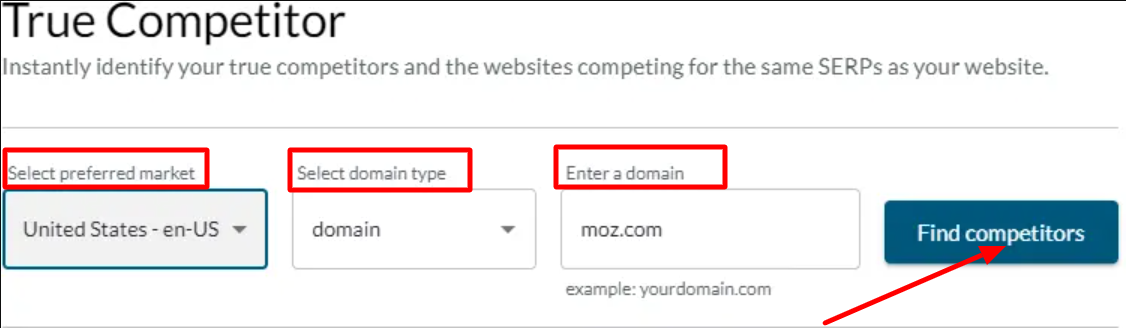
      You can also use the Moz Pro True Competitor tool to identify the top SEO competitors for your SaaS brand. Here’s how it works: Let’s say you want to identify the top SEO competitors of Moz. With this tool, you can find that information within a few seconds.

      The first thing you need to do is enter the following details in the tool:

      • Preferred market: The specific location you’re targeting

      • Domain type: The type of domain

      • Domain name: Your website URL

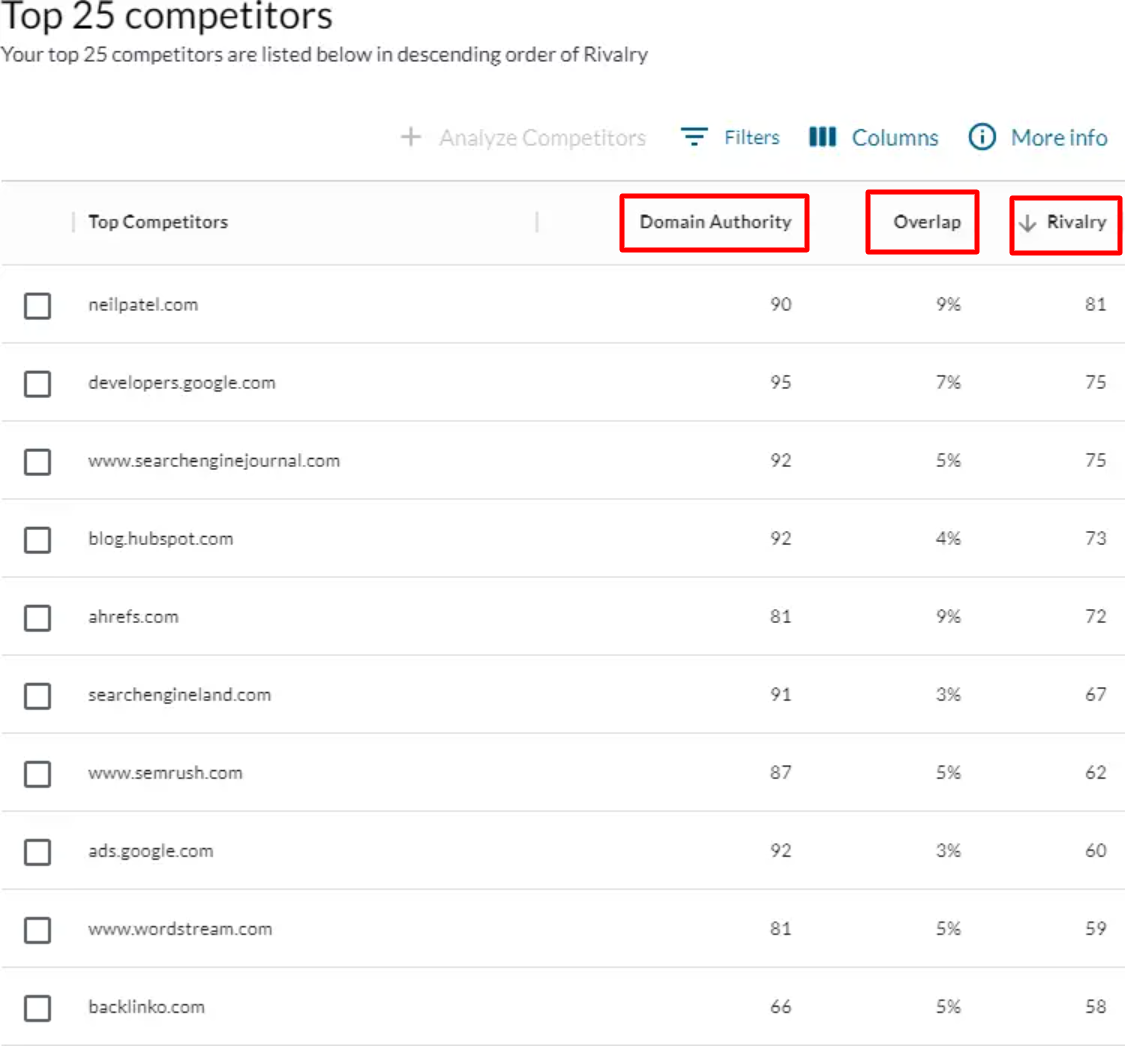
      Once you enter this information and hit the “Find Competitors” button, you’ll get a list of top 25 competitors:

      As you can see, websites competing with Moz on the SERPs aren’t limited to software brands alone. They include others such as:

      • Google

      • Search Engine Journal

      • Hubspot

      • Search Engine Land

      • Wordstream

      • Backlinko.

      This tool also has the Overlap and Rivalry metrics, to filter your top competitors.

      The Overlap metric filters your top competitors based on the shared keywords you both rank for on the first page of Google. The Rivalry metric uses factors like CTR, DA score, the volume of shared keywords, etc. to identify the most relevant competitors for your SaaS.

      After identifying your top SEO competitors, you can perform an in-depth analysis of at most 2 of them, to know the keywords they’re targeting.

      2. Survey or interview your new and existing customers

      If someone signs up for your SaaS product, chances are that they’ve demoed or tried out other options before deciding to go with yours. It’s also possible that they’ve just churned from one of your competitors to become a customer.

      This shows that they have an idea of who your direct and indirect competitors are. To get this information, all you need to do is reach out and interview them one after the other. This could be by talking to them via a quick call, sending a short survey for them to fill out, or asking them during the onboarding process.

      Here are some questions you can ask customers to identify your top competitors:

      • What tools were you using to [solve X problem] before trying out our product?

      • If you’ve never used any tool before, how were you able to solve this problem before now?

      • What made you interested in trying out our product?

      • When did you realize that a tool​ like ours is what you need right now?

      • How much research did you do to decide on our product? What are some other, similar tools you discovered during the research process?

      3. Perform a Google search targeting your SaaS use cases and features

      Performing a Google search for the use cases, features, and problems your software solves is a great way to identify your top SEO competitors. This is effective because most companies ranking high on Google are investing in SEO.

      Use the “related:website” advanced search feature

      This search operator shows you other websites related to the one you search for on Google.

      Let’s say you want to find websites like salesforce.com. You can search for “related:salesforce.com” on Google. The results on page one are some of SalesForce’s top SERP competitors:

      Search for the use cases of your software

      If your software helps SaaS companies onboard and activate new users, one of your core use cases is “user onboarding”.

      If you search “user onboarding software” on Google, you’ll unlock competitors who are either bidding for or ranking organically for the keyword.

      Some of the websites targeting this use case on Google include:

      • Appcues

      • Userpilot

      • Apty

      • Userflow

      Aside from that, there are SaaS brands paying to rank on the first page of Google for this keyword.

      Search for your SaaS features

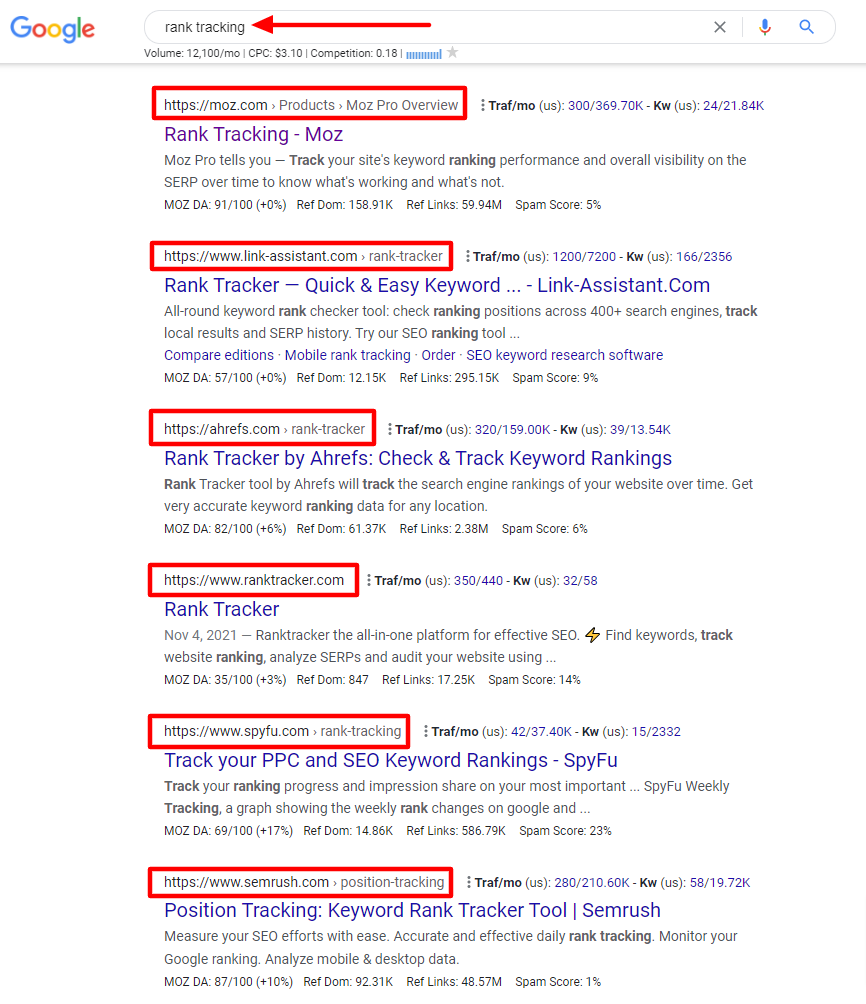
      One of the core features of the Moz tool is the “rank tracking” feature. To identify the websites that have a similar feature, you can input that keyword on the Google search bar.

      Here’s the result it returns:

      As you can see, aside from Moz, other competing websites for this feature include:

      • Link-Assistant

      • Ahrefs

      • Rank Tracker

      • Spyfu

      • SEMrush

      Search for your SaaS jobs-to-be-done (JTBD)

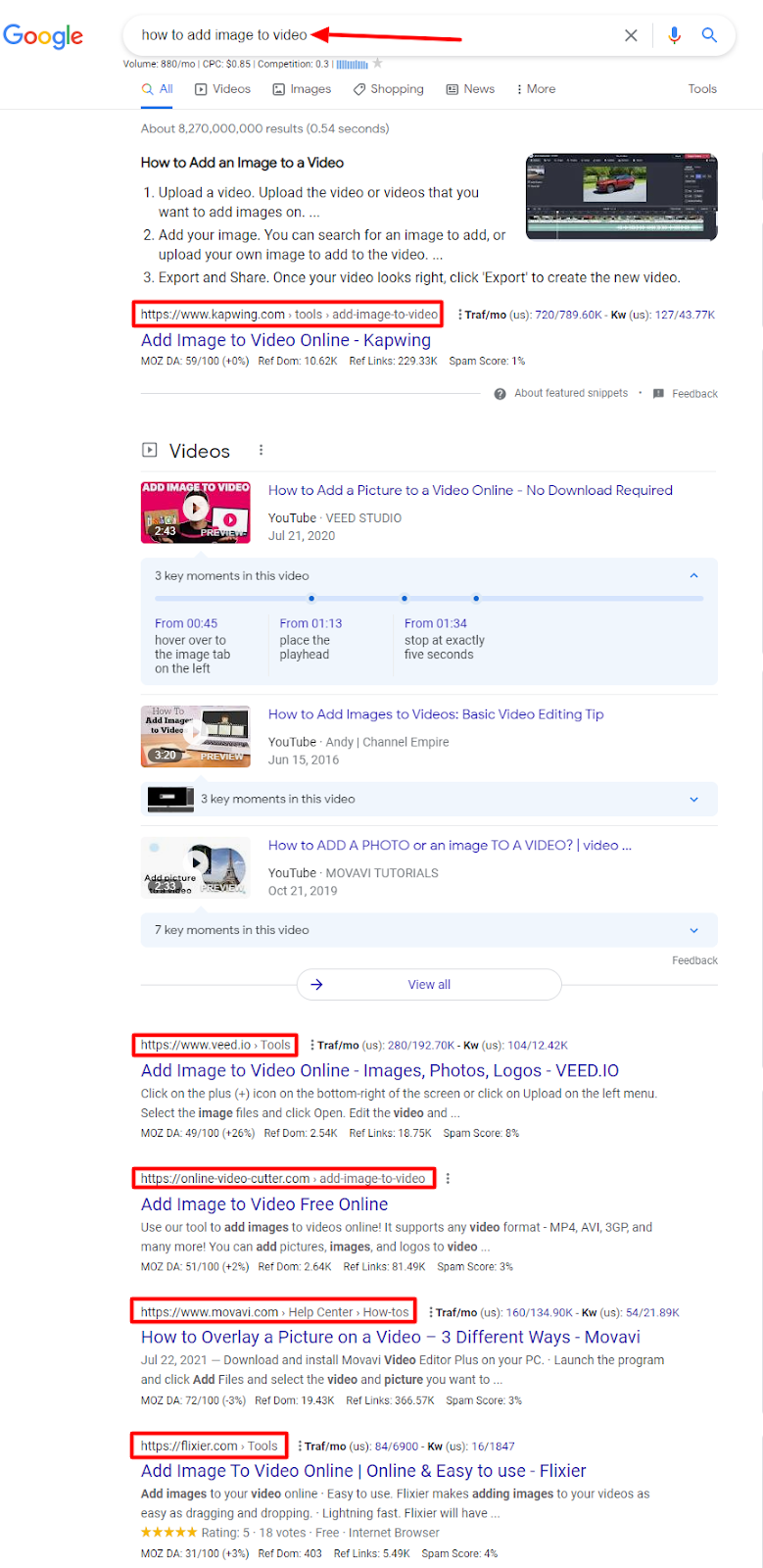
      Let’s say you run an online video editing software, one of the problems that your audience most likely have is “how to add an image to video”.

      By performing a Google search for this query, you’ll see a result that looks like this:

      This shows that some of the top SEO competitors in the online video editing space include:

      • Kapwing

      • Veed

      • Online Video Cutter

      • Flixier

      • Movavi

      Conclusion

      If you don’t know the SaaS companies you’re competing with, they’ll leave you behind and dominate your niche.

      In this post, you’ve learned three effective ways to identify your top SEO competitors as a SaaS brand:

      1. You can use an SEO software such as the Moz True Competitor tool to find your competitors and know the keywords they’re targeting.

      2. You can reach out to new and existing customers, to find out the solutions they’re comparing you with.

      3. You can search Google for your SaaS product’s features and use cases. This shows you the companies likely competing with your brand on the SERPs.

      Ever tried any of these tactics before? Kindly share which of them worked really well for your SaaS brand in the Q&A.

      source https://moz.com/blog/identify-saas-brand-competitors

      Categories
      Digital Marketing

      Best of Whiteboard Friday 2021: 21 Smart Google SEO Tips

      Our top Whiteboard Friday episode of the year was originally published all the way back at the beginning of January! So much has happened in the marketing industry since then, but Cyrus’s 21 SEO tips for the year are still definitely smart, and these go way beyond the SEO basics. He’s also included a bunch of helpful resources for your reference in the transcription below!

      How many of these were you able to implement throughout the past 12 months? Let us know on Twitter @Moz, and we’ll see you in 2022 with brand new episodes!

      21 Smart Google SEO Tips for 2021 Whiteboard

      Click on the whiteboard image above to open a high resolution version in a new tab!

      Video Transcription

      Howdy, Moz fans. Welcome to another edition of Whiteboard Friday. I’m Cyrus Shepard. Today, so glad that you can join us. We are talking about 21 smart Google SEO tips for 2021.

      We’re getting ready for a new year, a new year of SEO strategies. These are 21 practical tips that you can implement that should, hopefully, move the needle on your organic traffic. 

      These are some of the best tips that I’ve collected over the past year. Many of them that I’m going to use myself in my own SEO strategies. 

      Now we have four categories: increasing clicks, content/on-page SEO tips, technical SEO, and a little bit of link building.

      There are 21 of these. These are going to go fast. We’re trying to do 10 to 12 minutes, so we don’t get to spend a lot of time on each one. But don’t fret. We’re going to link to appropriate resources in the transcript below so that we can keep along and explore a little bit more. All right. Ready to dive in? 

      Increasing clicks

      Let’s start with clicks, specifically earning more clicks from Google without actually ranking higher, because that’s one of the great things about SEO. You don’t actually have to rank higher to get more traffic if you can get more clicks from the rankings that you already have. So let’s talk about some specific strategies for getting more clicks without increasing rankings. 

      1. Favicon optimization

      First, favicon optimization.

      Now I’m surprised more people haven’t talked about this in 2020. Google displays favicons in mobile search results, and they can influence your click-through rate if they’re high contrast, if they’re visible or not visible. Having a good favicon can make a few percentage points difference, very minor, but it does make a difference if you can get it right. Aaron Wall, SEO Book, wrote one of the very few posts about that

      2. Breadcrumb optimization

      While we’re optimizing our favicons, let’s take a look at breadcrumb optimization. Google displays breadcrumbs in both desktop and mobile search results. They can be keyword-rich breadcrumbs, which can influence your click-through rate. Now Google gets their breadcrumbs from a lot of places. That can be your URL, your schema markup, your actual breadcrumbs on the page.

      What you want to do is make sure Google is displaying the breadcrumbs that you want them to display, using those keywords that you choose. The best way to do that, make sure that you have breadcrumbs actually on your page with links, that you’re using schema markup. Ideally, it would match your URL structure, but that isn’t always necessary. So a great breadcrumb optimization audit. 

      3. Meta descriptions

      Let’s optimize those meta descriptions. This is so old-school SEO. But a recent study shows that 30% of websites don’t even use meta descriptions. Now that’s understandable because another study shows that 70% of the time, Google will rewrite the meta description, usually because it’s not using the keywords that the user is searching for. But if we write a well-crafted meta description, it can compel users to click, and that means using keyword-rich descriptions that people are actually searching for, so when Google does use your meta description, it’s encouraging those clicks and acting as marketing copy for your website.

      4. Numbers in titles

      Along with meta descriptions, titles. Just shared a study recently showing that dates added to titles increased rankings for a particular brand. Numbers are generally one thing that I always test in title tags that usually produce pretty consistent results. Specifically, dates in title tags are often a winner, January 2021.

      Don’t be spammy about it. Don’t include it if it doesn’t make sense and don’t fake it. But if you can include a number, it will often increase your click-through rate for any given query. 

      5. <Title> boilerplate

      How about doing a boilerplate audit for your title tag? Tip number five. What’s boilerplate? Boilerplate are the parts of your title tag that repeat every single time.

      For example, here at Moz, we put “Moz,” our brand name at the end of every title tag. We used to put “Whiteboard Friday” at the end of every Whiteboard Friday until we tested it and found out that we actually got more clicks and higher rankings when we removed it. So boilerplate, you want your titles to be unique, provide unique value. So I would encourage you to experiment with your boilerplate and see if removing it actually increases your rankings.

      Sometimes it’s not going to. Sometimes you need that boilerplate. But do the test to find out. 

      6. FAQ and how-to schema

      Tip number six: schema, specifically FAQ and how-to schema. Google gave us a huge gift when they introduced these in search results. FAQ schema gives you a lot of SERP real estate. You can’t always win it, and you can’t always win the how-to schema, but when you do, that can definitely increase or influence people to click on your result, expand those FAQ schemas out.

      It’s not appropriate for every page. You want to make sure that you actually have those FAQs on your pages. But it is one way, in appropriate situations, that you can increase clicks without increasing your actual Google ranking. All right. 

      Content/on-page SEO

      Let’s move on to some content and on-page tips. 

      7. Relaunch top content

      All right, number seven. This is the year I want you to look into relaunching your top content.

      Content can go stale after a few years. So we launch content. You have a blog, you launch it, and you share it on social media. Most people forget about it after that. So go back, look at your top content over the last two to five years or even 10 years, if you want to go back that far, and see what you can relaunch by updating it, keeping it on the same URL. In some cases, you can see gains of 500% to 1,000% just by relaunching some of your old content with some updates.

      So do a relaunch audit in 2021. 

      8. Increase internal linking

      Number eight: increasing internal linking. Now a lot of top SEO agencies, when they need to quickly increase rankings for clients, there are generally two things that they know are the easiest levers to pull. First, title tags and meta descriptions, what’s getting more clicks, but second is increasing the internal linking.

      You know that you can increase internal links on your site, and there are probably some opportunities there that you just haven’t explored. So let’s talk about a couple easy ways to do that without having too much work. 

      9. Update old content with new links

      Number nine is updating your old content with new links. This is a step that we see people skip time and time again. When you publish a new blog post, publish a new piece of content, make sure you’re going back and updating your old content with those new links.

      So you’re looking at the top keyword that you want to rank for, and going in Google Search Console or checking tools like Keyword Explorer to see what other pages on your site rank for that keyword, and then adding links to the new content to those pages. I find when I do this, time and time again, it lowers the bounce rate. So you’re not only updating your old page with fresh content and fresh links and adding relevance. You’re adding links to your new content. So make sure, when you publish new content, you’re updating your old content with those new links. 

      10. Remove unnecessary links

      Number 10, remove unnecessary links from your content. Now this is a form of PageRank sculpting. PageRank sculpting is a dirty word in SEO, but actually it works to a certain extent. It’s not nofollow link page sculpting.

      It is removing unnecessary links. Do you really need a link to your team page on every page of your website? Do you need a link to your contact form on every page of your website? In many cases, you don’t. Sometimes you do. But if you remove the unnecessary links, you can pass more link equity through the links that actually count, and those links are a major Google ranking signal.

      11. Mobile link parity audit

      Number 11, need you to do a mobile link parity audit. What is that? What is a mobile link parity audit? That is ensuring that the links on your mobile site are the same as the links on your desktop site. Why is that important? Well, the last couple of years Google has moved to a mobile first index, meaning what they see on your mobile site, that’s your website.

      That’s what counts. So a lot of sites, they have a desktop site, and then they reduce it to their mobile site and they’re missing links. They get rid of header navigation, footer links, and things like that. A recent study showed that the average desktop page has 61 links and the average mobile page has 54 links. That means on the web as a whole there are seven fewer links on mobile pages than desktop pages, meaning a lot of link equity is being lost.

      Mobile Link Parity Audit

      So do a study on your own website. Make sure you have mobile link parity between your desktop and your mobile site so you’re not losing that equity. 

      12. Invest in long-form content

      Number 12: need you to invest in long-form content. Now I am not saying that content length is a ranking factor. It is not. Short-form content can rank perfectly well. The reason I want you to invest in long-form content is because consistently, time and time again, when we study this, long-form content earns more links and shares.

      It also generally tends to rank higher in Google search results. Nothing against short-form content. Love short-form content. But long-form content generally gives you more bang for your buck in terms of SEO ranking potential. 

      13. Use more headers

      When you’re doing that long-form content, make sure you do number 13: use more headers. I’m talking about H2 and H3 tags.

      Break up your content with good, keyword-rich header tags. Why? Well, we have research from A.J. Ghergich that shows that the more header tags you have, generally you rank for more featured snippets. Sites with 12-13, which seems like a lot of header tags, rank for the most featured snippets of anything that they looked at in their most recent study.

      So make sure you’re breaking up your content with header tags. It adds a little contextual relevance. It’s a great way to add some ranking potential to your content. 

      14. Leverage topic clusters

      Number 14, leverage topic clusters. Don’t just launch one piece of content. Make sure you write about multiple pieces of content around the same subject and link those together. When you do that and you link them intelligently, you can increase engagement because people are reading the different articles.

      You can add the right contextual inner links. I have a great case study that I want to show you in the transcript below, where someone did this and produced amazing results. So look into topic clusters for 2021. 

      15. Bring content out of tabs

      Finally, bring your content out of tabs. If you have content that is in accordions or drop-downs or you have to click to reveal the content, study after study after study shows that content that’s brought out of tabs and brought into the main body, so people don’t have to click to see, generally performs better than content that’s hidden in tabs.

      Now to be clear, I don’t believe that Google discriminates content in tabs. They seem to be able to index and rank it just fine. But I think people generally engage with content when it’s out of tabs, and maybe some of those signals help those pages to rank a little better. 

      Technical SEO

      All right. Just a very few technical SEO tips. We’re going fast.

      16. Core Web Vitals

      Number 16: this is the year to invest in Core Web Vitals. These are some of the page experience signals that Google is bringing to the forefront in 2021. It’s going to be an actual ranking factor very soon. We’re talking about cumulative shift layout, hard word to say. Generally, we’re talking about site speed and delivering great page experience. Now some of these things are very technical, and Google has some tools, like Lighthouse, to try to help you to figure them out.

      One tip I like to share, if you are on WordPress, I highly recommend using Cloudflare, in particular their APO for WordPress. It’s a great way to speed up your WordPress website and help you score better for some of these Core Web Vitals. It’s very low cost, it’s easy to implement, and it’s a great way to speed up your WordPress website.

      17. Limit sitemaps to 10,000

      Number 17: sitemaps. Sitemaps, you’re allowed to have 50,000 URLs per sitemap. This is always a question in every SEO quiz. How many URLs per sitemap are you allowed? Instead, if you have a large site and you have indexing issues, tip number 17, limit your sitemaps to 10,000 URLs. You don’t have to use all 50,000.

      We have some evidence that using smaller sitemaps, compressing those into a limited URL set can actually improve your crawlability of those. It’s kind of like Google might prioritize those in some way. The data seems to support it. You also get a little bit better data out of Google Search Console. You can see what’s being indexed and what’s not.

      18. Leverage dynamic sitemaps

      Also, leverage dynamic sitemaps. Our friend Oliver Mason shows — that I’ll link to in the transcript below — that a dynamic sitemap is a sitemap that changes based upon what you want Google to crawl. So if you have a large corpus of URLs that you want Google to crawl, put the high priority ones in their own special sitemap.

      Maybe you limit it to one thousand URLs. As Google crawls and discovers those, remove them and put in additional high priority URLs that you want Google to discover. Keep the sitemap small and tight, and let Google know that those are the ones that you want them to pay attention to. 

      Link building

      Let’s quickly talk about link building tips for 2021, because everybody loves link building.

      No, kidding. Everybody hates link building. Link building is so hard. There are some professionals and there are some great people in the industry who do love it, who are great at it. Personally, I’m not that great at link building, but I still am able to build a lot of links. 

      19. Passive link acquisition

      One way that I’m able to do that is number 19: passive link acquisition. What passive link acquisition means is creating content that passively earns links as people discover it in the SERPs.

      It means I don’t have to outreach to people. It means that when they find it, when journalists find it, when bloggers find it, they naturally want to link to it. You do that by creating the types of content that journalists and bloggers and web creators are looking for. These are generally data, guides, definitions, how to, such as this video. When you create that kind of content, it generally earns a lot of links as people find it. Passive link building is one of the most sustainable ways to earn links over time. 

      20. Page-level link intersect

      Number 20, page-level link intersect. When you do have to do outreach, you want to do outreach to the pages most likely to link to you. Now we’ve known for a long time one of the top SEO tips for link building is find websites that link to your competitors but not to you.

      I like to make that a little more specific and find web pages that link to at least two of my competitors but not to me. That means that they are generally a resource page, if they’re linking to multiple competitors but not to me, and more likely to link to me if I ask them. We have a great tool here at Moz, Link Explorer, that does page-level link intersect. I think it’s the best tool for this specific task in the SEO industry, not because I’m biased, because I actually use it.

      21. Be the last click

      Tip number 21 for 2021, be the last click. What do I mean by that? I mean satisfy your users. Once you earn the first click, you want to get that first click that people click, but you also want to be the last click. That means they found what they are looking for. User satisfaction is ranking signal number one. Your goal with all of this is to satisfy the user, to give them what they search for.

      That’s the magic of SEO. They’re searching for something, and you’re delivering it to them at the exact moment they search for it. When you can be the last click, you’re almost guaranteed to rise in rankings and get the traffic that you deserve. 

      All right, those are 21 tips. That’s your roadmap for 2021. Hope you enjoyed it. Please share this video and share your tips for 2021 in the comments below.

      Thanks, everybody.

      Video transcription by Speechpad.com

      source https://moz.com/blog/21-seo-tips-2021

      Categories
      Digital Marketing

      The Core Elements of Storytelling that B2B Can Learn from B2C

      Meet the One Rand Man, an average 30-something-year-old living in Cape Town, South Africa. As an architect, he’s living his best life, eating out at swanky restaurants, buying rounds of tequila shots for the whole table, and splurging on clothing of the highest quality. He rarely tracks his finances.

      But one day, he wakes up and realizes the more he makes, the more he spends on his extravagant lifestyle. He gets curious, so he orders his entire monthly salary to be paid in one rand coins. Yes, you heard that right. The One Rand Man is now on a quest to understand just how much he’s spending in hopes that he’ll spend less by using coins to purchase everything.

      Sanlam Life Insurance took on his social experiment as a marketing tactic to teach people how to better manage their money and make smarter financial decisions. And this story blew up — we’re talking thousands of hits on Youtube and plenty of positive publicity. This B2C business used the One Rand Man’s story to educate consumers on the power of making educated financial decisions. And where do you think those consumers turned to when they needed financial assistance? Of course, Sanlam.

      What about B2B businesses, though? Does the same concept still apply? The truth is that many of you might believe incorporating this marketing tactic is time consuming or irrelevant to your business audience, but the truth is it works — with flying colors.

      For those in the B2B world, you’ve probably heard of B2B referred to as “Boring 2 Boring.” Well, it’s time to end that and spice things up a bit. So, let’s explore marketing storytelling techniques you can use to take your B2B marketing strategy to the next level.

      Why is storytelling important in B2B marketing?

      You’ve probably turned to the usual suspects in your marketing efforts — urgency, fear, and shock. By doing so, you’ve hit your ideal customers’ pain points with discounts and shiny offers, however, the power of a story can take those one-time customers and make them brand evangelists.

      Why does this matter? The most powerful form of marketing is word-of-mouth referrals.

      Story-based marketing pulls at heartstrings and cultivates trust. Instead of thinking about your customer as a sale, and them thinking about you as just a product or service, you’re creating long-lasting relationships that break through the barriers of consumerism.

      This is especially helpful for B2B businesses, where products and services can often be challenging for consumers to understand. Storytelling humanizes your brand and simplifies complex B2B topics by offering an alternative perspective.

      Seven benefits of storytelling you should know

      There are numerous benefits to utilizing storytelling as a marketing tactic, in particular, decreased customer acquisition costs and shorter sales cycles. When done right, story-infused messaging elevates and scales your business quicker than you believed possible.

      1. Humanizes the brand and conveys personality

      Dove portrays a sincere and authentic personality that’s inclusive for all no matter their skin tone, body shape, or complexion type. In a world where fashion brands and cosmetic powerhouses tell women how they should look, their story-infused messaging is a refreshing narrative changer.

      How to bring this into B2B

      Humans relate to other humans. So, think about how you can highlight the stories behind your team to create a connection with your target audience. As a B2B SaaS business, Dubsado does a really dashing job of highlighting their team’s backstory with super spunky copy. By simply incorporating the story behind your employees, you’re standing out from the sea of other businesses in your industry.

      2. Creates emotional connections with the audience

      To mention another example from Dove, this campaign showcases a little girl’s future being heavily influenced by all the beauty ads, and urges parents to start a conversation with their children about the industry before the ads do.

      By explaining how these ads potentially influence the minds of young girls, Dove creates an emotional connection with parents. They don’t just buy Dove for the product benefits, they purchase from a brand that stands for an inclusive and positive message.

      How to bring this into B2B

      Let’s look at a video created by Zendesk called, “Sh*t Support Agents Say”. Zendesk is a B2B SaaS company that makes businesses better by appealing to both their teams and customers. In this video, they pull on the relatable emotions of a specific group of people within a business: customer support agents.

      Think about a specific group of people within a business industry you’re targeting. How can you create a story-driven video that pulls on an emotion? How could you craft content around current events or values that matter to you and your target audience? By taking a stance, and weaving it into your brand messaging, you’ll create lasting impact and urge your audience to truly care.

      3. Motivates customers

      The image below is a snippet from the Dollar Shave Club website. This brand is well known for making it easy and fun for new customers to engage with their products and services.

      Website visitors can quickly identify the right products and understand how they can become a member through the “Easiest Quiz Ever”, about their daily grooming routine and product needs.

      This way, customers feel motivated as well as excited to see how Dollar Shave Club’s products could elevate their daily routine.

      How to bring this into B2B

      Let’s put this idea of motivating people to work for your B2B business. Motivating others doesn’t mean you need to stop what you’re doing and create a new quiz. Look at Zeb Evans, CEO and founder of ClickUp (a project management software). Each week he posts videos on Linkedin that motivate his target audience to join in on the conversation pertaining to work culture, localization, and even some of his biggest lessons scaling his team.

      You can simply motivate your target audience to first engage with your brand by sharing behind the scenes moments and lessons you’re learning along the way. This inspires others and makes you more approachable, too.

      4. Works as a basis for customer retention

      Canva does an excellent job of creating content their B2B and B2C audiences love. They understand that in order to retain their customers, their offering should not be just about design principles and templates. Their carefully curated blog touches upon various topics, such as case studies (how a redesign boosted a non-profit organization’s impact), efficient organization skills (teaching school teachers how to organize their digital notes), and how-to design guides.

      Canva is not just a leading brand for amateur designers, but is also a go-to destination for its users to learn more about several aspects of their daily life at work.

      How to bring this into B2B

      Map out the types of people that work at the businesses you’re targeting. You have graphic designers, content marketers, business founders, and various other titles. Think about them and create blog content to appeal to their specific areas.

      Maybe you do a series geared towards how content marketers could create more productivity in their daily lives by using your product or service. When you pose a solution to their individual stresses, they’ll be more likely to stick around if they feel seen and heard.

      5. Also a great way to get new customers

      To piggyback off the last point, because Canva’s blogs are super helpful, they’ll very likely get shared and act as free promotion on various channels.

      Let’s take a peek at how Eddie Shleyner, the founder of Very Good Copy, incorporates this into his business. Each week he provides fresh micro articles with story-infused, quick writing tips. At the end he encourages — and makes it easy for — his audience to share with others.

      How to bring this into B2B

      Creating rich, educational, and snappy content for specific individuals within your target audience, and then making it easy for them to share with a friend, is a sure fire way to get lots of referrals.

      6. Makes your content unique and exciting

      Most of us would gladly binge watch Netflix given a day off and some freshly popped popcorn. We crave stories, and are ready to invest our time in those ones that pique our curiosity and help us relate.

      One great example of this is the B2B software company in the UK called Advanced. In their “right the first time” campaign to increase brand awareness, they literally wove in fairytale elements from stories like “Jack and the Beanstalk”.

      This helped their complex industry become more digestible. In fact, the CEO of ILTA mentioned he wanted his software to be “like the Goldilocks story: not too hot, not too cold, but just right”.

      How to bring this into B2B

      When applying this to your own B2B business, think about stories you read as a child and weave that into a “story-telling” animated video (or blog) series, but instead of the original characters, use your company characters (you being the trusty friend, your customer being the hero).

      Using storytelling gives a unique and exciting edge to your brand messaging, as it helps people relate and engage with your content. So consider how you can use everyday stories we tell our kids in a new product or service you’re launching.

      7. Shows a less “salesy” side of your business

      Instead shoving “buy now!” or “purchase here!” CTAs down your customers’ throats, focus on copy that makes them laugh, piques their curiosity, and makes them feel in control. Take Barkbox, for instance: they do a really great job of using humor. In this tweet, you can see how their CTA totally makes their audience feel in control.

      How to bring this into B2B

      How can you be a bit more witty in your B2B copy? Look into what’s trending on social media, so that you can play into the bigger story of what’s happening in people’s daily lives and be more relatable. For example, Dave Harland is a well-known B2B copywriter in the UK and is popular for his witty and sarcastic LinkedIn posts that reflect his copywriting style and skills.

      Core marketing storytelling techniques B2B can learn from B2C

      As I mentioned earlier, it can often be challenging for B2B businesses to incorporate storytelling into their messaging because they’re not always talking to the decision maker, unlike B2C consumers. However, it is possible, and I’m going to show you exactly how you can break it down to build it back up— with a story.

      1. Build up a brand with personality

      Just like you have a playful, serious, humorous, or charismatic personality, your brand has one, too. Think of it as a living, breathing being. To truly humanize your brand, it’s important to give it a personality. Here are some common brand personalities that might resonate with your brand:

      • Educational: like the Moz Blog you’re reading from right now. Does your brand consistently create content to inform others about a different perspective, how your products work, or how-to do something?

      • Entertaining: like Netflix. Is your brand meant to distract others from the chaos of the world, and for a moment just forget their worries?

      • Disruptive/Rebellious: like Harley Davidson. A wild-at-heart kind of brand that’s not afraid to take risks.

      • Sensual and Luxurious: like Red Saint Botanical, a true spirit-based beverage brewed from rare teas. Does your brand ooze sophistication and scream refreshing?

      • Efficient and Motivational: like Nike. Maybe your brand’s heart beats like a champion and is eager to motivate others.

      • Happy: like Coca-Cola. If your brand’s sole mission is to cultivate joy, laughter, and radiance then happiness is its identity.

      Even with B2B, your brand personality doesn’t have to fit in one of these boxes, as they’re simply suggestions. Play around with identities and characteristics that feel right to you by diving deeper into your brand values.

      2. Create an authentic and original narrative

      Every piece of content that you publish should tell a story. Whether it’s an email, newsletter, Instagram post, or blog article, the messaging should be universal, memorable, consistent, and organized. Focusing on these elements will strengthen your content strategy and make it more powerful, and therefore unique. Let’s now take a look at content authenticity in action.

      Since 1973, Patagonia has always put out authentic content, constantly showcasing its brand values, company culture, and ethics. It’s evident through stories like trail runner Felipe Cancino’s of running through the Maipo River Valley, showcasing how Alto Maipo hydropower is greatly affecting the ecosystem, that Patagonia cares about our environment.

      In another story, Daniel taps into the mind of a beginner by teaching his daughter to surf. It’s clear that Patagonia not only cares for the environment, but also about how bonding over an outdoor activity cultivates healthy relationships.

      As you can see, consistently pushing out content that aligns with your values and brand personality builds a strong bond between your business and customers that can’t be broken.

      How to bring this into B2B

      Microsoft is both a B2B and B2C brand that offers a wide range of products. In an effort to share business-related stories about how their products are used, they developed Microsoft Story Labs. This was a true win-win, because Microsoft now has user-generated content to share across other channels, and users become more connected to the brand by sharing their stories.

      3. Wholeheartedly embrace emotion

      Displaying strong emotions helps consumers understand they’re not alone and that they can help a cause greater than themselves, especially when they have a brand by their side.

      Toms is a great example of this. On their impact page, they outline their aim to use the profits from their business to contribute to the issues of food scarcity and lack of resources in minority communities.

      Overall, consumers are keen to see a strong emotional connection to greater issues that matter, and they’ll be more likely to support a brand that displays this.

      How to bring this into B2B

      Your audience is made up of individuals, so the emotional element (which is often overlooked in B2B) needs to be a large component to drive the message home. In the same way that B2C does, write out their fears, joys, and anxieties and tie that into how your business could elevate or diminish those feelings.

      4. Get to know your audience

      Freaker USA, a brand that created a funky universal jacket, wrote this on their about page: “Your little one’s sippy cup can be just as freaked as your 40oz Colt.”

      This copy shows how well they know their audience. They understand sometimes parents need a one-size-fits-all product that will keep a child’s milk warm (and stylish) and something for their own adult beverage.

      How to bring this into B2B

      Simply ask your current clients through interviews, or conduct market research on look alike audiences to get to know them better. Get to know their quirks and nuances by asking them open-ended questions so that you can get first-hand insight that you may not have gotten otherwise.

      A business that has managed to understand even the tiniest details about its customers can really nail their paint points. Knowing their basic age, ethnicity, or location isn’t enough — get to know what they like at Starbucks, how they celebrate their birthday, or what Netflix shows they watch. When you understand these specific details, you can surprise them and communicate in their language to stay top of mind.

      The bottom line? The better you know your audience, the deeper your relationship with them can be.

      5. Make it personal

      Snapchat’s Bitmoji app launched in 2016, allowing users to create their own emoji (bitmoji) based on their appearance. Snapchat managed to bring out customers’ inner child through the creation of cartoon-like figures, which they can exchange amongst their contact list.

      How to bring this into B2B

      People want to feel unique, and they’re drawn to messages that appeal to their personality and way of thinking. The more ways you personalize your content, user experience, or messaging to showcase this, the more they’ll be tempted to try your brand.

      Plus, using personalization on your website is a surefire way to grab your audience’s attention. For example, you could offer a targeted lead magnet like a marketing template for those in that sector, or you could integrate a chatbot with pre-set answers so they’ll be directed exactly where they want to go.

      6. Hone in on data

      As the years go on and we become more integrated with technology, data will continue to play a huge role in how we personalize experiences for consumers.

      For instance, Refinery29 used data to showcase how plus-sized women are not adequately represented within images online. They incorporated this data in their brand strategy, and started shooting images and redesigning illustrations to accurately reflect real women in the US.

      How to bring this into B2B

      By using data and tying it to topics your B2B brand cares about, you can quickly form new and interesting stories, which in turn create an emotional connection with your audience. Collect data on your own marketing campaigns — social media in particular — to find stories that are already working for your brand, and scale accordingly.

      Start implementing storytelling into your B2B marketing strategy

      Storytelling not only solves some of your biggest B2B business issues (you’re familiar with dreadfully long sales cycles or unengaged prospects), but it can also nourish life-long relationships with customers to create a bigger impact. At the end of the day… isn’t that what we as marketers want?

      The marketing storytelling techniques that B2C businesses use are very similar for B2B businesses, too:

      • Brand personality

      • Emotions

      • Narrative

      • Knowing Your Audience

      • Personalization

      • Use of Data

      You’ll come to find that the benefits always outweigh the effort a B2B business spends on this process.

      By studying B2C brand storytelling (like the One Ran Man story from earlier), you can apply that same mentality and strategy into your B2B business to reap the same benefits.

      source https://moz.com/blog/b2c-storytelling-for-b2b

      Categories
      Digital Marketing

      Ecom, Locom, or Informational: Google Tracks Locally and so Should You

       The majority of surveyed consumers say that about half of their searches have a local intent, while the other half of queries can be satisfied with remote solutions. On either side of the chess board are businesses hoping Google will surface them fairly for appropriate keywords. 

      SEOs and marketers hear both sides of what can sometimes sound like a battle, with clients of multiple models rarely satisfied with the SERPs.  

      Meanwhile, the last two years have so blurred the lines of intent and fulfillment that it can start to feel rather vague at the agency level where a client falls within all of these possible identity categories: 

      • Local and independent/small

      • Local and part of a chain

      • Brick-and-mortar with in-store transactions only

      • Brick-and-mortar with digital shopping/delivery

      • SAB with or without online transactions

      • Solely virtual and independent/small

      • Solely virtual national brand

      • National brand that was virtual but is now showrooming or opening physical stores

      • B2B or B2C

      • Informational with unique income streams not from traditional sales

      Defining the client’s model properly should be the first step in any campaign. What and where the business is has long defined a major portion of its opportunities for visibility in Google results. But the SEO game is changing. Whether a particular client is best served by focusing more on the guidelines for representing your business on Google or the QRG, SEOs need to be able to effectively track local SERPs, because they are either the main goal or the main competitor, and without a doubt, because Google is so local-aware. 

      Local SERP tracking has historically been seen as challenging for any business type, but today, we’ll take a look at the lay of the competitive landscape and offer some helpful solutions.

      Rooks: businesses for which physical locations are the stronghold

      Whether a brand is little-known or a household name, if physical locations are its castle, then it will have become accustomed to eyeing virtual competitors warily.  

      Local businesses are understandably frustrated when page one organic SERPs are gobbled up by virtual competitors, regardless of what is shown above them in the local packs:

       And SMBs are not pleased by national brands being given the spotlight in features like this one documented by Mike Blumenthal, in which Google is weirdly populating the People Also Search segment with big brand chains that don’t even have locations in his town:

       Meanwhile, Google’s increasingly powerful shopping environment largely defaults to massive and frequently virtual sellers unless the searcher filters results down with the “available nearby” or “smaller stores” option:  

      Knights: business without physical locations that ship everywhere 

      Fully virtual brands that don’t have a public physical home base but can gallop deliveries to customers everywhere have two main sources of concern. The first is the mere existence of local packs, which eat up so much mobile and desktop screen space that formerly belonged to organic results only: 

      The second is the sheer volume of searches for which Google shows local packs and localized organic results. We’re fortunate to have some original data today from Moz’s own Dr. Peter J. Meyers. Pete ran 10,000 keywords through MozCast, half of which were localized to specific cities and half of which weren’t, and found that about one-third returned local pack results:


      When a search is explicitly local, because the searcher has included a city name or a similar refinement in their language, we call this a “geo-modified” query, and it’s hard to complain when Google responds with nearby results. But Google almost always knows where a device is located, and virtual business owners find it hard that these “geo-located” searches frequently yield localized results as well, even though the searcher hasn’t specified a town, zip code, or similar modification. Google is quite convinced of the implicit local intent of countless keyword phrases. 

      Clients running remote-only companies can find it hard to compete when Google places such emphasis on searcher locality and the localization of results. In order to vye for visibility, these entities have to be equipped to track local SERPs. 

      Bishops: businesses based on information with complex revenue streams

      The owners of directories, affiliate sites, enterprises that make their money from Google Adsense and other intricately woven indirect revenue streams are used to having to look at one another across a board cluttered with pieces owned by competitive virtual and physical commercial brands. They may have so much wisdom and learning to share, but it can be very hard to be seen.

      Often, these informational entities will have invested even more in the quality of their content than their more sales-y competitors. Look at a site like TripAdvisor, which has devoted itself to both UGC and original travel writing in an effort to be of use, but which is also running Adsense in quest of profits:

      When an informational entity isn’t set up to track local SERPs, they will miss out on fully comprehending both user intent and neglected gaps they could potentially fill within the localized results.

      Queens: emergent hybrids that can rule the board

      “What we’re seeing is that the more brick-and-mortar businesses that we’re creating, the more the digital is happening in those particular ZIP codes,” says Macy’s CEO, Jeff Gennette.

      By the dawn of 2020, we’d had nearly two decades of rooks, knights and bishops — each rigidly limited by the maneuvers available to their business model — battling one another for maximum control of the Google board. But:

      What is happening now is critical for every SEO and marketer to understand:

      1. The pieces on the board can now move in every direction. Whether a brand used to be solely physical, virtual, or informational, being all three is likely going to be the strongest strategy going forward for most companies. This means serious entities will invest in real-world locations, digital conveniences, and excellent, optimized content that generates income.

      2. Nevertheless, Google remains deeply tied to the physical location of the searcher. Because of this, whether you stick to your swim lane in the coming decade or reinvent the brands you market as powerful hybrids, you will always have to think locally, because Google does.

      Ready to start strategizing for this new contest of possibilities? Download this free guide to tracking local SERPs so that you can read the board and beginning making data-based moves in new directions: 

      This guide will coach you in:

      • Local search essentials
      • How mobile and local interact (and how to handle it)
      • The difference between geo-location and geo-modification
      • Searcher intent and all its nuances
      • Seven local SERP tracking strategies that you can tailor to your specific industry

      In this developing environment, it’s exciting to think that a family-owned country store can have digital sales and lucrative content, national brands can localize themselves and prove their commitment to localism by contributing to community tax bases, and informational enterprises can consider how developing a local footprint and developing product lines that fill gaps in the supply chain uncovered by their deep study of a market.

      Creativity is more welcome and more essential than ever before, and your study of Google’s obvious local leanings could stand the brands you market in good stead for many years to come.

      Image credits: Wayne S. Grazio, Tom Page, Joshua Alan Eckert. Will C. Fry, and Bob Whitehead

      source https://moz.com/blog/local-serp-tracking

      Design a site like this with WordPress.com
      Get started