Categories
Digital Marketing

How to Future-Proof Your Brand with SEO

The digital landscape is evolving quickly, and businesses must adjust their marketing techniques to maintain a competitive edge. You need to be able to transform how you operate your business and engage with your customers.

If you’re aiming for long-term success, you should learn how to future-proof your brand. This is no longer an option but a necessity. You’ll need to adopt a forward-thinking and strategic plan to be ready for the future to maintain your market share and remain relevant in the ever-changing search landscape.

SEO has become an essential building block to securing your brand’s future. Customers have turned to search engines to discover products and services, empowering brands to improve their online visibility, organic rankings, and the ability to attract and retain customers.

So, how can you make sure that you future-proof your brand?

Let’s explore how SEO can help your business establish credibility and authority, setting yourself up for growth and prosperity. Learn how to equip your brand for the future while leaving a lasting impression on your target audience.

The role of SEO in ensuring the long-term success of brands

SEO plays a big role in ensuring your website reaches your target audience. I like to compare SEO to a compass guiding brands in the right direction. Imagine it being a secret ingredient that will help your business to survive and thrive online.

So, how exactly does SEO do this?

It does the magic of making your brand visible to the right audience. Imagine having your business on a main street with heavy human traffic and selling a product everyone needs. You are nearly guaranteed daily sales. This is the same thing SEO does for your business.

According to Brian Njogu, the founder of SmartProfitsHub:

“SEO is about building a foundation for your business that will help you attract new customers, grow your online presence, and achieve your goals.”

SEO is not about appearing in search engine results. It’s about appearing on the first page and attracting valuable traffic.

Here’s an example: You are planning a lunch date, and you search for the “best restaurant in London.” You will most likely click on the top results on the Search Engine Results Pages (SERPs). This is how SEO helps businesses attain the top slots on the SERPs, helping them earn more clicks and visibility.

The best thing about SEO is that it’s a long-term investment. You will still experience results years after implementation. This means getting a steady traffic flow to your website without straining your marketing budget.

SEO also brings about brand credibility. When your website ranks high on the SERPs, your brand becomes more credible and authoritative. Who wouldn’t want that?

For your SEO to work, you don’t need just an SEO strategy. You also need the right mindset and commitment to play the long-term game.

8 Steps to future-proof your brand with SEO

Every business owner’s dream is to have a business that will last and run in the foreseeable future. But, the ever-changing digital landscape makes it difficult to promise this. Here is where SEO comes in. It has the potential to offer success now while setting your business up to thrive in the future.

Let’s look at the steps you can take in future-proofing your brand with SEO.

1. Understand the evolving SEO landscape

SEO is evolving, and techniques that used to work may no longer work. To keep on track, it would help if you understood the latest SEO trends and know how they affect your brand.

User intent optimization is one of the best techniques you can adapt for your brand. It involves selecting keywords that match the user’s search intent and answering their questions with relevant content.

The best SEO practice for this is searching your query on Google and seeing how it interprets the intent.

The image below shows the intent of the keyword “premium pet food,” which is commercial.

Analyzing search intent through the SERPs using the keyword

The mobile-first indexing is another Google practice that you should be aware of. It ensures your website is responsive on smartphones while saving traffic that comes on mobile. You’ll want to ensure that the navigation of your website is smooth on mobile. Also, ensure all buttons are easy to click, the text is readable, and the images load correctly. Research by Statista shows that mobile online usage has increased significantly, so you should make your website mobile-responsive.

To keep up with SEO’s evolving landscape, you must keep track of the ever-changing algorithms or risk losing your rankings overnight.

You must also understand user behavior to keep up with the competition.

Machine learning and AI have also had a great influence on search engine algorithms. This technology analyzes how users interact with content to deliver relevant results. Search engines are built in a way in which they learn user behaviors and serve up what they need. This is why learning how they work will help you secure a future for your brand.

2. Conduct a comprehensive SEO audit

When future-proofing your business, it is important to understand your position, strengths, weaknesses, and opportunities to stand a chance against your competition.

Every successful SEO journey demands a thorough self-assessment. It would be best to understand what is working, what isn’t, and what needs improvement. Think of it as a digital health check-up. For example, identifying your high-performing keywords will help you create relevant content that resonates with your audience, and you can do this with Moz’s Keyword Explorer.

You should also check your SEO technical health. Even if you have quality content on your website, your SEO technical health needs to be checked, as it will affect your performance and ranking.

Use tools like Screaming Frog and Site Bulb to check your technical SEO health, Google Search Console to check your website’s performance, and Moz Pro to identify common on-page issues. Using tools will help you identify your website’s SEO technical health, keyword performance, and traffic.

The screenshot below shows a website performance on Google Search Console.

Monitoring website performance with Google Search Console

In your SEO strategy, be sure to conduct a thorough competitor analysis. This will help you examine your competitor’s SEO strategies, keyword choices, backlinks, and content tactics. Use this information to build a better strategy to help you outrank your competitors and secure your brand’s future.

3. Establish a solid SEO foundation

Establishing a strong SEO foundation is a sure way to future-proof your brand for SEO. You should identify target keywords, optimize your pages, and craft content that resonates with your target audience.

Picture the keywords you choose as the pillar of your SEO strategy. Relevant keywords will help you understand your audience and what they seek. You should work with keywords with a decent search volume and that match with the searchers’ intent. This is where all the gold is buried.

The image below shows a keyword I researched via Moz’s Keyword Explorer tool. These keyword metrics can help you to understand how difficult it may be to rank for a keyword, as well as how you might like to prioritize it.

Analyze a keyword during keyword research, using Moz Pro's Keyword Explorer.

According to Louis Smith, the founder of Louis Smith E-commerce SEO:

“An effective Keyword research process is the foundation of organic growth campaigns, driving the discovery and attraction of a larger audience. It unveils the language and intent of your target audience, guiding you to create content that resonates and enhances visibility in search engine results.”

You also need to work on your on-page optimization. Once you’ve completed your keyword research, you should optimize your meta descriptions and titles with your chosen primary and secondary keywords. Let them act like breadcrumbs for search engines.

Having high-quality content is a gateway to future-proofing your brand. It makes your visitors stick around much longer and get the urge to share it with their connections. This helps increase traffic and conversions. Quality content on your website will bring you closer to future-proofing your brand. Great content acts like a digital feast that keeps your audience returning for more. When writing your content, address your audience’s needs by answering their questions. Optimize it by using relevant keywords and distributing them naturally in your content.

Different audiences love to consume content differently. Therefore, feel free to experiment with a variety of content formats like videos, infographics and podcasts to reach a bigger audience.

Also, you should have a strategic internal linking strategy in place throughout your content. This will help search engine crawlers navigate and index your web pages effectively while also providing greater context to your web pages.

Having user-friendly URLs improves user experience, leading to improved SEO, so make sure to think thoroughly about the URLs you are publishing. Lastly, pay attention to your site structure. A website with a good structure helps visitors navigate your website easily. This helps them to engage with your content more, increasing the dwell time.

4. Adapt to algorithm updates and industry changes

To survive in the digital landscape, you must keep up with algorithm updates and industrial shifts. Algorithms reshape the way search engines crawl, index, and rank search results. Website owners are, therefore, forced to adapt to these changes.

So, how can you survive these sudden changes?

To survive algorithm updates, you should stay informed, continue learning, and become flexible in your SEO approach. Join communities or have a network that can provide valuable insights into new algorithm updates.

When new algorithm updates are released, adapt quickly and look at them as opportunities for growth. Algorithm penalties can be a big blow. Think of them as being given a second chance to fix what is broken. To sort out the penalties, you’ll need to analyze the issue causing the penalty, fix it accordingly, and appeal for reconsideration. Imagine them as a ticket to getting back on track.

Search engine algorithms will keep on evolving. Therefore, your SEO strategy should be flexible, with room for the potential of new algorithm updates. You can only keep up with algorithms by continuously learning, adapting to change, and understanding user behavior and new trends.

5. Build a strong backlink profile

To successfully future-proof your brand, having a strong backlink profile is vital. It acts as a vouch of confidence by other users, and having one helps you rank and build digital credibility. This will help you now and in the future. I like to compare backlinks to positive online recommendations that influence your search rankings and Domain Authority. Your website becomes more credible and trustworthy with a great backlink profile.

Keep in mind — not all backlinks are good. Good backlinks are from trusted sources and are relevant to your content. On the other hand, bad links can be from spammy websites or perhaps are irrelevant to your content and are not worth paying attention to.

You need relevant, high-quality backlinks to future-proof your brand for SEO. Here are ways you can acquire backlinks for your brand:

  • Write guest posts for reputable brands.

  • Write high-quality content that others may want to reference.

  • Network with influencers, bloggers, and industry leaders — this can lead to opportunities for collaboration.

  • Reach out to websites to explore link building opportunities.

  • Share your content with communities. If people like it, they will share it with their network, which could possibly lead to more backlinks.

Always inspect your backlink profile and remove any bad backlinks. Moz Link Explorer is a great tool to explore and track the health of your profile. Google Search Console is a free tool that can also help you see an overview of your website’s backlinks.

6. Leverage user experience for SEO success

A great SEO strategy that aims to optimize user experience (UX) is key to securing a digital future for your brand. Great user experience influences search engine rankings and how users interact with your website.

A well-designed and user-friendly website will attract visitors and encourage them to interact with your content and stay longer on your website. When your website’s user experience and SEO are in harmony, they can help you boost your SEO rankings.

Having a user-friendly website design is the secret recipe to enriching your user experience. The design should be clean, have straightforward navigation, and have a reasonable font size to foster user satisfaction.

Also, you should consider having a responsive design to cater to user browsing using different devices. Taking this approach will boost engagement and lead to longer dwell times.

Never underestimate your website’s loading speed. A website that loads fast and can be accessed on mobile is vital in determining how well you rank. Today, speed and mobile friendliness are ranking factors that Google uses to rank websites.

To optimize for seed, you should:

  • Optimize your images

  • Minify CSS and Java script-codes

  • Reduce the number of redirects on your website

  • Use content delivery networks

Use Google Analytics to inspect bounce rates and dwell time to understand user interaction, among much more. Low bounce rates and high dwell time indicate quality and relevance.

7. Monitor and analyze your SEO performance

The journey to future-proofing your business with SEO is more than developing and executing a content strategy. It requires you to monitor and track your SEO performance and make data-driven decisions.

You need to understand that analytics in SEO is not all about numbers but the stories those numbers tell. For this to become successful, keep an eye on your progress.

SEO tools like Google Analytics can help you monitor traffic, user behavior, and conversion rates. On the other hand, tools like Moz Pro can help with keyword tracking, competitor analysis, and backlink insights. These tools will help you pinpoint what is working and what is not.

To make data-driven decisions, you should configure your analytics platform. Understand your goals, such as tracking form submissions or e-commerce transactions as your performance indicators. Check out Preeti Gupta’s article on creating custom reports in GA4 to learn more.

Track your keyword rankings, traffic, and conversion rates. Organic traffic will tell you how many people are finding your website on Google, keyword rankings will show you how effective your SEO efforts are, and conversions will show you how many visitors have become paying customers.

Understanding these metrics will help you understand the efficiency of your SEO efforts and identify areas to improve.

Make a point to regularly look at your data to spot and remove unwanted weeds to keep your SEO efforts in check.

8. Embrace emerging SEO opportunities and technologies

Are you doing some digging to find out the latest trends affecting your business? If you haven’t adapted to AI and generative technology, it is high time you did. This will give you a competitive edge that will help you future-proof your brand.

AI can help you work more efficiently. You can use tools such as ChatGPT to analyze data to find relevant keywords to make you stay competitive, among much more. Generative AI will help you shift your focus from keyword-based optimization to semantic search. This will help your website rank higher in search results by providing visitors with more relevant and accurate information.

Voice search is another trend that is getting more attention today. Most people are finding it easier to talk more than to type more. Voice assistants like Siri and Google Assistant have taken over, and people are talking to their devices more than ever. This is why your website should adapt to this trend by being mobile-responsive.

Failing to optimize your website for voice search can be a missed opportunity. So, how do you optimize your website for voice search? The first thing is to learn how to speak like your customers. Use more natural phrases that they could use when speaking. Focus on answering the questions “why,” “what,” “who,” “where,” and “how” in your content.

Valuable content is another trend you shouldn’t ignore. Always make sure your content answers the questions of your audience and meets the E-E-A-T guidelines.

Schema markup is another critical aspect of SEO that you should take note of. It helps search engines understand your content type and what it’s about. Schema markup is code added to key elements like product reviews, ratings, events, blogs, FAQs, and web pages to provide extra context, helping your website to stand out in the crowd. Implementing schema on your website can lead to more traffic and clicks.

Wrap up

So, there you have it. You are one step closer to future-proofing your brand with SEO. Use these strategies as your secret weapon to stay ahead in your SEO game.

Always remember to keep your eyes peeled for any industry twists and fine-tune your online presence. Doing this will not only help you future-proof your brand but also carve a permanent spot online. So, put on your armor, adapt, and enjoy the ride to your digital success.

source https://moz.com/blog/how-to-future-proof-your-brand-with-seo

Categories
Digital Marketing

August 18 Algo Update: The Cyclone Before The Storm

Around August 18, just prior to the August Core Update announcement, MozCast recorded extremely high temperatures, peaking at 127°F. This stood out even compared to August’s unusually high ranking-volatility and the Core Update itself (so far).

Screenshot showing MozCast temperatures from August 11th to 24th

While it’s easy to lump this volatility into the August Core Update, we recorded a distinct and probably unrelated event — a massive drop in indented results on page-one SERPs.

Indented results drop 50%

An indented result in Google is any organic result that’s grouped under another, higher-ranking result from the same domain. For example, below is a screenshot of a search for “Excalibur” that pulls up Wikipedia pages for both the sword and the film.

Screenshot of the Wikipedia ranking search results for the keyword 'Excalibur'

Between August 17-19, the percentage of page-one Google SERPs with indented results in the MozCast 10K tracking set dropped from 24.10% to 12.04%, as shown below.

Screenshot of evident drop in indented results from August 17th to August 19th

Half (almost exactly 50%) of SERPs with indented results lost them over this two-day period, and that loss has not recovered as of the writing of this post.

Indented = Promoted organic

Here’s why this matters and why this change shook up the SERPs: Indented results are often (not always) promoted from lower-ranking organic results. Consider this indented result from a search for “banquet halls” in Portland, Oregon, on August 17.

Screenshot showing the ranking search results for the keyword 'banquet halls'.

These two results effectively ranked 1st and 2nd. On August 20, the indented result (now a stand-alone organic result) dropped to 4th place, with a Places Pack and People Also Ask feature between 3rd and 4th, resulting in a substantial vertical drop.

And below is a set of indented results from a search for “green card renewal” on August 17.

Screenshot showing the ranking search results for the keyword 'green card renewal'

These results effectively occupied the 1st through 3rd positions. As of August 25, these results were split into 1st, 3rd, and 5th, with a People Also Ask feature before the 5th result.

Long-term trends (18 months)

While we can’t predict the future, this drop is consistent with a long-term trend. The graph below shows the percentage of page-one Google SERPs with indented results over the past 18 months.

Graph showing the drop in percentage of page-one Google SERPs with indented results over the past 18 months

The most recent drop is squeezed at the very end, but there was also a sizable drop at the end of July 2022 and a steady decline in the year since then. Keep in mind that Google had only reinstated indented results a few months earlier (at the end of 2021). This trend could reverse, of course, but my hunch is that Google’s initial roll-out was too aggressive.

Since this is effectively a re-ranking layer and doesn’t seem to be connected to the quality of individual results, there’s not much you can do about it. It’s like the car next to you at the stoplight turning down their music. Whether you like the song or not, they control the volume.

The volatility itself can be frustrating and adds to the noise of an already loud summer, but this shake-up should not impact your primary ranking for any affected SERPs. In some cases, if you were ranking below someone else’s intended results, you may even see minor gains. As always, keep your eyes open, monitor your organic search traffic, and try not to panic.

source https://moz.com/blog/google-indented-results-update

Categories
Digital Marketing

Why Should SEOs Measure Brand? — Whiteboard Friday

In this Whiteboard Friday, Tom discusses why SEOs should measure their brand, with specific reference to Moz’s new metric, Brand Authority.

Digital whiteboard showing why SEOs should measure 'Brand'

Click on the whiteboard image above to open a high resolution version in a new tab!

Video Transcription

Happy Friday. I’m Tom Capper, Senior Search Scientist at Moz. Recently at MozCon we launched a new metric, Brand Authority, and in this Whiteboard Friday I just want to briefly explain why we think this is important, why we think that going forward SEOs are going to care more and more about measuring brand.
Why SEOs should care

This is something that I personally have been thinking about for quite a long time. This is a study I put out in 2021, which hopefully will be linked below. This is just showing that in terms of domain level ranking correlation, branded search volume, which is not the same as Brand Authority but is a simpler metric that I had available at the time, branded search volume was actually nearly as well correlated with rankings as Domain Authority and certainly more so than links to domain.

Image showing a ranking correlation between Domain Authority, links and branded search volume

This is interesting to me, and I’ve been doing studies like this since around 2017. Although I didn’t work at Moz back in 2017, but little did I know at the time there were people at Moz thinking about this too, and this is something that Moz has actually had in the works for a very long time. Even when I started at Moz about two and a half years ago, there was already a prototype of this metric, and it was something that we were thinking about and sort of improving on and iterating on.

Now the reason why I think this is interesting is that there are a few reasons why this could be the case. Well, why is it that a simple, somewhat silly metric, like branded search volume, can be nearly as well correlated with rankings as Domain Authority? How does that happen? Well, one answer that a lot of SEOs will jump to is, oh, maybe it’s a ranking factor.

I don’t think so. I’m a bit of a pedant. Personally, for something to be a ranking factor, I think that needs to be a metric which is a direct input into Google’s ranking systems. I can’t be certain. I don’t work at Google. I don’t think that branded search volume is a ranking factor. But there are a bunch of other ways that it might play into rankings, which I think are interesting or should be interesting to SEOs.

Image showing reasons why SEOs should care about measuring 'brand'

One of them is that most of us agree and I certainly think links are a ranking factor. Brand and links have a lot of interplay. If you think about the things that you might do to build links, a lot of them will also result in increased interest in your brand. You think about things like digital PR. Similarly, a lot of the things that you might do as brand marketing result in you getting links.

The better established you are in the industry, the more people are talking about you, these are the things that you would do as brand marketing, right, those will result in people linking to you because you’re an authority or because you’re mentioned in their campaign or whatever it might be. SERP signals I think is another potential factor here. Now this is a controversial one. A lot of people don’t believe that Google takes into account SERP behavior, or maybe it does it indirectly or something like that.

I think SERP signals probably do play some sort of role in Google’s algorithm. I’ve written about that elsewhere. I won’t get into it now. But having a strong brand will definitely impact things like click-through rate from the SERP. Even if you don’t think that affects ranking, you probably do care about click-through rate from the SERP. So if people get to a SERP, they see three sites, and they’ve heard of one of them, which one are they clicking?

It’s quite simple, right? Then lastly, obviously we’ve been talking a lot in the last few years about E-A-T and now E-E-A-T, expertise, authority, and trust. This is kind of what Google originally set out to measure with links. But brand, however they might want to measure that, is very relevant. If you’re talking about expertise, authority, and trust, that’s all related to brand.

So these are sort of some of the big reasons why I think that SEOs should care about brand at least.

How to approach your job as an SEO

If we think about how these translate, there are a lot of things that once you start recognizing that brand might influence rankings, it might change how you approach some other parts of your job as an SEO. So, for example, if you work with other marketing channels, well, it’s going to help you to talk to them and to get buy-in for what you’re doing and then to get buy-in for what they’re doing if you can recognize that there are a lot of these positive side effects.

If you’re working on a brand campaign, it might influence SEO. If you’re working on SEO, it might influence brand, this kind of thing. Obviously, for you to leverage this, you do need to be able to measure it. Then also a lot of SEOs have been thinking about the role of links. Now I saw a survey I think most recently last year from [indecipherable]. I’ve seen a few of them over time.

In recent years, most SEOs, when polled, think that links either are of declining importance or will be of declining importance in the future. Now, obviously, this is speculation. But we can all agree that links are not what they were in the early days of SEO. They’re not the be-all and end-all anymore. You can’t do links alone as SEO.

So if you’re thinking about links maybe having a gradually declining value, then you might want to think about, well, what would Google replace that with as an authority signal. Again, I think brand is a pretty good answer, or at the very least it’s correlated with a lot of things which are a pretty good answer. Lastly, I think there are many other use cases here, but one of the ones that’s most exciting to me is sort of competitive analysis or strategy work, where you’re trying to position yourself within your industry and figure out what’s important, how you relate to competitors, this kind of thing.

Compare Brand Authority to Domain Authority

Image comparing Brand Authority to Domain Authority with examples

So this is a visualization that we have in Moz Pro at the moment, where you can put in your site on Domain Overview, and it will show you how you compare on both BA and DA to some competitors. So I’ve done this here for autotrader.com. I should say right now Brand Authority, it’s in beta. It’s currently quite U.S. leaning in the results it will give you.

That will change over time, probably very soon. But right now, it’s quite U.S. leaning. So this is autotrader.com, not, for example, autotrader.co.uk. They are different companies weirdly. So auotrader.com, it turns out they have a stronger brand but a slightly weaker domain than their competitor Edmunds. That tells them something about where they might want to focus their efforts, what might be causing them to do better or worse in certain scenarios, this kind of thing.

Then if you compare it with a site like cars.com, they can see, okay, they’ve got a quite similar level of Brand Authority, but a much stronger domain. So if they’re being outcompeted by cars.com, then maybe links wouldn’t be the focus area, for example. You can have your own theories.

You’ll know your own competitor space. You’ll know how you’ll use this information. But I think being able to show a C-level or show your manager or show your clients this kind of contextual data can be really useful both in setting expectations and in thinking about what your priorities might be as a brand. Anyway, I hope that gave you some food for thought.

Please do go and try out the metric. There will be lots of links below I’m sure. Thank you very much.

Video transcription by Speechpad.com

source https://moz.com/blog/why-measure-brand-whiteboard-friday

Categories
Digital Marketing

GA4: Leverage the Power of Custom Reports to Enhance Your Reporting

Google Analytics 4 (GA4) is officially here. If you’re not familiar yet, GA4 is the next generation of analytics.

While it offers a bunch of new features and benefits, it can be a little daunting to learn how to use it effectively. There are numerous new reports, and finding the data you care about can take a lot of time.

In this post, I will show you a great way by which you can leverage the power of GA4 to enhance your reporting by using custom reports.

What is the need for Custom Reports?

Don’t get me wrong, the standard reports are great. They provide a lot of data. And that’s the problem. They provide a lot of data that you might not need.

  1. The default reports don’t provide you with important data: The default reports in GA4 provide a good overview of everything about your website. For example, it will tell you how many new users you’ve acquired. Or how many sessions your website had in a given timeframe. However, they may not give you the specific information you’re looking for in your SEO campaigns. To find something like how many users are coming from specific countries that are coming from organic mediums, you would have to go through a lot of reports. But if you make custom reports, on the other hand, this work would be much easier.

  2. Finding key metrics and organizing data can be challenging: Every business has different goals. Some might focus more on getting new users, and others might focus on a specific channel, while some may focus more on increasing the views on particular pages. Finding and keeping track of different metrics for different businesses is difficult in the default reports. Suppose you’re a SEO consultant handling 25 different GA4 accounts, and you need to prepare reports that will highlight the key metrics that you’re tracking. Gathering the data from default reports will take you dozens of hours and a lot of brain power.

  3. Presenting this data to stakeholders and ensuring your SEO suggestions are implemented can be tricky: The default reports are designed to show the general overview of data. This means that it will not provide you with the specific data that your stakeholders are interested in. The next thing is that the default reports have a ton of data in them. This makes the reports hard to understand. Stakeholders must understand the data because if they don’t feel confident about the data, it can be really hard to get your SEO recommendations implemented.

A great way to get the most out of your analytics data is to make custom detailed reports.

What are Custom Reports?

Custom detailed reports are like default reports, except you make them using a template or entirely from scratch. Here, you can add any dimension or metric, filters, and more.

Making custom detailed reports is a great way to get deeper insights into your analytics data, and they can help you make informed decisions, which you can learn more about in my new GA4 course.

How can Custom Reports help you get the data you care about?

Custom detailed reports can help you be more productive by organizing all your important metrics in one place. This means that if you handle more than one GA4 account, it will help you analyze and understand data better in less time.

  1. Helps you focus on important metrics: GA4 allows you to create custom reports that help you focus on metrics you care about. You can add your preferred dimensions, metrics, filters, and charts. These will help you to customize the report according to your needs. So, for example, if your business is focusing on getting organic traffic from a specific country, then you can make a report that will show you this data. This will save you time, and you can focus on the metrics you care about.

  2. Get an accurate picture of your campaigns: By making custom reports, you can get granular data for a single or a group of pages. By tracking specific metrics and dimensions, you can identify trends and data that you might not get otherwise. This will help you understand what’s working and what’s not. This would mean that you can focus on making your campaigns better.

  3. Takes less time to set up and access compared to standard reports: If you were to get the specific data from the standard report, it would take you a lot of time. Making custom reports can take a few minutes to a few hours, depending on how many reports you want to make. And once your reports are made, you can publish them, and then you can access them from the sidebar. This will allow you to access important metrics quickly.

  4. Make better decisions with the data: When you have access to custom reports, you can understand what aspect of your campaign is performing best, and what’s not. What pages get more engagement, and which pages get the most views? Having access to this data means that you are making data-based decisions and not shooting in the dark. This will help your campaigns to perform well, and you can fix the issues you’re encountering.

  5. Feel confident in getting your recommendations implemented: When you make custom reports, you only include a few metrics. This will make your stakeholders understand the data better. And as they can understand what needs to improve, you can feel confident that your SEO recommendations are getting implemented.

Steps to create custom reports

Here’s how you can create a custom report:

  1. From the left menu, click Reports

  2. Navigate to Library, and click it (Note that you should be an editor or administrator to access the library option)

  3. In the reports section, click on “Create new Report”

  4. Click “Create Detail Report”

  5. Here, you have two options. You can either create a report entirely from scratch or use any template.

  6. Add your desired metrics, dimensions, filters, and click save

For example, your SEO campaign is focusing on generating organic traffic. And your goal is to find out what countries are generating the most amount of organic traffic.

You can do this by creating a report from the demographics template. When you click the demographics detail template, you will see a lot of data that is optional for you.

You can remove extra dimensions and metrics that are not important.

For this particular example, we want to keep the dimension as “country” and the metric as “total users.” This will give us all sorts of data like organic and referral. So, we will make a filter that specifies the session medium as organic.

This will only show us the total users coming from different countries from the organic medium.

But what if you want to know what those organic websites are? What if you want to know whether your traffic is coming from Google, Bing, or any other organic medium?

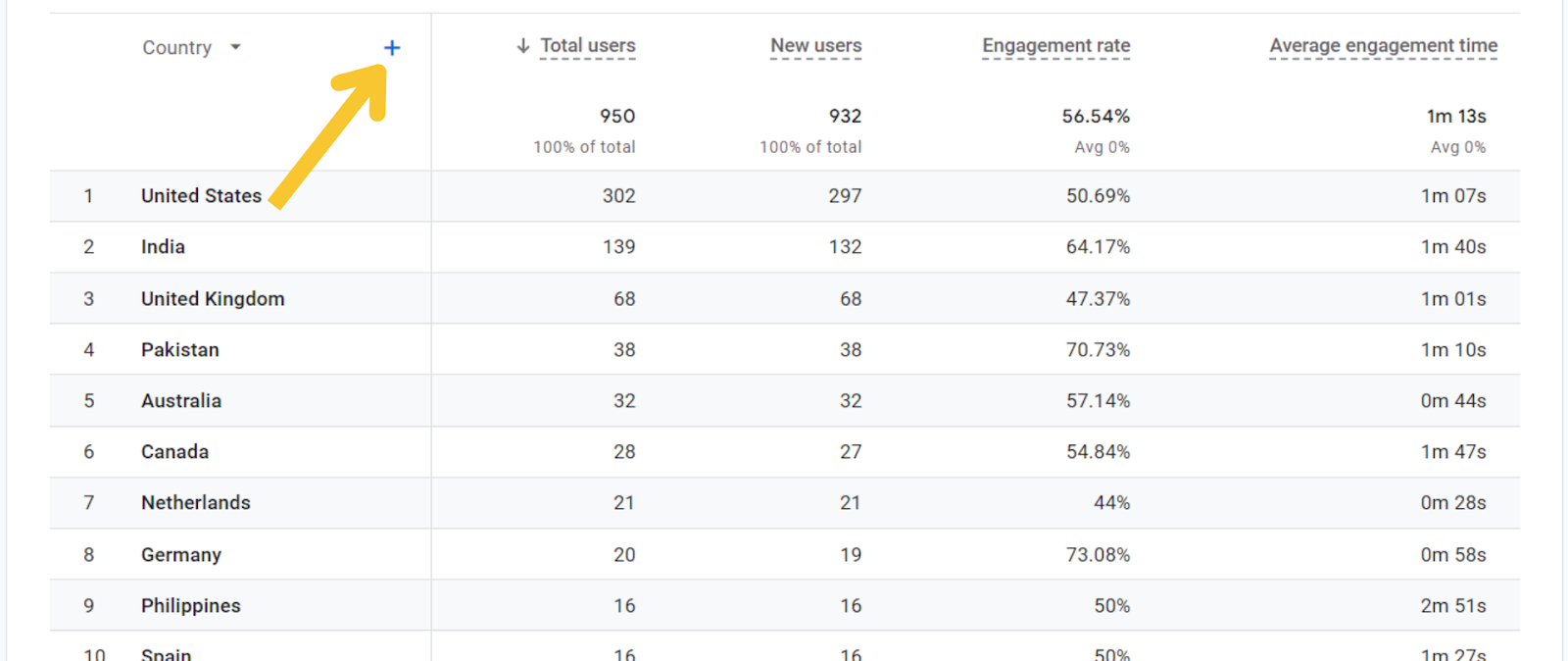
The second dimension can help you here. Click the little “+” icon on the right of the first dimension, “Country.”

Click the 'plus' icon to choose a dimension in GA4

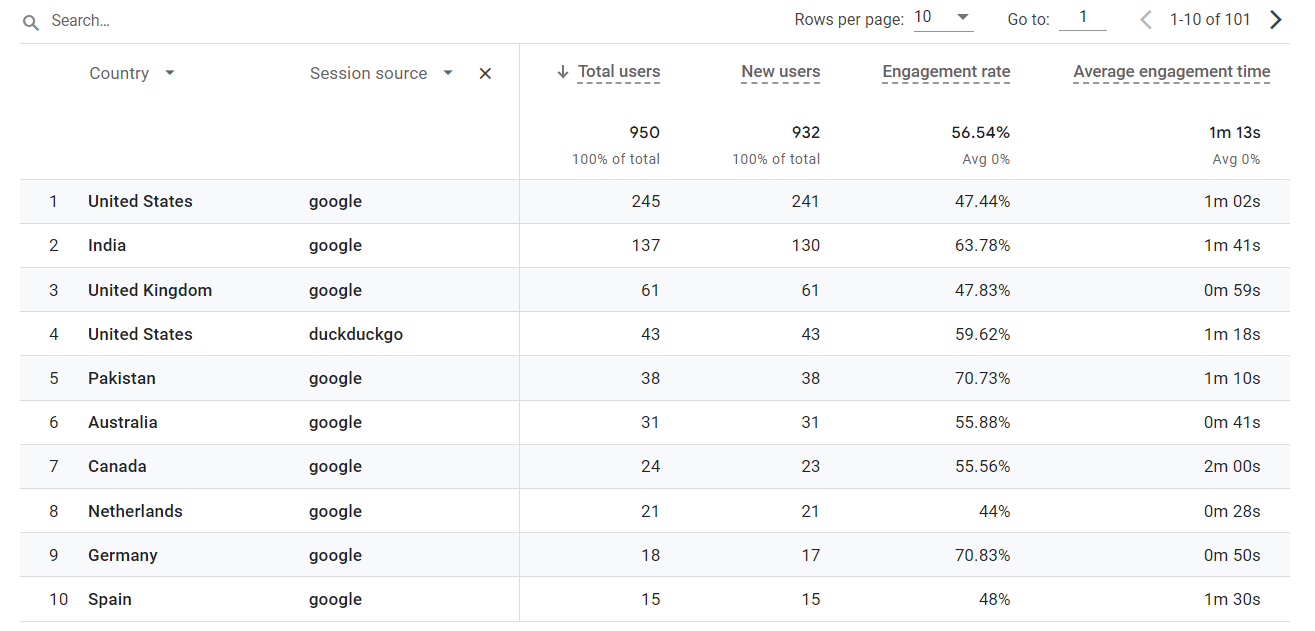
Select traffic source and then select session source.

This will give you specific data about the total users coming from:

  1. Different countries

  2. By a particular organic medium

report showing users coming from a particular country or origin

You can add additional metrics to understand the data better.

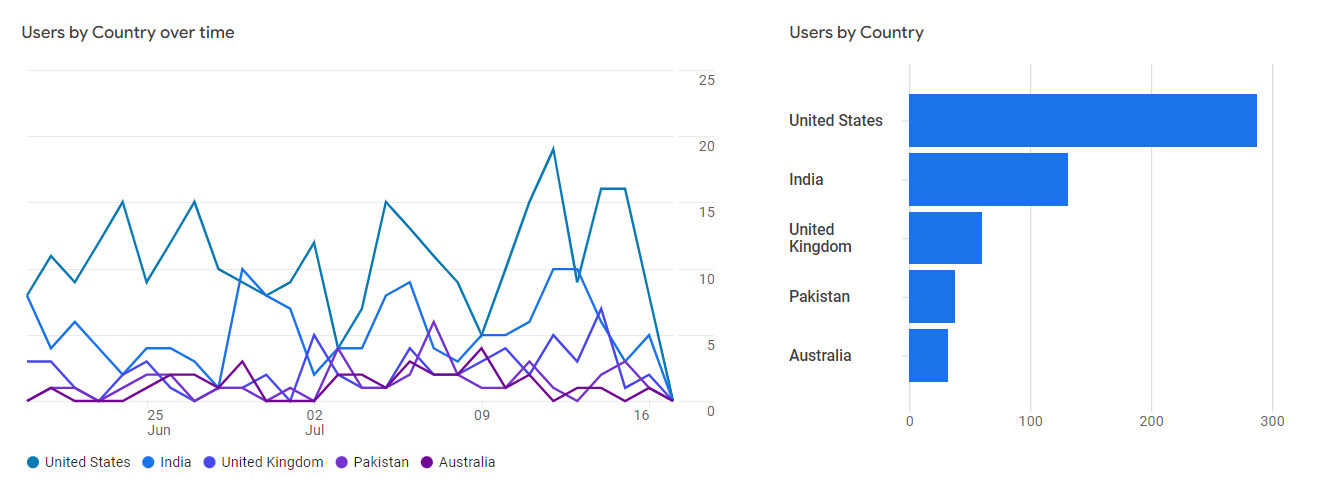
choose a line chart or a bar chart to suit your needs

As you can see, there will be two different charts, one is a line chart, and the other one is a bar chart. Whichever suits your needs, you can choose it.

You can also create summary cards according to the report so that you can see them in the overview reports.

This particular report will help you understand a specific metric. It will ensure that you and your stakeholders can make informed decisions.

When you have published a report, you can do things like:

  • Change the data range to find data over a period of time

  • Do MoM or YoY comparisons

  • Build a comparison to compare the data against other dimensions

  • Add filters to include or exclude a dimension

  • Share your reports with your teammates or stakeholders.

How to add metrics and dimensions to Custom Reports?

If you’re working with a template, then you will have predefined metrics and dimensions present in the report.

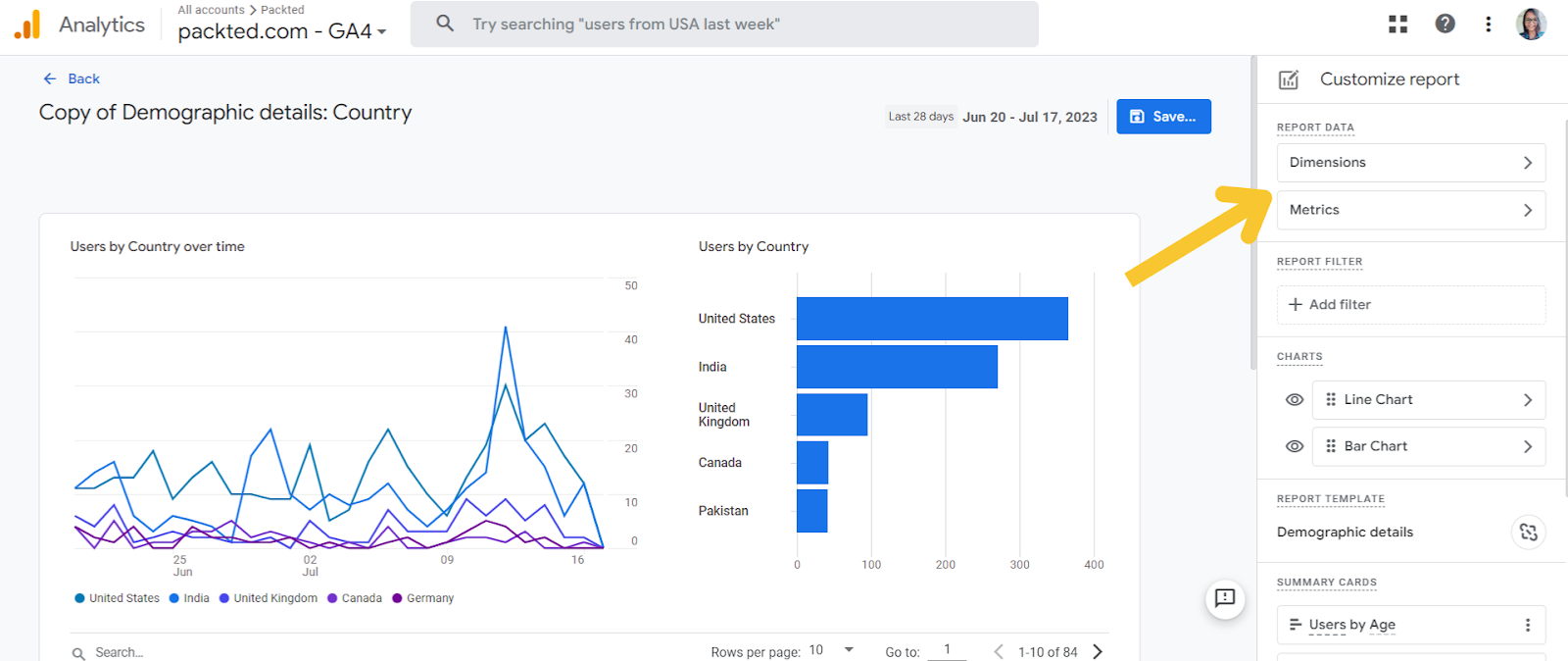
In every custom report, you can access the dimensions and metrics from here:

Customize your report with dimensions and metrics

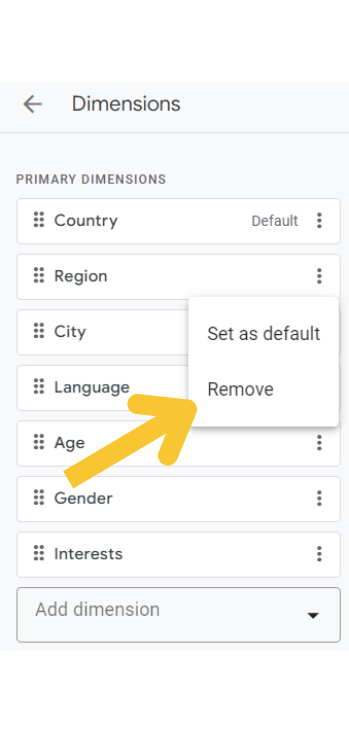
For example, the above image shows the demographics detail template. To check the dimensions, we will click on ’Dimensions’ and we will then be able to see all the default dimensions, which will look like this:

A list of all default dimensions in GA4 custom reports

You have the freedom to choose any dimension and metric you want. When you’re making custom reports, you won’t require all dimensions and metrics, it depends on your goals and what you actually want to see in a report. You can remove and add any dimension from the ‘Add dimension’ dropdown.

If you want to make any dimension a default, then you can click the three dots to the right and choose “Set as default”. This will make it the default dimension in the report.

Set a dimension as default in GA4

In the above example, we only want the ‘Country’ as our dimension. So you can remove all other dimensions by clicking the three dots and selecting “Remove”.

Remove dimensions by selecting the three dots on the right and then 'remove'

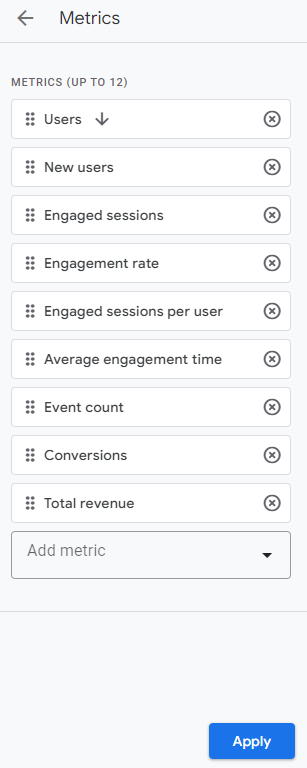
Similarly, when you click on metrics, you will get all the default metrics like:

A list of default metrics in GA4

As you saw above, we want to choose ‘total users’ as the main metric, but we don’t see it in the default metrics list. To find the total users, you can click on “Add metric,” and from there, you can select total users and add it to the list.

You’ll see that there’s a small arrow beside the ‘Users’ metric. This means that this is the primary metric, and, by default, it will sort the data from highest to lowest. If you want to make another metric as the default, then you can just click on that metric, and it will become the default one. And if you click on it again, it will sort from lowest to highest.

You don’t want to show every single metric in your custom report, so you can remove the ones you don’t want by clicking the cross on the right of the metric.

Standard reports in GA4 are only made to show general data. Finding and accessing important metrics can take some time, especially when you’re handling a lot of projects. Also, getting your SEO recommendations implemented is not always guaranteed with standard reports, as it can be hard for executives and stakeholders to understand the data correctly.

That’s where custom reports come in. You can add all of your important dimensions, metrics, filters, and more to get the data you care about. This will aid you in making informed decisions, and stakeholders will be also able to understand the data better, as it will be organized and presented in a better way.

source https://moz.com/blog/leverage-ga4-custom-reports

Categories
Digital Marketing

How to Earn Topical Authority in 2023 and Beyond

This was originally published on June 8, 2022, and has been refreshed with new and important information and images.

Topical authority isn’t a new concept, but as Google’s drive for helpful content is showing no signs of slowing down, topic authority is not something to ignore.

Topical authority is closely linked to E-E-A-T (Experience, Expertise, Authority, and Trust), and as of May 2023, it’s confirmed: topical authority is a system Google uses to determine which experts are most helpful to a searcher’s news query.

You can expect topical authority to weigh into your chances of ranking. Whether you’re reporting on the news or not, there are a lot of crucial takeaways for all sites on the subject of authority and how to rank higher. So, read on as we deep dive into topical authority: what it is, a step-by-step guide on how to earn it, and how you can measure success to get buy-in to your new SEO strategy. Plus, in the end, I put everything together into a quick case study in a highly competitive niche.

This is a comprehensive guide, and my goal is for you to feel highly confident in the power and execution of topic authority by the time you’ve read it.

Let’s get into it!

What is topical authority?

Topical authority is a system used by Google to determine which experts or publications have the expertise to cover news-related queries in niches such as health, politics, or finance.

Topical authority is a system used by Google to determine which experts or publications have the expertise to cover news-related queries in niches such as health, politics, or finance.

While topic authority is related to news-type queries, you want to consider building it no matter what you cover. If Google is using the topic authority system for news, there’s every chance they’re using it for other queries. Plus, becoming an authority on a subject (and proving it) just makes sense. You want your buyers to trust you, right? Showcasing authority helps them do exactly that.

How topical authority works in 2023

Through proven expertise, you build authority and trust in your field. You can showcase expertise and trust by publishing high-quality, informative content, refining your internal linking strategy, citing authoritative sources, and receiving high-quality, relevant backlinks.

Topical authority makes sense. We all want to buy from the best and most authoritative sources in the real world, right? The goal is for your site to be perceived as a trusted source of information on a particular topic.

Let’s look at content, links, and authorship to see how each element plays into topical authority.

Content clusters

To be topically authoritative, you need to focus on content clusters. These content pieces should be written by – or at least cite – highly qualified sources.

Your website must serve your web users, answer all their questions, and provide high-quality content at every step of the buyer journey.

To secure ranks, you need to showcase authority on your site’s subject. Google needs to trust you before it sends traffic to your site. We know this because Google is committed to showing its users the most helpful content and uses site-wide signals to gauge helpfulness.

Screenshot from Google Search Console Blog showing the text relating to helpful content.

For example, if you’re selling skincare products, it’s not enough to put products on your site and expect to rank for keywords like ‘skincare,’ ‘skincare products,’ or ‘skincare for dry skin.’

If you want to showcase authority, you should cover all the questions your audience is asking. You might also cover topics such as:

  • Use cases or success stories

  • Skincare routines for various skin types

  • Ingredients and how they benefit the skin

  • Tips and guides for using various skincare products

The list could go on and on. You want to develop a content strategy that aims to cover every type of query or question related to your topic. This topic coverage shows Google you know what you’re talking about. Better than that, it provides your brand with content that helps your user build their trust, and it’s something to share within other marketing channels, too.

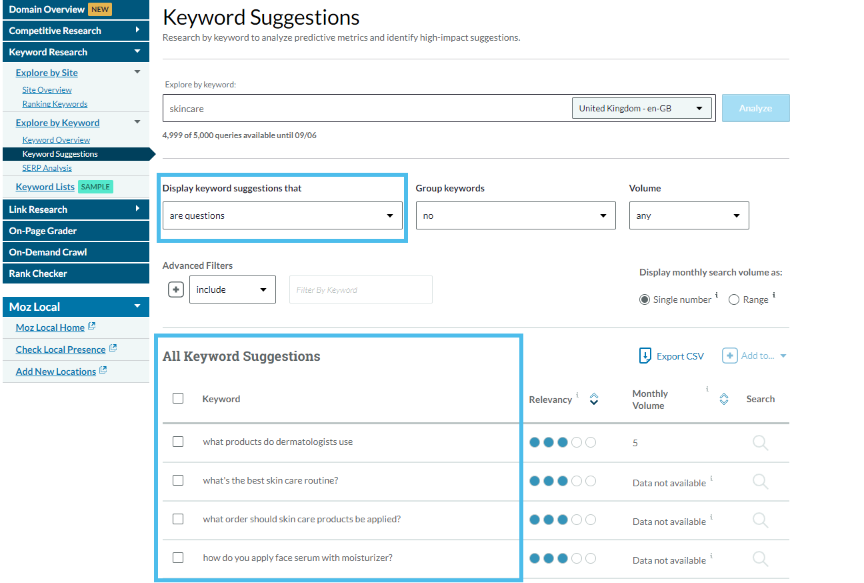
We’ll get into the step-by-step guide to building topical authority later, but for now, know that you can use Moz Pro to identify all the queries your users are searching for, which can help you decide what to write in order to build topical authority.

Screenshot from Moz Pro’s Keyword Suggestions report to demonstrate how a user can find topic inspiration to build topical authority.

If you were a skincare brand, you might start answering some of the queries discovered by Moz Pro above. And there’s a lot more where that came from, too!

In his video, Louis Smith explains the power of topical clusters for e-commerce brands.

Topical clusters are not limited to e-commerce sites; whatever your site, you need to build authority.

Internal linking

Internal linking is what groups your clusters together. Remember, you want Google to know you’re an authority on your website’s topic. You want Google Bot to crawl relevant pages after relevant pages on your site.

Internal linking is how you achieve that.

Most likely, you’ll naturally internally link your website content as in many cases, it just makes sense!

You want to be mindful of your clusters and where you want to link as you’re writing articles. Sticking with the skincare example from above, if you wrote an article on a skincare routine, you might link to another article titled, ‘The Benefits of a Skincare Routine.’

You can link in-line (within the body text of your article), you might showcase a particular article in a banner style, or you could add a ‘you may also like’ section at the end of your article. Within this section, you’d feature articles related to the topic. Take a look at the example from Moz’s blog.

Screenshot shows Moz's read next section, a demonstration of internal linking done well for building topic authority

In the screenshot above, taken from Moz’s article titled, ‘TikTok SEO: Understanding the TikTok Algorithm,’ you can see the ‘Read Next’ section with three related articles. The ‘Understanding the TikTok Algorithm’ article is clearly part of a social media cluster, so three relevant articles include content around Twitter, more on TikTok, and social media.

Repeat internal linking strategies just like this on your website!

Authoritative authors

Doesn’t it make sense that the most authoritative authors get the top ranks on Google? When you’re researching, you want to hear from the people who know what they’re talking about, don’t you?

Google wants to make its users’ lives easier, and it does that by putting the most helpful results at the top of Google.

Additionally, Google and other search engines are constantly trying to identify true authoritative sources from those that are not (for example, AI-generated content).

To help Google identify an authoritative author, try:

From the latest update on the Google Search Central Blog, we know that source reputation weighs into topic authority, so don’t hold back; show that your author is authoritative and reputable.

Screenshot of Google Seach Central Blog with lightbox highlighting the section related to source reputation for topical authority

Cite authoritative sources

You might not have the best of the best author writing for your site when it comes to authority, and even the most successful thought leaders don’t know it all. Thankfully, you can still bring some authority into your articles by showing, through citations and external links, that you’ve done your homework.

If you researched to write an article, say that and link to it—link only to authoritative sources that you (and your readers) can trust. Don’t be nervous about external links; they help you and add value to your readers.

Get backlinks

Unlike Domain Authority (DA), a third-party measure of website authority, topical authority is more of a quantitative measure of how authoritative a site may be.

DA looks primarily at backlinks and the number of high-quality, relevant backlinks. Topical authority is proven expertise built over time by accurately covering the breadth and depth of a topic with reliable sources.

However, backlinks will still play a role in your success in earning topic authority. We can see that in the Google Search Central Blog.

Screenshot of Google Seach Central Blog shows how backlinks have an impact on topic authority

Influence and original reporting result in a ‘highly cited’ label. And how does Google know that a page is highly cited? You got it, backlinks.

The takeaway here is that you want to create content that is so good, informative, and useful that other people will cite and link to you.

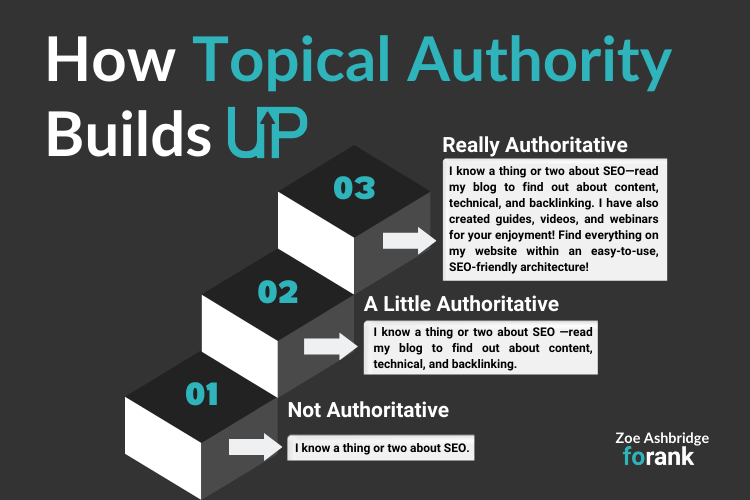
Infographics shows the stages of topical authority and how it builds up

Why is building topical relevance important for SEO?

If you reach out to someone for a service or product and they speak confidently and passionately about their offering, answer all of your questions, and understand your needs, then you’re more likely to trust them.

Why should the internet be any different?

Your buyers are drawn to your offering, your expertise, and your passion. Buyers also want to know you can help serve them and that you understand them.

In the digital world, content is how you nurture buyers. Where Google is concerned, topical relevance proves to search engines that you’re trustworthy and knowledgeable. We all know that Google wants to show its users the best possible content from the most credible sources.

If you reach out to someone for a service or product and they speak confidently and passionately about their offering, answer all your questions, and understand your needs, then you’re more likely to trust them.

Why should the Internet be any different?

Your buyers are drawn to your offering, expertise, and passion. Buyers also want to know you can help serve them and that you understand them.

In the digital world, content is how you nurture buyers. Where Google is concerned, topical relevance proves that you’re trustworthy and knowledgeable to search engines. We all know that Google wants to show its users the best possible content from the most credible sources.

You know a thing or two about your product or service, so prove it to Google through content. Cover related topics, hit keywords, and present information in a way that’s easy for your user (and Google) to understand.

A step-by-step guide to building topical authority

Topical authority allows you to showcase why someone should buy from you. In doing this, you build trust and authority with Google, encouraging the search engine to see you and your site as the subject authority that deserves to rank.

To be the most authoritative site, you must cover everything your competitor is and some more. Plus, you want to create different types of content to appeal to your audience (videos, guides, etc.) This is why you’ll find long-form content, many headings, images, and video in this article.

Once your site starts looking more authoritative and helpful, why would Google prioritize a competitor site when it perceives your site to have the most helpful information?

There’s one key thing to remember: when ranking on Google and earning favor in the algorithm, you need to use keywords in your content. As you center your strategy around creating high-quality articles, you must be cautious of keyword cannibalization.

There’s also what I call topical cannibalization. To build topical authority strategically, you need to know how to build out your content architecture effectively. I’m going to walk you through that now, step by step.

1. Research your topic.

Before you can build out your content strategy, you need to research your topic. You’re looking for the search terms your buyers are typing into Google to solve their problems.

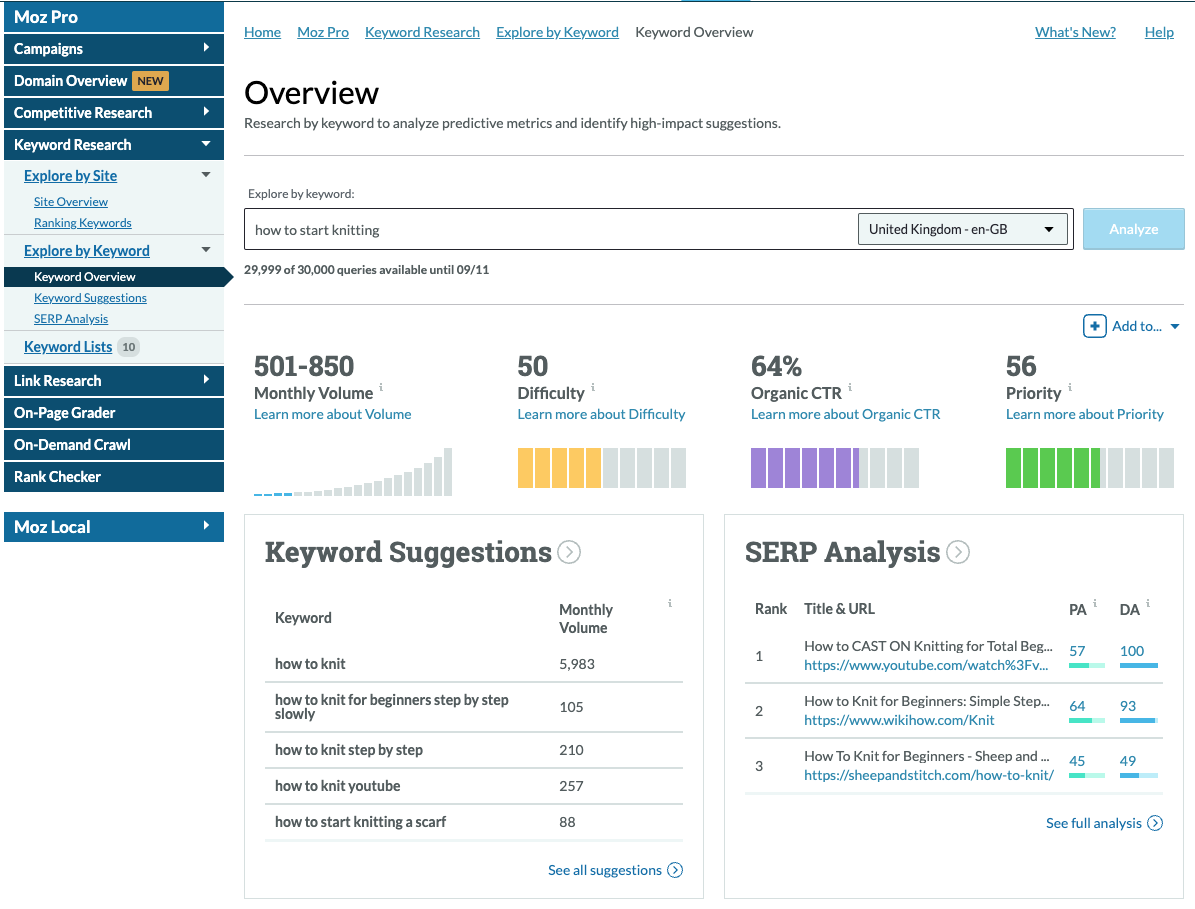
Here, you can turn to keyword tools like Moz’s keyword explorer. Type in a keyword (or your topic) and see what’s suggested. You will find exactly what terms are being searched in Google so you can use them within your content and rank for them.

Let’s use the subject of knitting to illustrate this.

Results for the keyword 'how to start knitting' in Moz's Keyword Research tool

Moz shares keyword suggestions, many of which can form part of your content strategy. Remember: covering all relevant topics helps build topical authority.

Social media sites like Quora and Reddit are also helpful. Within these sites, you can see what discussions your audience is having. You’ll likely encounter their pain points, queries, and buyer apprehensions that you can solve, answer, or soothe within your content.

Finally, my favorite, people also ask (PAA). Want to know what your audience is asking? There’s a trove of information in there!

Screenshot of the 'People also ask' feature on Google, showing questions relating to topical authority

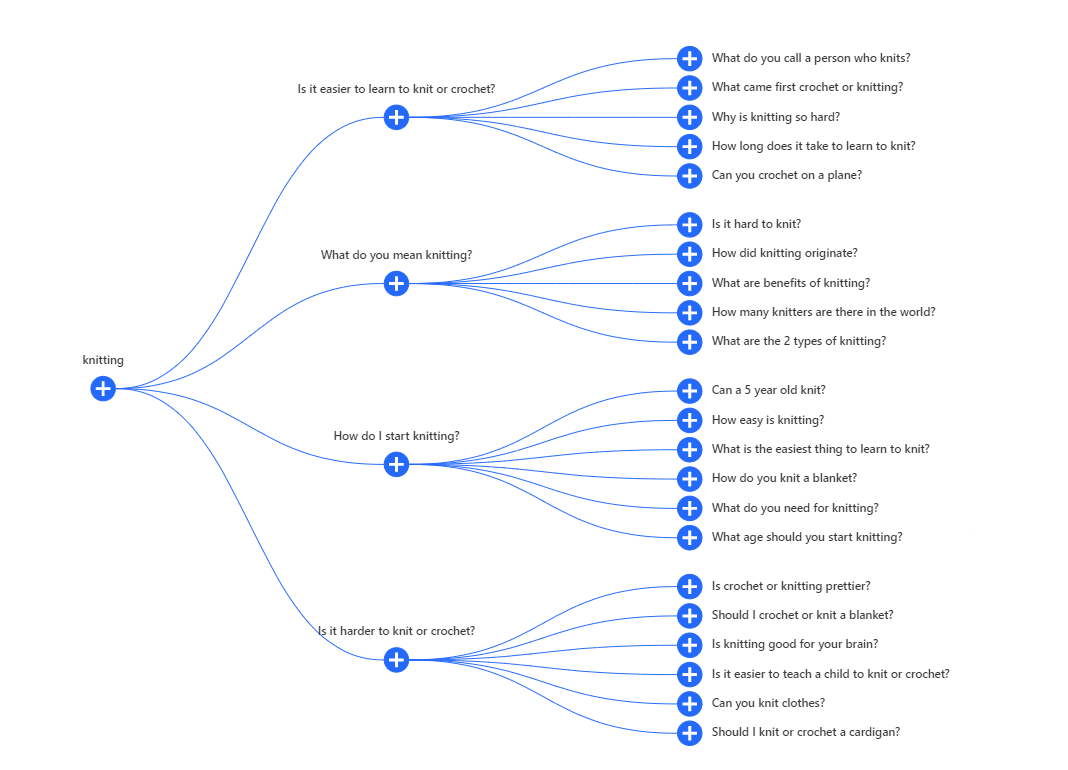
Tools like AlsoAsked make light work of PAA, allowing you to view PAA data in a visually appealing, hierarchical structure. There’s a lot of opportunity to build topical authority in any niche. Just take a look at knitting as an example!

The tool 'AlsoAsked' showing questions relating to a People Also Ask snippet on the keyword 'knitting'

2. Create pillars and clusters

When researching your topic, map out every single piece of content that you want to create based on what your audience is searching or looking for. I like to do this in a large Excel spreadsheet or Google Sheets.

Take note of the content you will create in one cell; next to it, list the focus keyword and all supporting keywords.

You’re going to cover every single query or question within your content.

Then, you’re going to work on assigning keywords to the pieces. This is the crucial step that prevents keyword and – as I call it – topical cannibalization.

3. Map keywords to content pieces using SERP analysis.

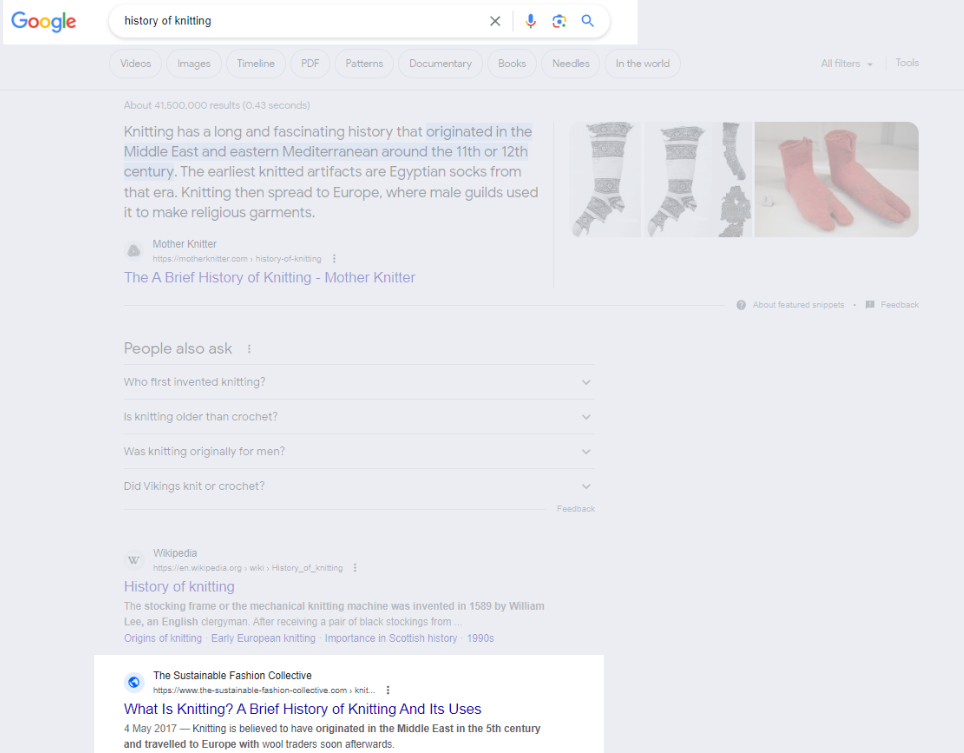
When mapping keywords, it’s easy to assume that every keyword needs its own page. Take the knitting example: if you dig around in the keyword suggestions, you can find ‘what is knitting’ (590 searches/month) and ‘history of knitting’ (480 searches/month).

A quick analysis of the SERPs shows that these two keywords can perform well in SERPs used on the same page. You don’t need to write two articles. Two articles could result in what I call topical cannibalization.

Here’s a screenshot from the SERPs when searching ‘what is knitting.’

Screenshot of Google SERPs with a lightbox demonstrating how topical authority helps ranks

The Sustainable Fashion Collection has a rank two position, likely the best rank they can achieve considering they’re competing with Wikipedia. From the title tag, we can see the article targets keywords ‘what is knitting’ and ‘history of knitting.’

The screenshot below shows they’ve successfully done so, too.

Screenshot shows a keyword ranking one article that has achieved some topical authority with many keywords ranking.

The article ranks successfully for both keywords. The point is that you don’t have to create articles for every single keyword or query. You can create long-form articles, which brings me to my next step nicely.

4. Write high-quality, well-researched content.

When planning your content, look for opportunities to write quality, well-researched, long-form articles instead of just trying to publish as many as possible.

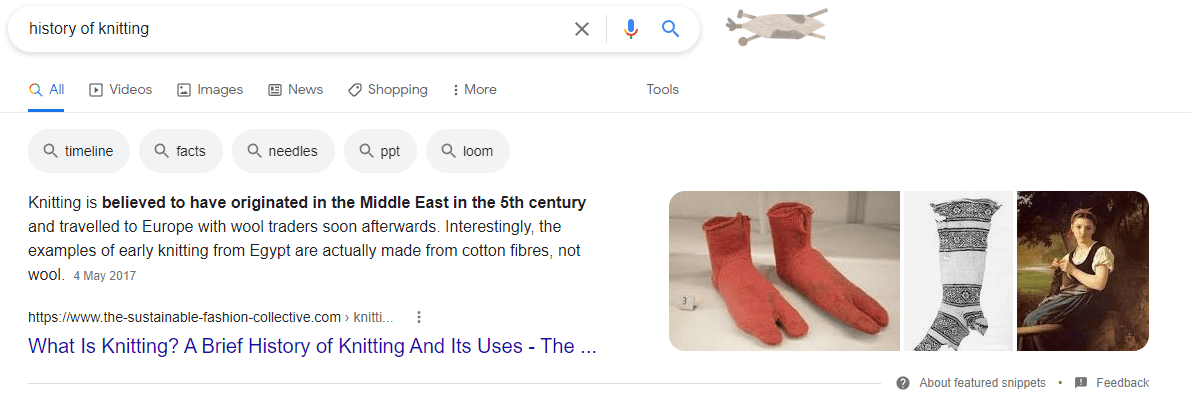
Instead of writing two articles, consider writing one more in-depth article like sustainablefashioncollective.com did. As we’ve established, their article features high up on the SERPs for ‘what is knitting’ and has a featured snippet for ‘history of knitting.’ It’s also on page one for ‘knitting uses’ (20 searches), plus 28 other keywords.

The keyword 'history of knitting' searched on Google.

5. Share it with your audience.

There’s no need to wait for your page one rank before you get eyes on your article or page. Share it with your audience, use social media, and present content to your subscribers through email. Try repurposing content and creating videos.

Using your content in this way can prove its value to decision-makers, too. I’ve gone into this in some detail below. Check out the section, ‘Measuring the impact of your authoritative content.’

A brief history of authority in Google SERPs

Although topical authority has been a buzzword with increasing interest since 2022 (see trend below), it’s not a new concept. Since its inception, Google has been refining SERPs through algorithm changes to provide authoritative sources.

topic authority is a search term that's been searched for years, as seen in this screenshot from Google trends. The trend line is increasing with more prominence in 2022

Let’s look at the clues through SERP history that show that topic authority is a big deal when it comes to ranking.

2023: Topic authority system and news

This is where we are right now and exactly what we’re talking about in this article. Google uses a topic authority system to determine the most trustworthy sources to report and rank for newsy queries.

2018: Medic and topical authority

Google’s desire to present only the most useful information was made clear (if it wasn’t already) in 2018 through the medic update. In 2018, the medic update impacted all verticals, predominantly health.

It was a positive update, encouraging everyone to improve content production. The update meant that instead of writing content in isolation and expecting it to rank well, content needed to showcase experience, expertise, authority, and trustworthiness (E-E-A-T).

And it makes sense for this standard to be upheld across the web, especially when we consider that more pieces of content are being published than ever before. In short: post only the most well-written, well-informed articles on your website if you want to stay competitive.

What we learned from medic relating to topic authority: Though medic focused primarily on medical content, it impacted all verticals. Your site should showcase authority through E-E-A-T.

2013: Hummingbird

Hummingbird took inbound links and keywords into account; this update emphasized content relevance and authority. It marked a shift away from keyword stuffing and towards the importance of the quality and relevance of content.

What we learned from Hummingbird relating to topic authority: Create content in clusters and link them together. Top tip: Where natural, use the keyword you want the linked-to page to rank for in the anchor text.

2012: Google launched Penguin

Penguin launched on April 24, 2012, and impacted around 3% of searches. This new and impactful algorithm tackled webspam, including keyword stuffing and backlinks.

The backlink layer of this algorithm update is most related to topic authority; it wasn’t enough to have a high number of backlinks after Penguin launched. Instead, web admins needed high-quality, relevant links to prove their site authority.

What we learned from Penguin relating to topic authority: Focus on quality link building – just write linkable content – instead of focusing on quantity or poor quality links.

2011: Google launched Panda

Panda launched on February 23, 2011. The new algo targeted low-quality sites that lacked authoritative content. Sites with thin, duplicate, or plagiarized content suffered, while those with in-depth, valuable, and unique content were rewarded. Some things never change; Google always wants quality content that provides genuine value to the reader.

What we learned from Panda relating to topic authority: Aim to write long-form content that helps your user. Avoid writing short web pages for the sake of it.

These algo updates are just a handful in a long and complex history. But from just these updates, you can see that authority is a pretty big deal, right?

Measuring the impact of your authoritative content

As an SEO reading this article, you might think about how you will

  1. Sell in increased content production to decision-makers.

  2. Prove it works.

Naturally, topic authority isn’t a majestic strategy that’ll work overnight. Still, it is crucial and powerful for ranking, building trust (with Google and your audience), and getting qualified traffic to your site.

With SEO being a slow mover, you need to get creative with how you can measure the impact of your authoritative content before you start earning clicks and conversions.

Increased visibility in SERPs

Look for increased visibility in SERPs using Google Search Console. You can gauge how much visibility your site is getting by looking at impressions. Generally, in content strategy, impressions is the fastest metric to move. You increase impressions before you earn clicks. An upward impression trend is a strong indicator that your content strategy is working. As you increase content production and authority, you can expect clicks to follow the impression trend eventually.

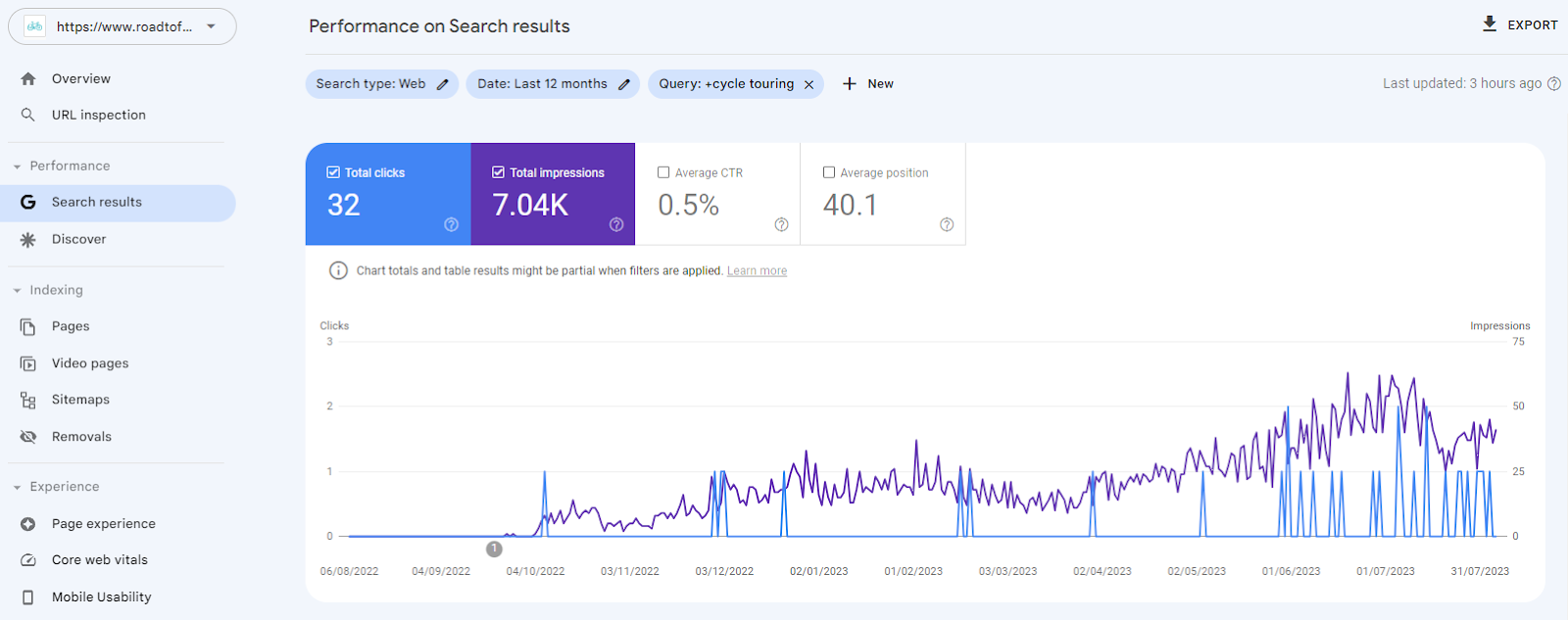
Screenshot from Google search console showing an upward trend of impressions. This demonstrates how topic authority and content clusters build website visibility

The screenshot above is taken from my blog, Road to Frame, a small website with low authority. It’ll be a while before the site earns many clicks, but the upward trending impressions, albeit small, indicate that the site is on the right path to earning more clicks for the head keyword. This was achieved through content production and working in clusters.

Assists in conversions

Businesses need to make money, and SEO can help them do that. Proving the role of SEO in sales will help you tremendously if you need to convince decision-makers to invest in SEO and content production for topic authority. With SEO tied directly to revenue, you’ll have an easier time convincing decision-makers to invest in SEO.

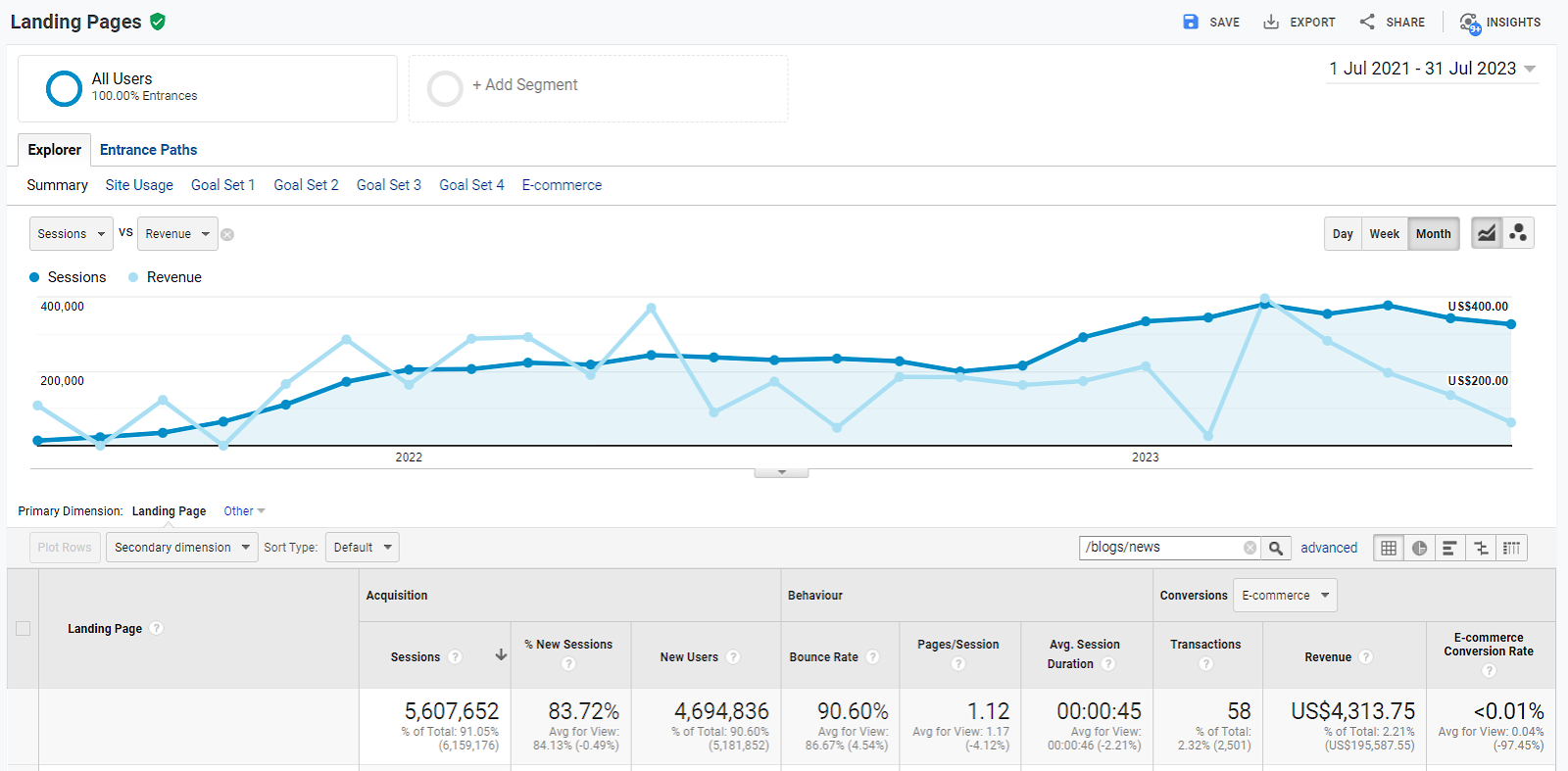
I like the landing page report to demonstrate how content contributes to revenue.

Note: This will only be effective if people buy directly from SEO efforts; if they’re not, Segment Overlap can be good. I’ve demonstrated this in the case study below.

Google Analytics screenshot shows the percentage of sales from content strategy

In my anonymous client’s Google Analytics, you can see how revenue, particularly between 2021 and 2022, increased with traffic. Blogs (not all of them ranking well) used as part of other marketing strategies (e.g. email or social media) had a direct impact on revenue. People who landed on a blog also bought an item. Any blogs that ranked, did so for keywords outside of brand keywords, meaning the revenue was directly attributed to SEO efforts.

While you build your authority for ranks on Google, you can prove the value of content in other ways. Sales from quality content are an indicator that the content built trust in the user.

Check your backlink profile

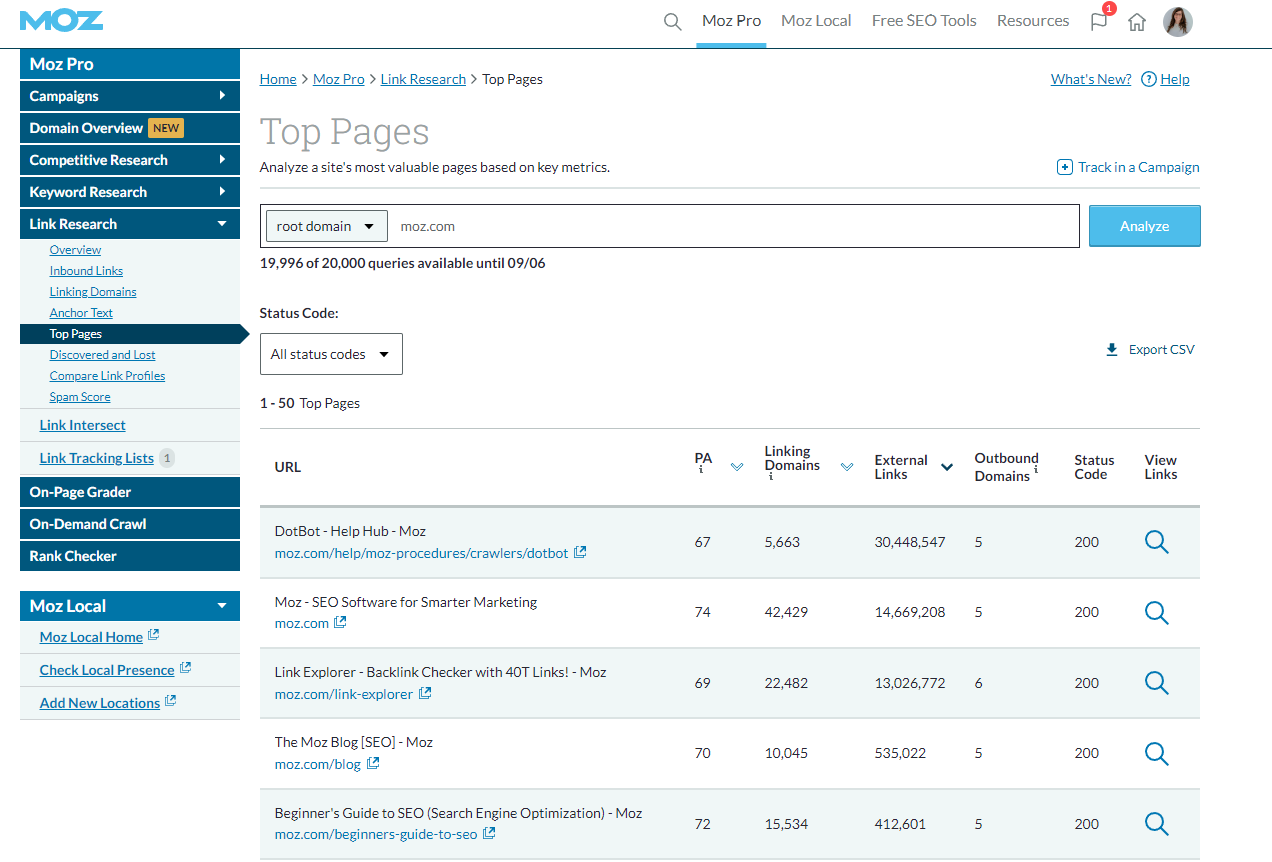
High-quality content will eventually earn backlinks from credible sources. You can use Moz Pro to take a look at which content is getting the most backlinks and also prove that credible websites are linking to your brand.

Topic authority and content creation helps increase backlink profiles. Screenshot displays external links to Moz's top pages

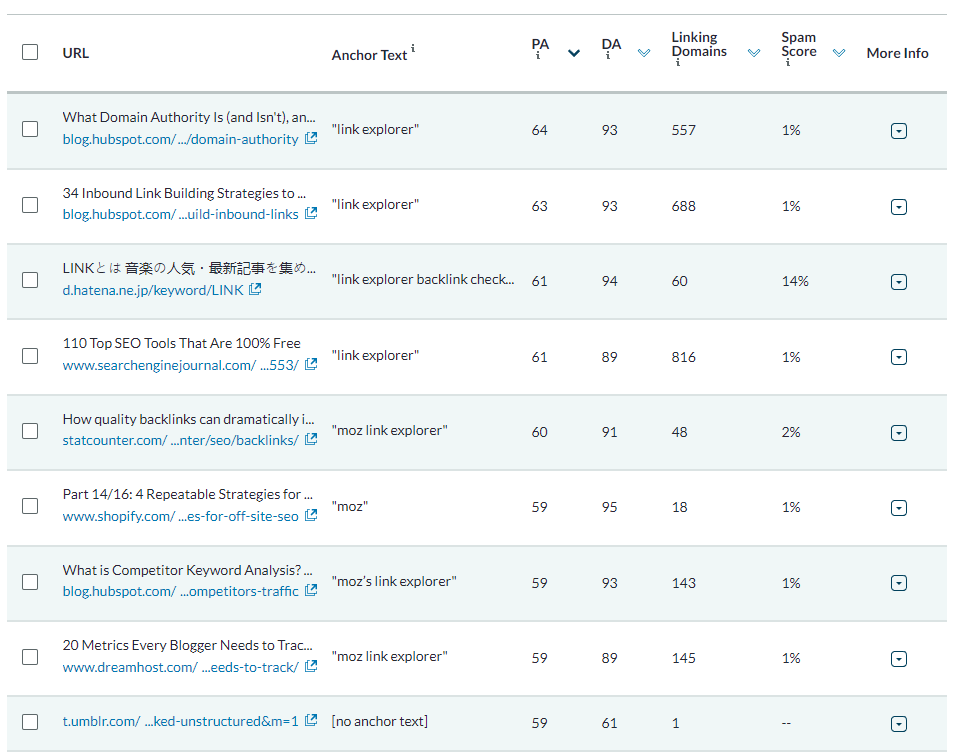
After the homepage, Moz’s most linked page is the link explorer. You can click the magnifying glass to view the links. There are some highly authoritative sites linking to Moz here! See HubSpot, Search Engine Journal, Shopify, and DreamHost.

Screenshot shows how Moz Pro can be used to demonstrate topic authority in action.

Top tip: you can take this measure a step further by proving traffic increases or revenue direct from the users sent to your site through your high-quality links.

Topic authority case study

Let’s put all of this together by looking at a real-world example using my client, Kineon. In the red light therapy market, Kineon’s competition is high. The site was new, with a low DA, in a niche that’s leaning into medical.

Ranking was going to be tough, but through topical authority, we were able to achieve improved ranks; in less than six months, the blog went from earning zero clicks to 1,280 and one cluster contributed to 7% of overall revenue. The screenshot below demonstrates the continuous success despite market and website challenges.

Screenshot from Google Search Console proves the case study's success using topic authority to build clicks

We achieved this by:

  • Using Google Search Console to identify where the site, although small, already had authority. We found the site was getting the most clicks for queries related to the knee and red light therapy.

  • We researched as many queries and questions as we could find on this subject. We used Quora, Reddit, and People Also Ask.

  • We created a keyword map and assigned keywords to pages.

  • An in-house writer created content.

  • Content was linked together where natural and using a ‘you may also like’ section at the end of each article.

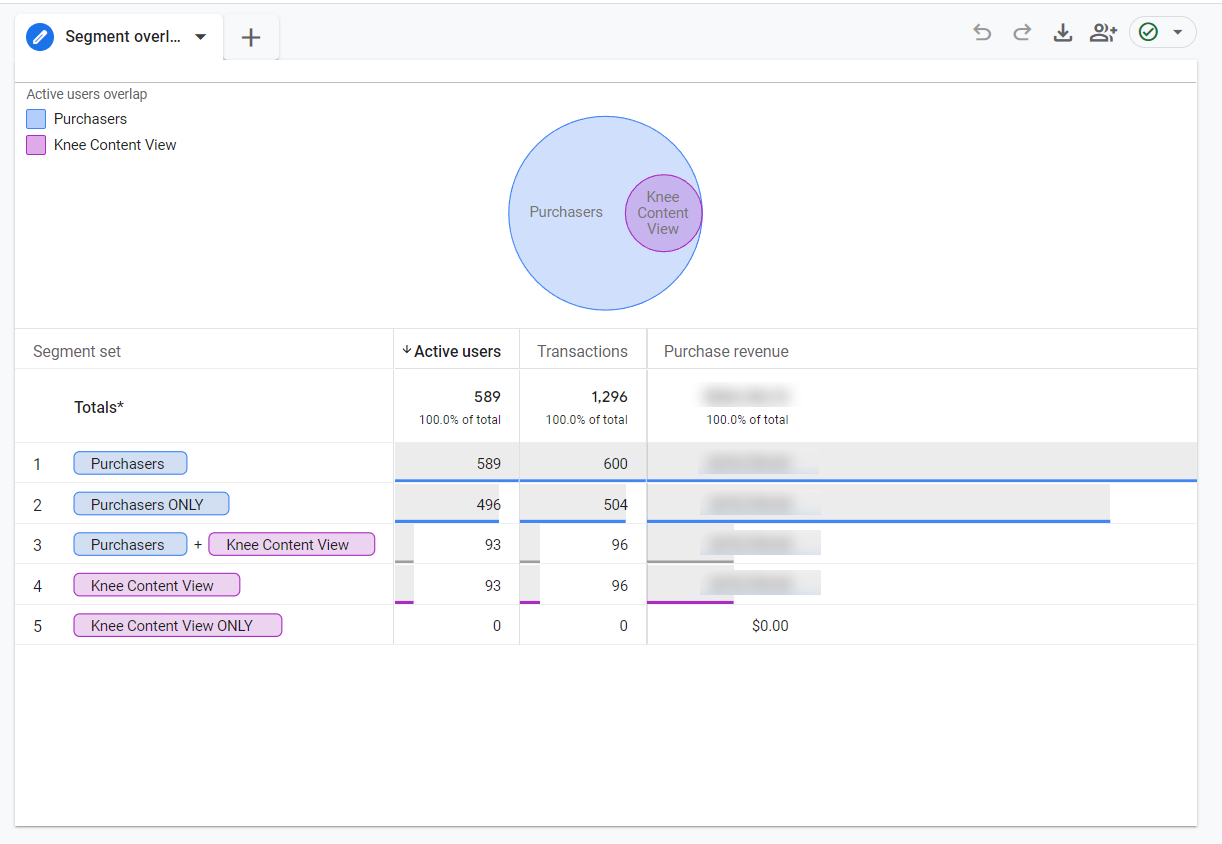
While SEO was taking its time to work, we measured the value of the content by using a segment overlap report in G4.

I have blurred the revenue to protect client data, but you can see the overlap between people who viewed a blog on the subject of the knee (the smaller circle) at 7% of the size of overall purchasers (the larger circle). This graph is for July 2023 only.

Segment overview shows how content created to build topic authority contributes to the sales journey

To support SEO efforts, we started an intentional and high-quality backlinking campaign, resulting in backlinks from highly relevant sites. Backlinks drive traffic and revenue.

Quick tips for earning topical authority

Infographic lists quick tips for earning topical authority

The steps above briefly detail the steps you can take to help build topical authority over time. Here are some final steps to integrate into your content plan:

  • Identify new trends and write about them.

  • Cluster your keywords and cover a topic in full based on SERP analysis.

  • Keep up with current events related to your topic and cover them timely.

  • Don’t be afraid to share something new — just because it’s not on the SERPs doesn’t mean you can’t be the first to say it.

  • Don’t be afraid to link out to trusted sources. Referencing other materials is a great way to show you’ve done your research.

  • Update your content to keep it fresh. For example, if a page is dated with 2022 data, it might be time to update it and make that article relevant to 2023 and beyond.

How can you tell if a website is authoritative?

There are many ways to work out if a website is authoritative. You can use the following ways to tell if a website is authoritative:

  • Check the Domain Authority

  • Check your Brand Authority

  • Look out for indented SERPs

  • Check organic keywords

  • Strong internal link profile

  • Well-written, informed content

Check the Domain Authority

An SEO favorite is Domain Authority (DA). Although we’re focusing on topical authority here, Domain Authority is still a measure of an authoritative website. The DA score is a number between 1 and 100 which indicates the website’s strength in search engine results pages. There are several factors that feed into this algorithm, and backlinks are one of them.

Simply put, the more high-quality, relevant backlinks a site or content piece has earned, the higher your domain’s authority will likely be. After all, other websites tend to link to highly authoritative websites.

Check your Brand Authority™

Brand Authority is Moz’s new metric that can measure a brand’s strength, on a scale of 1 to 100, showing how authoritative your brand is online. Using Google’s rich results and brand signals, a wide variety of brand terms are detected to understand how often people are looking for your brand, and thus a score is computed.

Where Domain Authority measures your website’s ability to rank on search engines, Brand Authority measures your broader influence across marketing channels.

Look out for indented SERPs

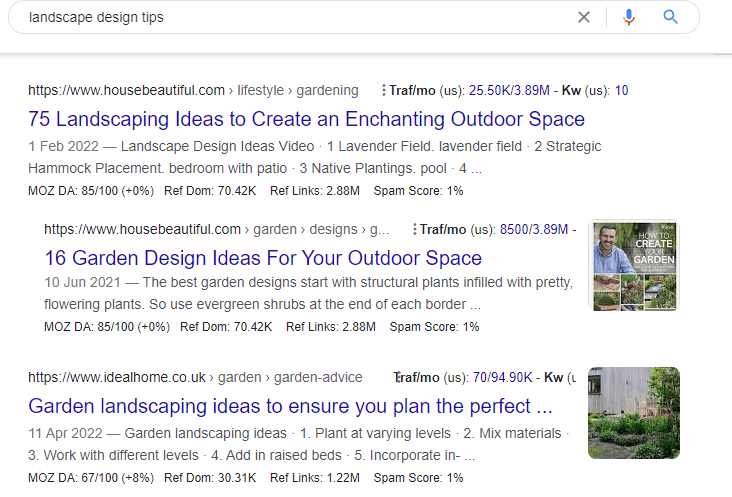
Indented SERPs are a strong indicator that a site is topically relevant. If you search a keyword such as: ‘landscape design tips’ (90 searches/month), you might find housebeautiful.com and its indented search results.

Indented SERPs are where similar topics that exist on one website are grouped together, giving the site more prominence in search results.

The keyword 'landscape design tips' searched on Google and the results that follow

Check organic keywords

Generally, the more keywords a site ranks for on a topic, the more topically authoritative it will be.

SEO tools provide some insights into what your competitors are ranking for. They can also share topic ideas for how you can close the gap by covering the same topics.

If you do cover the same topics, remember to add more detail, more media, or a unique perspective.

Strong internal link profile

Assuming a site is using internal linking well, a strong internal link profile should demonstrate that a site is authoritative on a subject.

Take ‘beginners guide to SEO (480 searches/month) as an example. For this keyword, Moz is in position one.

The keyword 'beginners guide to seo' searched on Google and the results that follow.

A quick internal link analysis tells me there are 26 links within content pointing to this page. Links are coming from pages such as On-Page Ranking Factors in the ‘learn’ section of the website. This is a highly relevant topic for beginner guide SEO.

Well-written informed content

If you’re on a website and you’re discovering well-written, high-quality, original pieces of writing, then it shows that the site has some topical authority.

If the site is also updating this high-level content regularly, it’s probably earning topical relevance.

Do backlinks still count toward website authority?

Yes, backlinks still contribute to website authority. We can also predict that backlinks will continue to be helpful toward SERP rankings — but they’re not everything.

Backlinks needn’t be your goal when it comes to topical relevance. They will happen naturally as you earn visibility in SERPs and write high-quality, linkable content. Authoritative sites will continue to earn backlinks at a higher rate than non-authoritative sites. Plus, having topical authority can only help you attract links from other websites.

Final thoughts on topical authority

Building authority on a subject should come easily. After all, this is the topic you loved so much you built a website to share your expertise on it, right?

Reach out to your subject matter experts, ask them questions, and get to writing.

Be creative with what you put out there, repurpose your content, answer questions, and nurture your buyer.

Follow my steps above, and don’t be afraid to inject some new information into the SERPs. Your buyer wants to know you and your business! The extra efforts go a long way when it comes to content.

Remember, content and topical authority in a digital world often replace face-to-face interactions. Show your buyer why you’re an expert, what you know about your subject and all the reasons why they should trust you.

If you’ve still got questions, feel free to drop me a message on LinkedIn.

{
“@context”: “https://schema.org”,
“@type”: “Person”,
“image”: “https://zoe.forank.com/assets/images/zoe.webp”,
“email”: “zoe@forank.com”,
“jobTitle”: “Senior SEO Strategist”,
“name”: “Zoe Ashbridge”,
“description”: “Zoe Ashbridge is the co-founder of forank. She is a senior SEO specialist and published author in notable SEO publications.”,
“birthDate”: “1990-08-23”,
“url”: “https://www.forank.com”,
“knowsAbout”: “SEO, writing, content strategy”,
“sameAs”: [
https://www.linkedin.com/in/zoeashbridge/”,
https://www.tiktok.com/@zoefreelanceseo”,
https://www.youtube.com/@zoefreelanceseo”,
https://blog.hubspot.com/service/author/zoe-ashbridge”,
https://searchengineland.com/author/zoe-ashbridge”,
https://moz.com/community/q/user/zoe_ashbridge”
],
“contactPoint”: [
{ “@type” : “ContactPoint”,
“email” : “zoe@forank.com”
}
]
}

source https://moz.com/blog/how-to-earn-topical-authority

Categories
Digital Marketing

Map Your Keywords to the Buyer’s Journey and User Intent — Whiteboard Friday

Rejoice takes you through how to map your keywords to both the buyer’s purchasing journey and the relative user intent.

Digital whiteboard showing the steps in the buyer's journey and how that translates to user intent

Click on the whiteboard image above to open a high resolution version in a new tab!

Video Transcription

Hi. So I’m Rejoice. I’m an SEO account manager for SEO Sherpa, and welcome to this edition of Whiteboard Friday. So I will be talking to you about how to map your keywords to your user intent and the buyer’s journey, so showing you a good framework to use when you’re building out your strategy, doing your keyword research, and sort of want to give that extra added value to your clients so they fully understand the whole point of keyword research.

So I’ll be taking you through the diagram. So we understand that we have the buyer’s journey, which is the journey the buyer takes from the start to the end in terms of how they can sort of build and create and solve their problems.

Awareness Stage

Image showing elements within the awareness stage of the buyers journey

So if we start with awareness, we all understand that awareness is when your buyer identifies that they have a problem.

So they become aware that they have a problem, and they need to find a solution. So within awareness, essentially any content you make or any keyword research you are doing, you want to find the type of keywords that would help your users or your users might search for them to either explain or be informed about something.

So what kind of keywords can we sort of look into? So there are something called keyword modifiers. Now we all know keywords can be short-tail, it can be long-tail, but the modifiers are sort of what helps us figure out the intent of a keyword or the purpose. So within awareness, the modifiers that we can have are what, how, where, and who.

So these can be modified to let us know that the buyer is within the awareness stage because that’s the type of keywords that they’re using. But furthermore, the intent behind it would be informational, because we all know informational keywords are utilized when users sort of want to be informed about something, again going back to the purpose of awareness.

So that’s informational- based keywords. Now we don’t necessarily always talk about the goal. Of course, we definitely know that awareness brings about explaining, brings about the informational intent behind it. But if we want to talk about the goals in which the user wants, we can classify it as Know and Know Simple. So Know just means your users are trying to know an information.

Know Simple would be those queries that they want the answers quickly. So what is Beyoncé’s age? That would be a Know Simple query because Google will just bring up her actual age without the user having to go into any website to look at that. So that is awareness. So it’s pretty simple, pretty basic, very easy to understand.

Consideration Stage

Image showing elements within the consideration stage of the buyers journey

But when our buyer moves across to consideration, now consideration is why they’re in this stage is because they know their problem. So they have a better understanding of what the problem could be, but they’re just trying to find the best solution for it. So that’s why it’s called consideration. They’re considering their options.

Again, in this stage, you will still need to explain to them what their options are, and sometimes you might have to demonstrate because this is where your users are going to look for options. So here we can maybe see content such as explainer videos or comparison guides as such. So the keyword modifiers that you tend to find are the best foundation for dry skin, or a review about Canon cameras versus this, or a review about iPhone versus iPad, all of those things.

You might start to see affordable. So now they know what the problems are, they might be looking for the best affordable option. So they might do a cost comparison. So these are the kind of modifiers that you can see and look up and know that, okay, these are what we need to serve to our users’ user intent. We come down to it being commercial because they might be looking to investigate further into products and services.

That is why they’re sort of trying to consider their options. So it would be commercial. But what’s the goal? The goal can be they want to be led to the right site. So a goal of sites just means that they are looking for that particular site that will help them, I guess, decide, help them move across to the decision stage.

But the whole point of this is you want to kind of create the kind of content that are sort of making sure that you’re targeting that user intent, that query that they’re looking for. So our buyer, they have the options. They’re looking at it, and they’ve picked the one best solution. So, of course, the next stage is going to be the decision stage.

Decision Stage

Image showing elements within the decision stage of the buyers journey

So in the decision stage, they want to, again, just find the best price. I know what provider I want. I know where I need to sort of go to to get this one solution. So again, you’re still going to explain. You’re still going to demonstrate. But how can you demonstrate within the decision stage? That’s easy — FAQs.

So we have FAQ pages answering key questions. So they land on your site. They know I want you to be that service provider for my problem. So I need FAQs. I need maybe case studies for me to read about other people’s things. I need reviews. I want to review products.

I actually want to see what people’s experiences are. So for that keyword modifiers, don’t be surprised when you start to see deals. When people know the products they want to find, they want discount codes. I do it all the time when I know I want to shop in like ASOS, so I want to find an ASOS discount code. Thus, I’ve already made my decision.

So you might see test. You might see, if you’re a service-based client, book now, so they want to book a particular service with this particular site. That intent will be transactional because they’re looking to either make a purchase, sign up, book a service, buy, or download something. So they’re already at the stage where that’s their final decision. I’ve picked you, so there will be a transactional intent.

Then we call this, in terms of goal-wise, Do. So they’re ready to take an action. Across all of these stages, you can absolutely put different calls to action. So awareness you can do, if it’s a blog for awareness, read more, discover more. Those are calls to action. Consideration, it would be still explore more because you have that explainer guide.

Here, it could be sign up, buy now. All of those things are calls to action that you can attribute across different stages. So when you’re creating your strategy, this is a very clear way to sort of tell your clients or explain to managers how you’ve kind of gone about to map out all these keywords, put them into the right categories, and explain it. I think that way you start to track and understand consumer behavior better because you now know the purpose why your consumers are utilizing certain keywords and where they exactly are within the buyer’s journey.

Even if you have to take a wild guess, categorizing it this way just provides a lot more clarity for you. So that is essentially how you map your keywords to the buyer’s journey and then back to the user intent. So I hope this helps and gives you a better idea of how to sort do it and how to play about it and build your Excel sheet and build your strategy to kind of help you.

So thank you, and hope to see you soon again on another Whiteboard Friday.

Video transcription by Speechpad.com

source https://moz.com/blog/buyers-journey-and-user-intent-whiteboard-friday

Categories
Digital Marketing

What Diners Write About Most: A Study of Restaurant Review Place Topics

John Singer Sargent's painting

Marketing a restaurant? You already know what a huge role online reviews play in your reputation, rankings, and revenue, with 98% of US adults reading this content and 86% writing it. You may have read that there’s a demonstrable Google local ranking boost when a brand-new restaurant gets its first ten reviews. You may also have seen that many experts consider your overall Google review rating to be the sixth most important of all local search ranking factors.

But have you advanced yet to full use of Google reviews as a source of business intelligence for the brands you’re marketing? Formal surveys can be costly to run, so don’t overlook the free, ongoing sentiment analysis shorthand offered right on your listings in the form of Google Place Topics, telling you at-a-glance what real-world attributes inspire reviewers to get typing. These most compelling offline components, aggregated by Google online, can give insights into the areas a business should focus on most.

Back in 2020, I examined Place Topic trends for US grocery stores. Today, I’ll do the same for restaurants, and I want to emphasize that this is a case study you can do for any industry to get a sense of what drives customers to take the time to leave reviews. Given the impact of reviews on business viability, this type of study is a very smart thing to engage in!

Methodology

I wanted to find out which factors inspire the most mentions in restaurant reviews. This small survey looks at 250 data points. I found the top-ranked business for the phrase restaurant+city (like “restaurant sacramento”) in all 50 US state capitals. I then recorded the top 5 place topics for each restaurant, put them in a spreadsheet, and after reviewing the data, realized I could bucket the findings into three main categories: food & drink, amenities, and other.

But first, what is a Google Place Topic?

Screenshot of the review overlay of a Google Business profile showing a set of Place Topics drawn from reviews, including words like crepes, savory, vegan, and gluten free.

If you navigate from a Google Business Profile to the full review overlay, you’ll see a section right below the star rating labeled “People often mention.” Place Topics consist of this row of clickable tabs displaying the words that come up most in the review set, including the number of times each phrase was mentioned.

Restaurant review results

Pie chart showing that 64% of place topics refer to food, 24% to amenities, and 12% to other information in the reviews of the top ranked restaurants in the fifty US capitol cities.

Here’s what I’ve learned:

  • 64% of reviews for the top-ranked restaurants in state capitols across the US mention food & drink most prominently.

  • 24% mention amenities prominently.

  • 12% mention something else prominently.

Under the ‘food & drink’ category, I included any reference to specific foods (tacos, risotto, coffee, etc.), any mention of meals (brunch, dinner, etc.), as well as food qualifiers like “vegan” or “gluten-free.” Fun fact: people seem very excited about paella at the moment in the United States.

Under the ‘amenity’ category, I included any reference to physical amenities (patio, lake, antiques, etc.), any reference to intangible amenities (atmosphere, happy hour, entertainment, fine dining, etc.), and any reference to staff and services (bartender, valet parking, waitress).

The ‘other’ category proved interesting. One thing that stood out to me was the number of references to personal celebrations, most prominently “birthday” and “anniversary.” So much is riding on a restaurant when it’s chosen to mark an occasion. There were also several compliments like “gem” and some concerning trends like “cold.” I also filed a few things in this category that weren’t immediately intelligible to me, like “6:00,” “night,” and “silver.” Fun fact: I had to figure out why reviewers kept mentioning “wall,” only to discover they were describing an eatery as a “hole-in-the-wall.”

Interpreting the results

Different diners offer contrasting opinions of the same dish in their reviews

Place Topics simply indicate which subjects are being mentioned most by your reviewers. For example, lots of reviews might mention your alfredo. That’s good to know as a first step. But the essential second step is to understand what people are actually saying about your alfredo. Place Topics don’t automatically tell you whether the sentiment is positive or negative. As seen above, these two reviews characterize alfredo quite differently, as being worthy of love and as being just okay, but both count as Place Topic mentions.

The simplest way to drill down is to choose one of the Place Topics Google is surfacing on your listing and then combine it with a ‘Sort By’ filter. Here, you can see that I’ve combined “alfredo” with “most recent”:

Combining a Place Topic with one of the sort by filters in the Google review interface enables you to segment data for more insight.

This filtered view will allow you to see if the most recent customers talking about your alfredo are satisfied or not. By scrolling through the reviews surfaced by this filter combo and noting down what you see, you can get a sense of present performance for a most-talked-about topic. You can then go through the same process with both the ‘Highest’ and ‘Lowest’ filters to note the best and worst sentiment you’ve ever received on the topic. You could create a spreadsheet to compare how you’re currently doing with a particular topic to your overall highs and lows. The ability to use Place Topics in combination with sorting makes the information a bit more intelligible!

This workflow is reasonably manageable for the 10 Place Topics shown by Google for a single-location business. It becomes less so for each additional location of a multi-location business. And, of course, Place Topics only relate to your Google reviews – not to your customers’ sentiments across multiple review platforms. While this feature is useful, it’s limited and feels very manual. If you’re starting to realize this, you may be at a point of learning that an investment in more sophisticated sentiment analysis would make sense if it could highlight multiple most-discussed review elements across all your listings and across various platforms. In that case, you might want to sign up for software like Moz Local, with its more sophisticated sentiment analysis data and clues to whether your locations are trending upward or downward in terms of customer satisfaction:

Screenshot of the sentiment analysis section of the Moz Local software dashboard

But back to the more limited Place Topics, what should you actually be doing with this information?

What to do with Place Topic information

Screenshot of article discussing how chicken alfredo is Olive Garden's most popular entree

I was interested to see that only one truly large restaurant chain appeared to be given a top spot for my search through the 50 state capitals: an Olive Garden in Topeka, Kansas. All the rest were small businesses. I spent a little time looking at a variety of Olive Garden listings. According to Popsugar, chicken alfredo is this well-known brand’s most popular dish, and this is borne out by it showing up as a Place Topic for the Kansas City location in my screenshots above, as well as for many other locations.

The most practical use of Place Topics for restaurants (or any other businesses) is to understand that they represent the factors you must get right, because they are the things your customers will talk about most in your reviews.

86% of consumers say local business reviews are either the most important or a somewhat important factor in whether they can trust a nearby company. We can readily imagine prospective diners looking at all the sentiment about whether they can get a good alfredo at Olive Garden. If the sentiment is positive, this would be a yes. If negative, maybe not. Whatever the majority of your customers are writing about in your reviews, you need to examine those areas of your operations with a magnifying glass to ensure that you are giving customers every reason to speak well of your most prominent features.

Additionally, if worrisome Place Topics are trending on your Google Business Profile, it’s an actionable piece of business intelligence. For example, if enough people are writing about food temperature to make “cold” a top Place Topic on your listing, a structural fix will be needed so that guests are no longer experiencing this problem, and other things they’re mentioning can replace this word as a Place Topic. Even during the brief period of my study, I saw Place Topics change for specific locations, so take courage from that.

If the restaurant you’re marketing is experiencing a downtrend, you might also want to check out your top competitors’ Place Topics for amazing, fast insight into what their customers think they are getting right (and wrong). How does your establishment stack up, and what changes might you make to catch up?

Big takeaways for today’s restaurants

Overall, what we’ve learned about restaurants from this examination of Place Topics is that for top-ranked dining establishments:

  • Your food matters most. It is the subject that the overwhelming majority of your guests will mention most in their reviews.

  • Your amenities come second but still get lots of mentions in your reviews.

This may come as no surprise, but I grew up in a funny era where the emphasis on food in restaurants threatened to disappear. As food writer M.F.K. Fisher described the 1980s,

“Many of those young chefs pay more attention to the way food is arranged than the way it tastes.”

And as food historian Sylvia Lovegren explains the habits of eighties two-income fueled, credit card-wielding diners in that era,

“When they went out to dinner, it wasn’t to a quiet corner bistro where they could relax over a favorite and familiar dish. It was to an expensive, flashy, trendy place, where the fame of the chef or the hipness of the food might help guarantee their place in the demanding, unending struggle for status.”

If Google Business Profiles had existed back then, amenities might well have topped the Place Topics, but the 2020s are a very different period, with Americans feeling poor for good reason and restaurateurs really struggling to source affordable ingredients to keep menu pricing reasonable for patrons. Given these factors, it makes sense that the actual food on the table is what drives customers to write about their experiences rather than the atmosphere or social cachet of the spot.

When I look around my own town, I see how many pretty restaurants have closed over the past few years, while every night, a very ugly parking lot near me is filled to bursting with people seeking the affordable and fabulous Mexican entrees of a humble food truck:

Place Topics for 4.5 star food truck

In fact, they’ve been so successful in their tiny mobile kitchen that they’ve got a second truck now, and its location, which is totally lacking in prestige or ambiance, is full now, too. Reviews tell the story of success while also helping to build it.

This is a great week to form a new habit of analyzing Place Topics on a regular basis to see what matters to your best salespeople over time, perfecting your fulfillment of those components which could help your reputation most and give a meaningful boost to new customer acquisition.

source https://moz.com/blog/what-diners-write-about

Categories
Digital Marketing

Identifying, Fixing, and Preventing Cannibalization — Whiteboard Friday

In this Whiteboard Friday, Jon discusses how to identify, fix, and prevent cannibalization. He identifies three specific types of cannibalization: internal, international, and subdomain.

Digital whiteboard on the topic 'Identifying, Fixing, and Preventing Cannibalization'

Click on the whiteboard image above to open a high resolution version in a new tab!

Video Transcription

Hey, Moz fans. How’s it going? My name is Jon Earnshaw. I’m the Chief Product Evangelist at Pi Datametrics, and today I’m going to be talking about a subject that is super close to my heart, and it’s been close to my heart for over 15 years. When I was analyzing the SERP one day and I started to discover this unusual flux, and what I was seeing was content that was doing really well on page 1 and suddenly it drops.

Then after a few weeks, we noticed that it wasn’t dropping for no reason. This content was dropping due to other content somehow conflicting. Now, we know there’s no such thing as a duplicate content penalty, and Google has always said that. But what we have understood since then is that Google and other search engines as well are becoming increasingly sensitive to content of a similar nature, and that’s what cannibalization is all about.

So today we’re going to take a look at how you identify it briefly because you can do that with tools. I’m going to show you how you fix it, and finally how you prevent it from happening in the first place, and if you get that bit right, you obviously don’t need to worry about one or two.

Step 1: Identify the type of cannibalization

image showing the three types of cannibalization that you need to identify

So cannibalization, there are three types. Well, there are more, but there are three types that we kind of need to be aware of.

The first one is internal conflict or cannibalization. I’ll use those terms interchangeably. That’s where your content conflicts with itself. Then we have international conflict, and that’s a totally different kettle of fish, because that’s dealt with, for example, by hreflang. So we’ll keep that out of the mix.

Then we have subdomain conflict, and subdomain conflict is something that will always happen. For example, if you have a help subdomain, help.mysite.com, and you’ve got content on there that’s similar to the content on your main domain, that’s always going to conflict. But we’re not going to talk about that today. Really, we’re going to talk about internal conflict and how you fix it to start with.

Step 2: Fix cannibalization issues

image showing step two for fixing cannibalization

So let’s imagine you wake up one day, you were on page 1 for “men’s blazers.” We all want to be on page 1 if we’re selling men’s blazers. Then suddenly you notice your content drops. Then when you take a closer look, you might discover that you have multiple URLs returning over a period of time for the same keyword. A point to note about cannibalization, it happens at keyword level.

It’s not content level. It’s all about the keyword. So one piece of content may not be in conflict for another term, for a derivative term, for example “men’s jackets” or “men’s summer jackets,” and that page may exist beautifully on page 1. But let’s imagine that you have one, two, three, four pages.

These could be men’s summer blazers, men’s winter blazers, men’s 2023 blazers, for example. The chances are if these pages are similar and if they contain the keyword that you’re trying to position for, i.e., “men’s blazers,” in the title, chances are you’re going to get conflict because we know that the HTML title is one of the strongest indicators to Google from a theming perspective.

URL, title, Header 1, meta description, content, all of that counts. But you’ll find when you make changes to the title, that can have a pretty instantaneous impact on visibility in less than 24 hours. So back to our situation of cannibalization. For URLs, what do we want to do? Well, we’ve got to make a decision.

Which one do we want to be the doorway into our ecosystem? Because if we don’t make a decision on which one is the doorway into our ecosystem, then Google is going to make that decision for us and we’re going to end up in a situation of cannibalization. Cannibalization, it could be in line. It could all be happening at the bottom of page 1. Sometimes people say, “Well, I’m on page 1, but I don’t really care.”

But you should care, because imagine your audience are searching for the men’s blazer and they find your piece of content and they love it, and they come back the next day and they Google it again, and they find it again, “Oh, it’s a different page.” They go into the site in a different area. Suddenly, I’m confused because we’ve got incoherent, uncoordinated, and haphazard doorways into our world.

So we need to make the decision and not leave that to the search engines. There are a number of things that we can do to actually fix this. But the first thing we need to do is check the position of the URLs for other terms, for derivative terms. Do these pieces of content position in their own right?

Before we start tampering, before we start playing with titles, before we start redirecting, before we do anything, do they position in their own right? Then we have choices to make. One possible choice, and I’ve seen a lot of clients do this, is to actually merge one of the older bits of content and put that in with the new content, and that works wonderfully because we’re not losing anything.

So we merge that, and then, of course, we 301 the original article. So we immediately get that injection of authority. Okay, downgrade the theme. How do you downgrade the theme? Remember the title, the strongest element on the page? We can actually change the title so it’s not about men’s blazers. We can say “men’s outfits for the summer,” if that’s appropriate.

Again, let’s not do that if that page positions in its own right because we don’t want to lose that traffic. We can also check the traffic to the page as well. Internally link. If we decide, for example, that A is the page that we want to be our doorway, let’s give it the authority that it needs to position.

Let’s link internally from B, C, and D to A using the anchor text “men’s blazers.” What are we doing? Well, we’re saying to Google this page over here is all about men’s blazers, and the anchor text and those links are going to give that page the authority that it needs.

So we do that in conjunction with some of these other options. We can also No Index if appropriate. So we have a number of tools in our arsenal. But just imagine that we love all of these pages and we don’t want to lose those because that’s summer blazers, winter blazers, linen blazers, and other blazers.

Another thing that you can do, if your CMS allows, is to actually build a hub page. Let’s call that hub page Men’s Blazers, and let’s link down from the new page, call that Page X, Men’s Blazers, to this one using the anchor text “summer blazers,” to this one, Winter, Linen, etc. Then crucially, we take the internal linking here and we link back from all of these to the hub page.

What have we created there? This wonderful hub and spoke structure within our site that your audience are going to make sense of and Google is going to make sense of it as well. So really it’s about sending signals to Google so that Google doesn’t get confused.

So this is down to us because the search engine is incredibly sensitive. So that’s how you can fix it, and you’ve got a number of choices.

Step 3: Prevent cannibalization

Finally, my favorite part, how do you prevent it? How do we not have to go through this and this? Well, the key to preventing it really is to employ one of the four pillars of contextual optimization.

Step 3: Preventing Cannibalization through contextual optimization

Contextual optimization is all about optimizing in the context of the SERP, optimizing in the context of your competitors, optimizing in the context of Google’s algorithms, and optimizing in the context of your ecosystem. So what we mean here is about before I inject any new content on the subject of men’s blazers into my ecosystem, I’ve got to stop and think and ask the question, “Is there anything within my ecosystem that is potentially conflicting?”

That’s the first question you ask, because if there are other pieces of content in the ecosystem with “men’s blazers” in the title, chances are they’re going to conflict, and you may end up taking one page of page 1 of Google and your page never gets to page 1. So you may lose out all over. So a really simple way of analyzing your ecosystem is with a site operator.

So site:www.mysite.com intitle, and you bring in intitle, and we’re looking for, in inverted commas, “men’s blazers” because that’s going to return all the pages from your site, that Google has indexed, that have “men’s blazers” in the title.

Remember, the strongest theme. So we might find before we inject the new content, hey, I’ve got A, B, C, and D in my ecosystem. So we then go back here, and we make the decision. If this is a new piece of content, I can start to adopt and deploy one or more of these techniques to prevent it from happening in the first place.

Honestly, cannibalization of content is causing so much loss of visibility. I’d estimate somewhere around 40% of content that’s sitting on page 2 and 3 is down to this. Identify the conflicts. Once we’ve done that, we identify the complements. How do you identify the complements and why?

Well, I’ll tell you why. Because when you put a new piece of content into your ecosystem to go sit alongside these, it needs authority if it’s going to perform well, and the best and quickest way of authority is to get that from other pages on a related theme that talk about blazers or men’s style or men’s fashion. We do another site operator here, site:www.mysite.com.

Forget the intitle. Let’s look for “men’s blazers” in the body copy. We can do that, and we can find complements. Once you’ve found the complements, you want to create links using “men’s blazers” as the anchor text to your new piece of content. How do you find older pieces of content?

Inverted commas, “2019” or “2018.” Add that, you’ll suddenly start to find older content that you’ve totally forgotten about and, in addition to those links, that are going to inject authority. You can then add some redirects. Really, in a nutshell, that’s all there is to it, identifying, fixing, and preventing, and I guarantee these are all going to work for you.

Thanks for watching.

Video transcription by Speechpad.com

source https://moz.com/blog/identify-fix-and-prevent-cannibalization-whiteboard-friday

Categories
Digital Marketing

Top Local SEO Takeaways from MozCon 2023

It’s my pleasure to bring you this annual re-cap of one of the industry’s best-loved events. While only one talk at MozCon 2023 was specifically local SEO-focused, there were tons of takeaways from multiple presentations that are highly relevant to our space of local SEOs and local business owners! Without further ado, let’s dive right in:

Are you categorizing your links yet?

I confess unashamedly that Amanda Jordan’s presentation on local link building was the talk I was looking forward to most this year, and it did not disappoint. As a local SEO or local business owner, you already know why analyzing and earning backlinks matters to your online visibility, but Amanda really upped the sophistication level of how we think about links, and she had a surprise in store for the audience, as well.

Beware of any advice that leaves this topic at “you need to get links”, and instead, take a look at this slide in which Amanda shows the results of a study she did on the HVAC industry across the 50 most-populous US cities:

Slide shows a site with 59 links ranking on page one of Google for 133 search terms while a site with just 7 links isn't far behind, ranking for 118 search terms.

You might predict that SA Service Experts, having earned 59 backlinks, would be running away with the number of search terms for which it’s earning page 1 rankings, right? Yet look at One Hour Houston, with only one link less, but many more rankings. Then look down at Penguin Air, which has only earned 7 links but is barely behind the most-linked-to competitor in terms of its visibility. If links were a mere numbers game, this chart wouldn’t look this way, and Amanda wanted to figure out why the top and bottom businesses are so far apart in links earned, but not very far apart in visibility earned. Check out slide 2:

In Amanda's HVAC study, the sites that had earned the most local and topical links were ranking for the most terms.

What Amanda discovered is that it appears to be the category of links earned which is enabling businesses with few links to compete with those with many more. She proposed the categories:

  • Local Links

  • Topical Links

  • Citations

  • Links stemming from tools or coupons

  • Other

And she noticed that the highest performing local business websites in her HVAC study had the most local and topical links. In fact, Amanda mentioned that she saw a local business being really dominant in the rankings with just one good link from a local news site. Amanda stressed that we should remember that for local brands, location falls into both the “local” and “topical” categories because your location is a topic. She also mentioned that different categories of links could exert more power in different verticals. To understand your own scenario, she suggested the following workflow:

  • Identify your top competitors for your key search phrases.

  • Analyze their links with your favorite tool (Check out Moz Link Explorer for free right now!)

  • Categorize your competitors’ backlinks by type. For example, is the link local, like a link on a local community blog, topical, like a link on an industry publication, a citation they built somewhere like Yelp, a link from the distribution of a tool, or something else? You can create your own buckets, but do stick to them throughout your workflow to get consistent results.

  • Look at your data to see if there is a particular category of links your top competitors have focused on.

  • Identifying whether these sources represent link opportunities for you.

  • Get those links!

Amanda’s company, Rickety Roo, is in the process of developing a tool to help you categorize links at scale, and that should be a winner. In the meantime, I suggest doing some of this work manually to start thinking in terms of local link categories and learning to see the patterns between link type and visibility.

Are you making up your mind about AI yet?

Please don’t, because if MozCon proved one thing to me, it’s that our SEO colleagues are all over the map on this hot topic. There’s a general consensus that AI is a game-changer…to some degree, and a general groan at the idea that, yet again, “SEO is dead”, but no real consensus on what the eventual impact emergent features like ChatGPT will be.

Speaker Wil Reynolds is focusing in finding the percentage of coverage brands are getting in generative AI

A speaker who stood out to me as forecasting the strongest impacts from AI was Wil Reynolds. You can dive into Wil’s resource at SEER interactive for what he termed “The Great SEO Reset,” but my top takeaway from a local perspective is that you need to figure out what your coverage is in a generative search. I’ve been saying the same here to local SEOs in my Moz column, but part of Wil’s workflow for arriving at a % of your coverage in generative AI struck me as both novel and practical for small local business owners.

Wil recommends using People Also Ask feature of Google to get a sense of the kinds of searches people are doing in settings like ChatGPT and Google’s SGE, because of their more conversational quality:

Screenshot of a People Also Ask box in Google.

If you’re doing this at a large scale for a big brand, definitely read Wil’s full process, but if you’re doing this for a local SMB, simply take these questions, enter them into something like ChatGPT or SGE, and see how often you’re showing up for questions that relate to your business.

Why is this a good idea?

MozCon speaker Top Capper says Google will be building on their local listings.

My fellow Mozzer, Tom Capper, pointed out that both the most common SERP features and SGE features are, in fact, local results. Tom took the pragmatic view that well-written content that requires a human element will be safe from too much AI disruption. That’s good news, but I also strongly resonated with Dr. Peter J. Meyer’s point, that factual queries, like “restaurant near me,” are not ideally fitted to generative search, because he sees this dynamic:

MozCon speaker Dr. Peter J Meyers makes a distinction between factual queries like

Dr. Pete envisions search vs. AI chat as the difference between a factual space and a fluid one, with search providing good quick answers and chat being a more imaginative space that may be akin to letting your mind wander rather than sticking to facts. In my experience, local search intent tends to be pretty factual; ‘tacos near me’, ‘museum downtown’ and “eye doctor San Diego” need a quick, straight answer, not a wander down the primrose path. Google could have a sizeable problem here if local is SGE’s most common feature, but SGE is not strictly factual. I want to reiterate here that Tom’s research found that local results are also the most common ‘traditional’ SERP feature as well, and there isn’t a local SEO worth their salt who isn’t totally aware of the historic problem of local packs containing false information.

MozCon speaker Andi Jarvis says marketing isn't changing much; it's still all about the customer.

But of all the possibilities I heard at MozCon 2023 on the topic of AI, this one from Andi Jarvis of Eximo Marketing shone out to me as having the most important message for local businesses and local SEOs:

“How you talk to your customers is your competitive advantage.”

In Andi’s brilliant talk on how much never changes throughout the history of marketing, he emphasized the mistake large brands are making if they are choosing the promised efficiencies of AI over great human employees, who are able to build relationships with real human customers. I’ll join Andi in urging local brands to devote themselves to really talking to customers, all the time, and to tailoring their marketing to make connections around real human needs. In fact, I’ll go on the record here by predicting that any brand that prioritizes its employees and customers over the ‘next big thing’ in tech is going to start feeling the competitive advantage they’ve won more and more over the next few years.

Are you making the most of your local marketing opportunities yet?

On-page video SEO

MozCon speaker Crystal Carter says 9 out of 10 consumers want videos from brands.

Now let’s get into some really grounded tips for setting your business apart in a competitive local market. I think my applause is still echoing somewhere around Seattle for Crystal Carter from Wix and her approachable presentation about on-page video SEO. People are watching an average of 84 minutes of video per day, and 9 in 10 customers want videos from brands. To utilize video efficiently, consider applying these facts and tips in your local business marketing:

  • Even if Instagram, TikTok, Facebook, or some other platform is your favorite, you should be uploading your videos to YouTube. YouTube is auto-set to meet Google’s quality standards, and unlike text content, Google can index YouTube videos and display them live in the SERPs within 2 hours of uploading!

  • If that’s not enough to convince you, re-read Joy Hawkins’ study of what happened to a client’s traffic when they switched away from YouTube to another platform. Yikes!

  • Google has gone all-in on video. They not only include video from multiple sources in the SERPs, but they will often feature the same video from the same source multiple times for a single query.

  • Link from YouTube to your website.

  • Put your videos above the fold on your web pages.

  • Write a transcript for every video and treat this as you would any other piece of content, with a clear set of keywords you’re focusing on.

  • Avoid going on off-topic tangents in your videos, or Google can become confused about the intents your video should be matched to.

  • Do everything you can to engage your audience. Win those comments! But do have on-site comment moderation in place to weed out spam.

TikTok SEO

Tweet from MozCon attendee says they will need to get the video bundle to re-watch presentations like those given by speaker Carrie Rose.

I’m with Erik Simmons on this – I will need to wait for the MozCon 2023 video bundle to drop (pre-order here!) to understand everything the brilliant Carrie Rose of Rise at Seven said. But while we’re talking about video SEO, I’m reminded of how the youngest folks in my own family have really embraced TikTok, and if 2023 is the year you’re wading in, use these 3 quick tips from Carrie in creating TikTok videos for your local business:

  1. Include your focus keywords in the text on your video within the first 5 seconds.

  2. Also, include these keywords in the caption.

  3. Limit your hashtags to six at the most to avoid confusing TikTok’s algorithm.

Local Landing Pages

Speaker Lily Rose shows the traffic drop that happened to a client who built thousands of low quality location landing pages.

Meanwhile, my ears pricked up when Lily Ray warned that one of the top 3 reasons you might be negatively impacted by a Google core update is if you are publishing low quality local landing pages at scale. The above video still captures a client Lily saw take a nose-dive as a result of publishing thousands of local landing pages to cover the map, and she cautioned that it can take months to recover from an event like this, often until the next core update for Google to notice that you’ve mended your ways.

The message is clear for large multi-location brands or any brand that is trying to appear bigger than they are: don’t waste your time or money publishing sub-par local landing pages. It could put your brand at risk. If you’re looking for a sensible answer and approach to the local search marketing FAQ, “How do I rank beyond my location”, I recommend reading: I Want to Rank Beyond My Location: A Guide to How This Works.

Brand Building

Starbucks is known for premium coffee and pastries while Dunkin Donuts is known for affordable coffee and doughnuts.

Miracle Inameti-Archibong had two local-worthy brand-building tips I’m eager to share:

  • Find your brand’s personality and emphasize it at the outset at the top of your funnel; look at the difference, above, between what these two businesses have become known for.

  • Grow authority and trust through reviews, social media, and website usability.

Customers first, always!

An example of benefits-first product copy reads

Finally, I’ll peregrinate back to Andi Jarvis’ talk for another practical tip for the publication of content that matters to real people: put your benefits first in what you write. In this screenshot, you can see some specs on a vacuum cleaner, and on the far left, how to turn that into content that speaks to customers’ needs. I’m paraphrasing, but Andi reminded us that, “Customers don’t want a quarter inch drill; they want a quarter inch hole.” Local businesses should write product and service descriptions from this perspective

Summing Up

Apart from catching all the local tips I could over the course of two info-packed days, my personal goal for attending MozCon this year was to listen to a ton of smart people sharing their views on the impact of AI on search and society. These are my top takeaways tied to my goal:

  1. There is a really obvious divide in the large SEO industry over what has already happened with AI and what will happen in the near future. Everyone is doing their best right now to figure this out and find their place in a dynamic scenario. One prediction I listened attentively to and have heard elsewhere is that AI will do to “white collar” workers what real-world automation did to “blue collar workers.” The striking image was conjured of how small farmers have been replaced by the self-running machines of factory farms and mono-agriculture.

  2. This food production scenario is seen as a great gain by those who own the technology and for that technology’s stakeholders, but as a massive loss to people and the planet.

  3. MozCon 2023’s speakers represented both ends of this spectrum in relationship to AI, both encouraging attendees to become the owners and stakeholders to stay relevant, and warning of loss of jobs, human connection, and the general quality of the thing we call ‘Search.’

  4. I highly, highly recommend investing in the video bundle so that you can listen to each talk yourself and find where you stand on this issue. Particularly if you work at a local SEO agency, this is a set of educational talks at the highest possible level. It could set your course for the next 5 years. Study the viewpoints, facts, hype, pitfalls, potentials, tactics, warnings, surprises, and delights for yourself to map out your own plan for the future. If you can’t wait, learn more about this year’s talks in the day one and day two recaps.

I want to close by saying that there has never been a more interesting time in search, and every exceptional speaker in the MozCon2023 lineup opened doors and windows to possibilities that I will be thinking about until next year. I hope you’ll act on today’s local takeaways for the local businesses you’re marketing and see success from them. Keep making those connections with your customers – at the end of the day and whatever your approach, they matter the most to your business and your community.

source https://moz.com/blog/mozcon-2023-local-seo-takeaways

Categories
Digital Marketing

Balancing Creativity With Caution When Using AI to Create Content

I’m the kind of writer who hates to write but loves having written. Leading a marketing consultancy, where 99% of my work involves writing, only amplifies this conundrum.

If this statement resonates with you, you’ll understand the allure of generative artificial intelligence (AI) tools like ChatGPT for marketers, whether they are client-side or agency-side. These technologies have the potential to simplify an arduous writing process, helping writers skip the torture of the blank page and fast-forward to the gratification of a published article. It’s a junk food promise, satisfaction without effort.

I first dipped my toes into the world of generative AI in November 2022 and was initially captivated by the quick wins ChatGPT seemed to offer. Here was a tool that could churn out paragraph after paragraph of seemingly well-crafted copy at lightning speed. It was easy to envision how this might revolutionize my work and allow me to become a prose powerhouse. But the more I played with a number of large language models (LLM)/generative AI tools, the more I became aware of the risks. Especially as someone who works with clients and has a duty to provide them with well-researched, well-articulated, and credible advice.

This article is my attempt to provide guardrails and advice for marketers who are rightfully skeptical of the AI revolution.

Some basic rules everyone should be following

Whether you’re using generative AI tools to create content for yourself, your employer, or a client, there are some basic tenants to follow.

Safeguard proprietary information

Never, ever input proprietary or sensitive data into the AI model, including company data and IP that is not freely available in the public domain. This also includes client-specific information like private datasets, business strategies, internal reports, customer information, and other confidential materials. Several companies, including Amazon, have restricted employees from using tools like GitHub Co-Pilot and ChatGPT due to fears AI could lead to a potential leak of confidential data due to the potential for inputs to be stored and used as training data.

I’d go one step further and always replace the subject’s name with a pseudonym. If you need to use real data for context, replace all personally identifiable information (PII) and sensitive business information with anonymized or fictional substitutes.

Consent is critical

Before using any client data, ensure you have the necessary permissions. Sharing data with an AI model can be considered data sharing and can violate confidentiality agreements and data protection laws, so you do need to tread carefully and should not assume you have consent to share information. Get legal advice if you need it.

Most clients and businesses will be aware people use generative AI now as part of their work. If you can be transparent about how you use AI tools and how you approach consent and data sharing, you can go a long way toward demonstrating that you understand and have mitigated any risks.

Rigorously review outputs

Always review the generated content for accidental inclusion of sensitive data. AI models might infer from the data provided and unintentionally generate 3rd party sensitive content based on their extant dataset.

You should also thoroughly review outputs to ensure they don’t unintentionally reference proprietary or sensitive client/business information.

Avoid intellectual property infringements

When using Midjourney to create imagery or ChatGPT to create copy, avoid using “in the style of X” prompts which direct the model to imitate an individual’s work. This could violate copyright laws and is frankly extremely lazy, even when you’re referencing historical artists whose work is no longer protected by copyright. A recent example of the backlash of using generative AI has been discussed by artists on imitating their style. However, you can absolutely leverage client brand tone of voice directions to guide copy outputs.

In addition to not replicating the style of specific authors or artists, respect all intellectual property rights. This includes text, images, designs, or any other content that may be subject to copyright.

Don’t mindlessly trust outputs

Full Fact CEO Will Moy recently told the UK Online Harms and Disinformation inquiry on misinformation and trusted voices that “the ability to flood public debate with automatically generated text, images, video and datasets that provide apparently credible evidence for almost any proposition is a game changer in terms of what trustworthy public debate looks like, and the ease of kicking up so much dust that no one can see what is going on. That is a very well-established disinformation tactic.”

As members of a democratic society striving for transparent public discourse, we must recognize our role in counteracting the ease with which AI can be harnessed to disseminate disinformation that could materially damage our way of life. The responsibility of fostering an informed society lies not only with fact-checkers and official authorities but also with us as content creators, curators, and consumers of information.

There are two significant issues with large language models such as ChatGPT. The first is hallucination – which refers to the generation of outputs that are not based on input data or that significantly deviate from factual information present in the input. Secondly, the models are only as good as the data they are trained on – if the training data contains misinformation, the model can learn and replicate it.

Sadly there isn’t a technological solution to verifying if outputs are factually correct. Automated fact-checking has been around for some time now, and while it is making significant strides in verifying a select range of basic factual assertions with available authoritative data, it still has its limitations. As of yet, there is no tool that can fully automate the checking of outputs from another tool with 100% accuracy.

The challenge lies in context – the complexity and contextual sensitivity required for comprehensive fact-checking is still beyond the scope of fully automated systems. Subtle changes in a claim’s wording, timing, or context can make it more or less reasonable. Even a perfectly accurate statistic can misinform when the correlation is mistaken for causation (for example, by year, the number of people drowned in pools correlates with the number of films featuring Nicholas Cage).

So how can we use our human powers of reasoning and decision-making to ensure that facts and figures are verified and used in the correct context?

Verify sources, figures, and facts with multiple third-party trusted sources

Refrain from taking the information presented at face value. Make a habit of cross-checking any facts, figures, or sources presented in AI-generated content with multiple trusted sources. This could include reputable news outlets, government databases, or academic journals.

Don’t trust links generated by Generative AI tools; find your own

While AI models like ChatGPT may suggest links related to the topic, verifying these before using them is crucial. Ensure that the links are active, the domains are reputable, and the specific pages are relevant and reliable. In many cases, it’s best to find your own sources from established, trustworthy sites that you’re familiar with.

Use fact-checking websites

Websites like Full Fact, Snopes, or FactCheck.org can be invaluable when verifying facts. They provide detailed analyses of claims, often referencing their sources, and can help you separate fact from fiction.

Get up-to-date data

The accuracy of data is often time-sensitive. What was true a year ago may not hold today. When using data in your content, always check the date it was published or collected. Try to use the most recent and relevant data available, and remember ChatGPT’s training data has the cut off-date of September 2021. So, if you ask where the Queen of England currently resides, it will tell you Buckingham Palace.

Even using the most up-to-date model, such as ChatGPT 4, does not guarantee data or accuracy will be improved. While ChatGPT 4 is better at synthesizing information from multiple sources, OpenAI still admits its hallucination rate is similar to previous models.

Still unsure? How to deal with uncertain information

When encountering uncertain or unverified information, it’s essential to exercise caution and transparency.

If you come across dubious or unsupported facts, consider excluding them to maintain credibility. However, if the information is key to your topic but its validity is unclear, it’s important to express this uncertainty to your audience, presenting any alternate perspectives if available. If possible, consult subject matter experts in the relevant field to gain further insight and possibly resolve the ambiguity. (Also, remember the expertise element of E-E-A-T – it’s in your interest to cite expert opinions.)

Speaking of expert opinions, it’s important to verify that the expert you’re quoting is credible. Think like Google here – is the individual mentioned on other high-quality websites? Do they have relevant qualifications, are they cited in professional journals or publications? You are responsible for fact-checking the status of the fact checker.

How should we be using AI then?

So far, I’ve explained how you can reduce risk when using AI tools and how to prevent the dissemination of misinformation. After all this, you might feel like tools like ChatGPT sound more trouble than they’re worth. After all, considering the due diligence required, you might question if it’s easier to simply create the content unaided. There is an element of truth to this perspective.

However, as a marketing advisor and consultant, instead of treating AI as a tool to create the raw material, I’m using it to improve my creativity and efficiency in three ways. You’ll note that none of these involve asking the technology to come up with something from scratch.

Acceleration

During the initial stages of the creative process, my first batch of ideas often lacks originality or spark. This is something I hate about writing; it can take me a long time to get into the flow of it.

A wise creative writing tutor once told me that the first 30 minutes of writing is about getting the crap ideas out of your head to make way for the good ones. That’s why it feels so painful. Since AI-generated content like ChatGPT is based on existing material, using a deterministic engine to return the most probable result, I use it to quickly generate these “bad” ideas, effectively taking the reductive concepts off the table. If ChatGPT can come up with it, it’s probably not a novel or interesting idea.

Reflection

Another way I use AI to enhance my creativity is by reflecting on my own creative output. For example, after writing an article or developing a piece of work, I often use AI to summarise the key points or arguments I’ve made, which I can then review for completeness. This helps me ensure that I haven’t missed anything important and that my messaging is consistent and coherent. Additionally, AI can help me identify gaps in my arguments or inconsistencies in my messaging. This process is akin to “rubber-ducking” my copy at scale. Interestingly I still prefer to pass things by a human editor for a full review once I’m happy.

Variation

I also use AI to generate variations of my original content, giving me different perspectives on presenting my ideas. By exploring alternative phrasings, sentence structures, or even entire paragraph arrangements, I can identify more engaging and impactful ways to convey my message. I don’t typically copy and paste the variants word for word, but cherry-pick the best bits from the outputs. Sometimes that’s just a word.

source https://moz.com/blog/use-ai-with-creativity-and-caution

Design a site like this with WordPress.com
Get started